The Composition of the Universe: A Detailed Breakdown
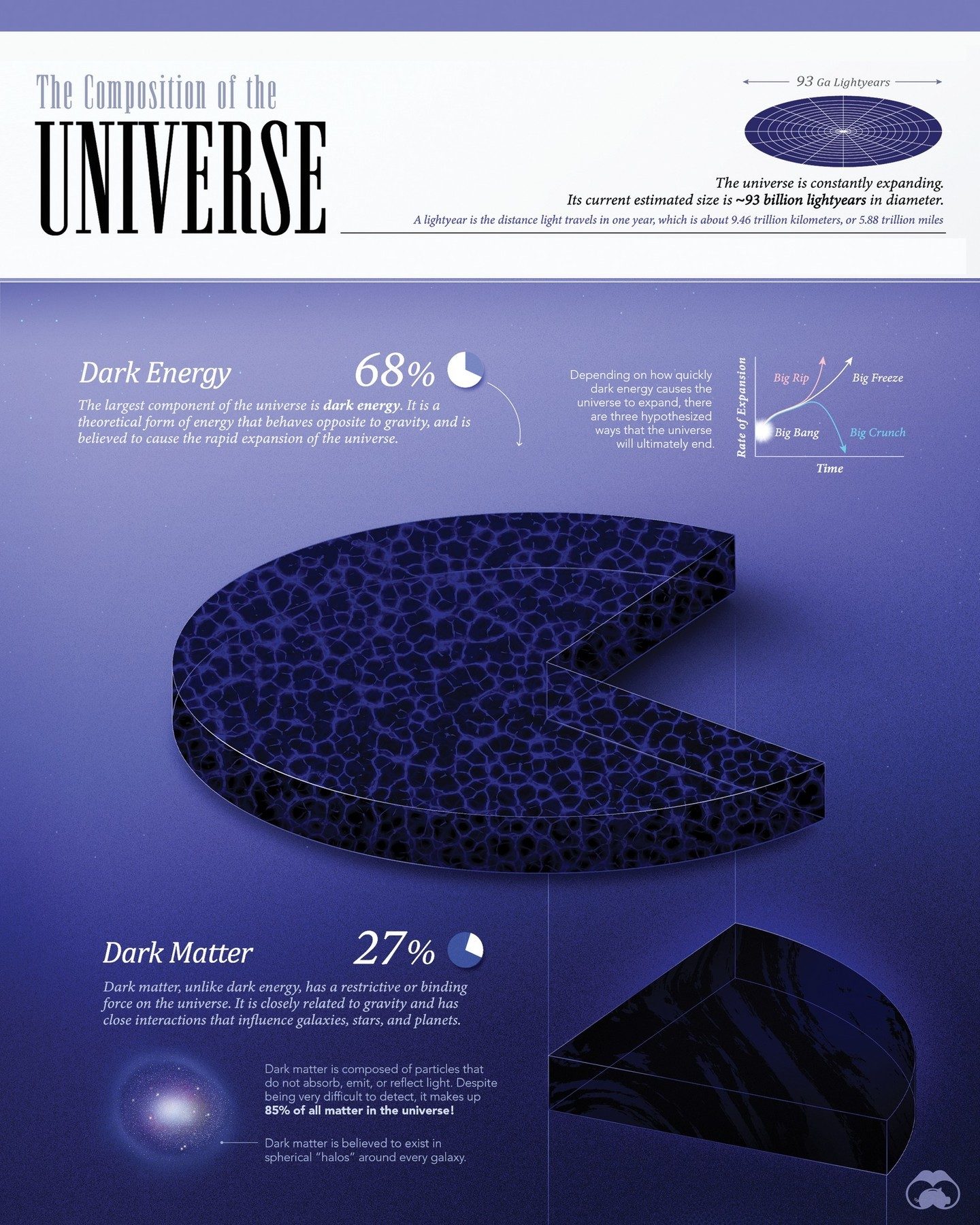
The universe is composed of three primary components: visible (or measurable) matter, dark matter, and dark energy. These components form a complex tapestry that defines the structure and behavior of the cosmos. Understanding the composition of the universe helps scientists make sense of its origins, evolution, and future. A lightyear, the distance light travels in one year, is about 9.46 trillion kilometers, or 5.88 trillion miles. This unit is crucial for measuring the vast distances between celestial objects.
Why This Matters
The study of the universe's composition is fundamental to cosmology. By understanding the proportions of dark energy, dark matter, and visible matter, scientists can better grasp the forces that govern the universe's expansion and the behavior of galaxies. This knowledge is essential for developing theories about the origin and fate of the universe.
Main Discussion
Dark Energy
Dark energy makes up approximately 68% of the universe. Despite its significance, it remains one of the most mysterious components. Unlike visible matter, which we can detect through light, and dark matter, which we infer through its gravitational effects, dark energy is only detectable through its influence on the universe's expansion. Scientists believe that dark energy is responsible for the accelerating expansion of the universe, a phenomenon that challenges our understanding of gravity and the fundamental forces of nature.
Dark Matter
Dark matter accounts for about 27% of the universe. Although it does not emit or absorb light, its presence is inferred through its gravitational effects on visible matter, such as stars and galaxies. Dark matter plays a crucial role in the formation and structure of galaxies. Without it, the visible matter in galaxies would not have enough gravitational pull to stay together. The nature of dark matter remains one of the most intriguing puzzles in cosmology.
Visible Matter
Visible matter comprises only about 5% of the universe. This includes everything we can see and measure, such as stars, planets, galaxies, and the interstellar medium. Visible matter is composed primarily of hydrogen and helium, with trace amounts of heavier elements. These elements form the building blocks of stars, planets, and all the matter we encounter in our daily lives.
Hydrogen and Helium
Hydrogen and helium are the two most abundant elements in the universe. Hydrogen, the lightest and simplest element, makes up about 75% of all visible matter. Helium, the second lightest element, constitutes about 24%. These elements were formed during the Big Bang and are essential for the formation of stars and galaxies. A small portion of the universe contains these elements floating freely in space, not locked in chemical reactions or molecules.
Other Components
While dark energy and dark matter make up the bulk of the universe, other components play significant roles:
- Stars: Stars make up about 0.5% of the universe. They are the primary sources of light and energy in the cosmos.
- Neutrinos: Neutrinos are subatomic particles that barely interact with matter. They make up about 0.3% of the universe.
- Heavy Elements: Elements heavier than helium, such as carbon, oxygen, and iron, make up about 0.3% of the universe. These elements are essential for the formation of planets and life as we know it.
Practical Tips
Understanding the composition of the universe can provide valuable insights for various fields, including astronomy, physics, and cosmology. Here are some practical tips for those interested in exploring this fascinating topic:
- Stay Updated: Follow reputable sources for the latest research and discoveries in cosmology. Websites like Swinburne University of Technology, ESA Science & Technology, and other scientific journals can provide up-to-date information.
- Engage with Community: Join online forums, discussion groups, and social media communities focused on cosmology. These platforms can offer a wealth of knowledge and foster a sense of camaraderie among enthusiasts.
- Read Comprehensive Resources: Explore comprehensive resources like books, documentaries, and educational websites to deepen your understanding of the universe's composition. Resources such as "Planck’s New Cosmic Recipe" from ESA can provide detailed insights.
Important Takeaways
- Dark Energy: Makes up 68% of the universe and drives its accelerating expansion.
- Dark Matter: Accounts for 27% of the universe and plays a crucial role in galaxy formation.
- Visible Matter: Comprises 5% of the universe and includes everything we can see and measure.
- Hydrogen and Helium: The most abundant elements, forming the basis for stars and galaxies.
- Other Components: Stars, neutrinos, and heavy elements make up the remaining 1% of the universe and are essential for the formation of planets and life.
The universe's composition is a complex and ever-evolving field of study. As scientists continue to explore and uncover the mysteries of dark energy, dark matter, and visible matter, our understanding of the cosmos will deepen, shedding light on the fundamental forces that shape our existence.
Conclusion
The universe's composition is a captivating and intricate puzzle, with dark energy, dark matter, and visible matter playing distinct roles. By understanding the proportions and interactions of these components, we gain insights into the origins, evolution, and future of the cosmos. This knowledge is not only intellectually fulfilling but also essential for advancing our understanding of the universe and our place within it.
Watch the Reel
Questions readers ask
What is the primary composition of the universe?
The universe is mainly made up of dark energy, dark matter, and visible matter. Dark energy constitutes about 68% of the universe, dark matter makes up around 27%, and visible matter, which includes all the atoms and particles we can observe, accounts for about 5%. This composition is crucial for understanding the universe's evolution and future.
What is dark energy and why is it important?
Dark energy is a mysterious form of energy that permeates all of space and tends to accelerate the expansion of the universe. It is important because it plays a significant role in the universe's future, potentially leading to a 'big freeze' where galaxies move away from each other so quickly that stars burn out and the universe becomes a cold, dark place.
How does dark matter influence the behavior of galaxies?
Dark matter influences the behavior of galaxies through its gravitational effects. Despite being invisible, it provides the necessary gravitational pull to hold galaxies together and explains the observed rotational speeds of stars within them. Without dark matter, galaxies would not maintain their structure as they rotate.
What is visible matter and what role does it play in the universe?
Visible matter, also known as baryonic matter, includes all the atoms and particles that we can directly observe, such as protons, neutrons, and electrons. It makes up the stars, planets, and everything on Earth. Visible matter, even though it is the smallest component, is vital for the formation and evolution of celestial bodies and life itself.
What are the origins and nature of heavy elements in the universe?
Heavy elements, such as carbon, oxygen, and iron, were primarily formed in the cores of massive stars and released into the universe through supernova explosions. These elements are essential for the formation of planets and life. The lighter elements, like hydrogen and helium, were created during the Big Bang and form the bulk of the universe's visible matter.
What insights has the Planck mission provided about the universe?
The Planck mission, a space observatory operated by the European Space Agency, has provided precise measurements of the cosmic microwave background radiation, the relic radiation from the Big Bang. These measurements have refined our understanding of the universe's composition, age, and the fluctuations in density that eventually led to the formation of large-scale structures, such as galaxies and galaxy clusters.
How do scientists measure vast distances in the universe?
Scientists use the light-year as a unit to measure the vast distances between celestial objects. One light-year is about 9.46 trillion kilometers, or 5.88 trillion miles, which is the distance light travels in one year. This unit is essential for mapping the cosmos and understanding the scale of the universe.
Related deep dives
Similar reads based on topic and creator.




Recent articles
Fresh deep dives from the latest Reels we unpacked.




Comments
Be the first to comment.