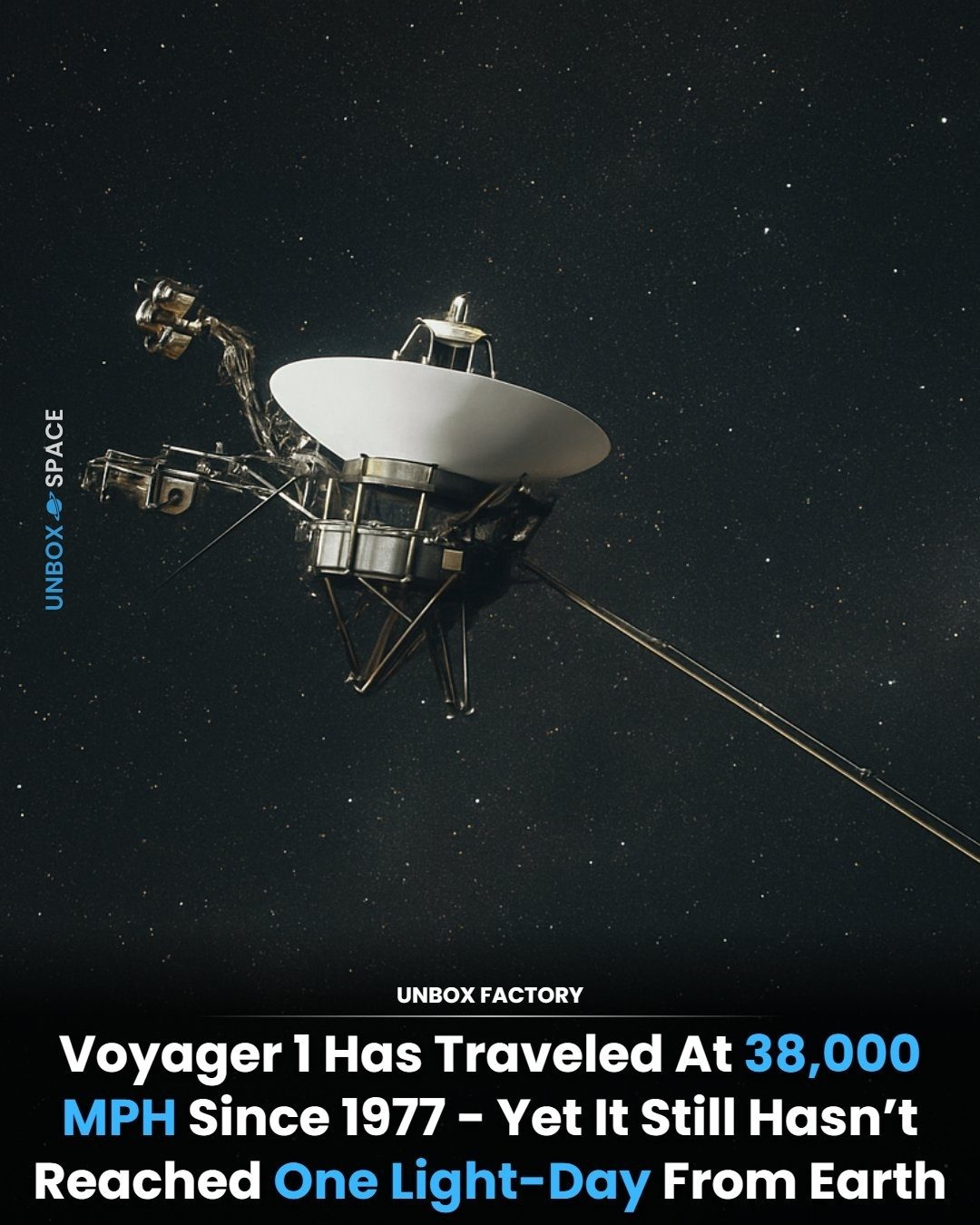
Exploring the Journey of Voyager 1
Launched in 1977, NASA's Voyager 1 has been a pioneering spacecraft that has traversed through space for nearly five decades at an astonishing speed of approximately 38,000 mph (61,000 km/h). Despite its incredible journey covering more than 25 billion kilometers (15.5 billion miles), it has not yet reached one light-day from Earth—a distance light travels in just 24 hours, or about 26 billion kilometers (16.1 billion miles). The space journey of Voyager 1 stands as a testament to human ingenuity and our quest to explore the cosmos.
Context / Why This Matters
The journey of Voyager 1 is a remarkable achievement in space exploration. It serves as a beacon of human curiosity and technological advancement, pushing the boundaries of what we know about our solar system and beyond. Understanding the scope of this mission helps us appreciate the immense scale of the universe and the challenges involved in space exploration. Voyager 1's journey also highlights the enduring legacy of human-made objects in the cosmos, emphasizing the power of science and exploration.
The Launch and Early Years
Voyager 1 was launched as part of a pair of spacecraft, Voyager 1 and Voyager 2. It was initially sent on a mission to explore the outer planets of our solar system, including Jupiter, Saturn, Uranus, and Neptune. The spacecraft was equipped with advanced scientific instruments to capture data and images, which have provided invaluable insights into the composition and behavior of these distant worlds.
Crossing into Interstellar Space
One of the most significant milestones in Voyager 1's journey occurred in 2012 when it crossed into interstellar space. This event marked the first time a human-made object had ever ventured beyond the heliopause, the boundary where the solar wind's influence wanes, and the interstellar medium takes over. This transition provided scientists with unique opportunities to study the interstellar environment and the conditions beyond our solar system.
The Challenge of Distance
The immense distance Voyager 1 has traveled highlights the vastness of our solar system. It is currently the most distant human-made object from Earth. Radio signals from the spacecraft require more than 23 hours to travel one way between Voyager 1 and Earth, underscoring the sheer scale of space and the technological marvels required to maintain communication over such distances.
Scientific Contributions
Throughout its journey, Voyager 1 has made several groundbreaking discoveries. Some of its notable contributions include:
- Detailed images and data from Jupiter and Saturn, revealing the intricate dynamics of their atmospheres and moons.
- The discovery of active volcanoes on Jupiter's moon Io.
- The identification of complex ring structures and moons around Saturn.
- The detection of the heliopause and the conditions of the interstellar medium.
Practical Tips for Understanding Space Exploration
Space exploration is a vast and complex field, but there are several practical tips for anyone interested in learning more about it:
Stay Updated with the Latest Research
One of the best ways to stay informed about space exploration is to follow reputable sources like NASA, the European Space Agency (ESA), and other space research organizations. They regularly publish updates, research papers, and news about ongoing missions and discoveries.
Participate in Citizen Science
Citizen science projects allow anyone to contribute to space research. Platforms like Zooniverse offer opportunities to participate in data analysis, image classification, and other tasks that support scientific research.
Engage with Educational Content
There are numerous educational resources available, including online courses, documentaries, and podcasts, that delve into the intricacies of space exploration. These resources can provide a comprehensive understanding of the subject and inspire further learning.
Attend Space Conferences and Events
Conferences, workshops, and space-related events offer valuable opportunities to connect with experts, learn about the latest advancements, and engage in discussions about the future of space exploration.
Important Takeaways
Voyager 1's journey has provided us with invaluable data and insights about our solar system and the interstellar medium. Here are some key takeaways from its mission:
- The universe is vast, and our understanding of it is continually evolving.
- Human-made objects can travel incredible distances and endure the harsh conditions of space.
- Communication with distant spacecraft requires advanced technology and careful planning.
- The data collected by Voyager 1 has expanded our knowledge of the outer planets and interstellar space.
Conclusion
The journey of Voyager 1 is a testament to human ingenuity, curiosity, and the desire to explore the unknown. It has pushed the boundaries of our knowledge and provided unprecedented insights into the cosmos. As Voyager 1 continues its journey into the interstellar medium, it serves as a reminder of the endless possibilities that lie beyond our solar system.
Watch the Reel
Related deep dives
Similar reads based on topic and creator.
Recent articles
Fresh deep dives from the latest Reels we unpacked.




Comments
Be the first to comment.