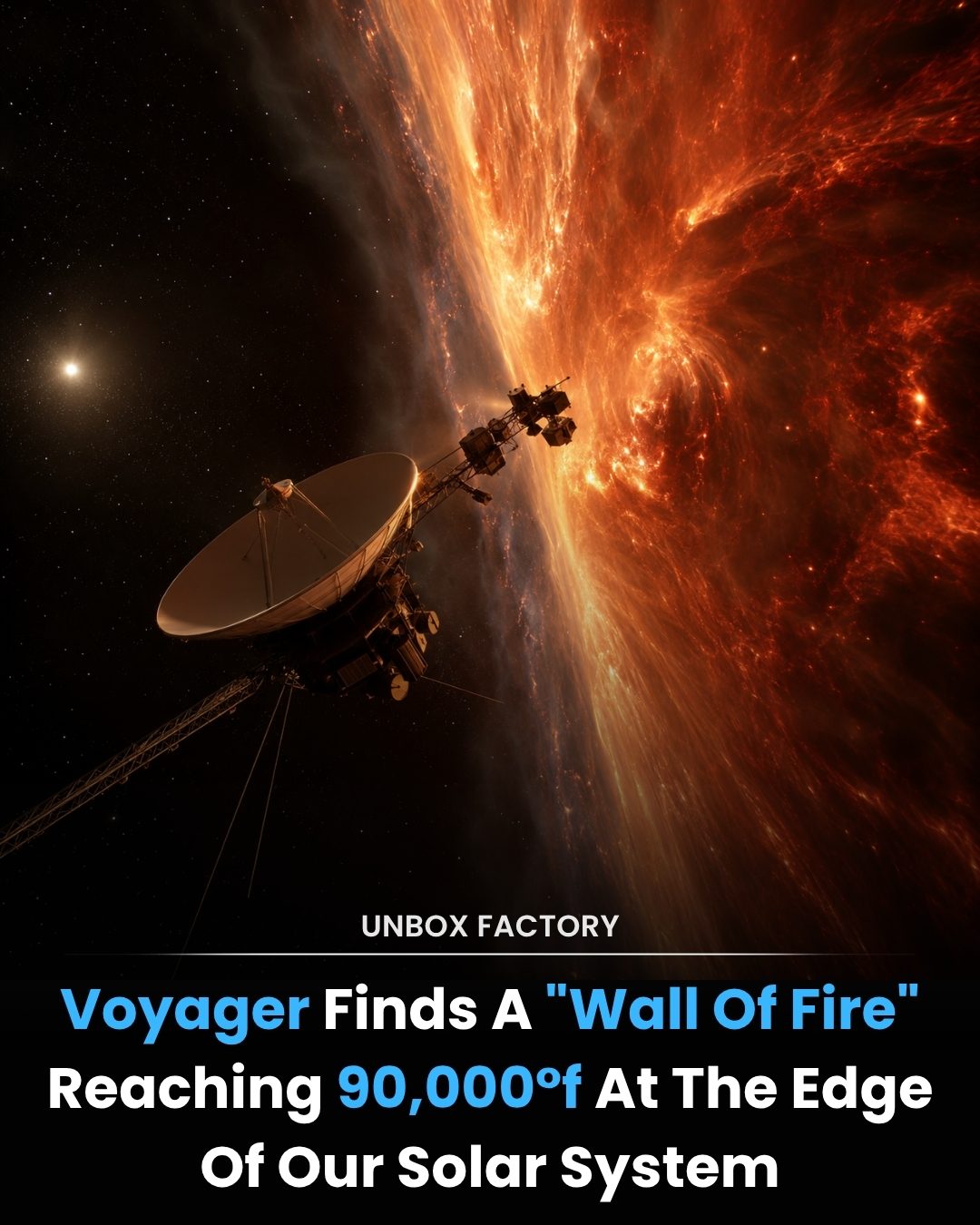
NASA's Voyager 1 Encounters a 'Wall of Fire' at the Edge of Our Solar System
The Voyager 1 spacecraft, launched in 1977, has journeyed to the edge of our solar system and beyond, uncovering fascinating phenomena along the way. One of the most intriguing discoveries made by Voyager 1 is a 'wall of fire' with temperatures reaching 90,000°F at the boundary between the Sun's influence and interstellar space.
Context/Why this matters
Voyager 1 crossed the heliopause, the boundary where the Sun's solar wind is stopped by the interstellar medium, in 2012. This transition marked the beginning of the spacecraft's journey into interstellar space. The detection of the 'wall of fire' in this region has significant implications for our understanding of the interstellar medium and the dynamics at the edge of our solar system.
Main discussion
The Discovery of the 'Wall of Fire'
The heliopause is a critical region where the Sun's solar wind, composed of charged particles, interacts with the interstellar medium. Voyager 1's instruments detected an extremely hot region within this boundary, with temperatures approaching 50,000°C (about 90,000°F). Despite the high temperature, the region is incredibly sparse, meaning there are too few particles to transfer significant energy to the spacecraft. This makes the phenomenon a fascinating scientific puzzle, as it defies our everyday understanding of heat.
The Nature of the 'Wall of Fire'
The 'wall of fire' is a layer of hot plasma that forms at the interface between the solar wind and the interstellar medium. This plasma is heated to extremely high temperatures due to the interaction of charged particles and magnetic fields. The solar wind, which is composed of protons, electrons, and other charged particles, collides with the interstellar medium, creating a shock wave that heats the plasma to such extreme temperatures.
The Science Behind the Phenomenon
The 'wall of fire' is a result of the interaction between the solar wind and the interstellar medium. The solar wind, which is a stream of charged particles released from the Sun, travels outward at high speeds. As it reaches the heliopause, it collides with the interstellar medium, creating a shock wave. This shock wave heats the plasma to extremely high temperatures, forming the 'wall of fire'. Despite the high temperatures, the region is incredibly sparse, meaning there are too few particles to transfer significant energy to the spacecraft. This makes the phenomenon a fascinating scientific puzzle, as it defies our everyday understanding of heat.
Technological Challenges
The detection of the 'wall of fire' by Voyager 1 highlights the technological advancements in space exploration. Voyager 1 is equipped with sophisticated instruments that can measure temperature, magnetic fields, and particle distribution. These instruments have enabled scientists to gather valuable data about the interstellar medium, even at such extreme distances from Earth. The spacecraft's ability to send back data from over 25 billion kilometers (15.5 billion miles) away is a testament to the ingenuity and innovation in space technology.
Practical tips
Understanding the Distances
Traveling at about 17 kilometers per second (38,000 mph), it takes radio signals from Voyager 1 over 23 hours to reach Earth. This means that communication with the spacecraft is a challenging and time-consuming process. Understanding these distances and the time it takes for signals to travel can help appreciate the technological marvel that Voyager 1 represents.
The Importance of Continuous Monitoring
Continuous monitoring and data collection from space probes like Voyager 1 are crucial for advancing our understanding of the universe. The data collected by Voyager 1 has provided insights into the nature of the interstellar medium, the dynamics of the heliopause, and the behavior of charged particles in space. This ongoing monitoring is essential for furthering space exploration and scientific discovery.
Important takeaways
The 'wall of fire' discovered by Voyager 1 at the edge of our solar system is a testament to the incredible phenomena that exist in the vast expanse of space. This discovery highlights the importance of continuous monitoring and data collection from space probes, as well as the technological advancements that make such discoveries possible.
Conclusion
Voyager 1's discovery of the 'wall of fire' at the edge of our solar system is a groundbreaking achievement in space exploration. This phenomenon, with its extreme temperatures and sparse particle distribution, challenges our understanding of heat and energy transfer in space. The technological advancements that have enabled Voyager 1 to journey to the edge of our solar system and beyond are a testament to human ingenuity and innovation. As we continue to explore the mysteries of the universe, discoveries like the 'wall of fire' will undoubtedly shape our understanding of the cosmos and our place within it.
Watch the Reel
Questions readers ask
What is the 'wall of fire' that Voyager 1 detected?
The 'wall of fire' is a region of hot plasma with temperatures reaching 90,000°F. This layer is found at the boundary where the Sun's solar wind interacts with the interstellar medium, marking the edge of our solar system. Voyager 1 detected this phenomenon as it crossed the heliopause and entered interstellar space.
Where is the 'wall of fire' located?
The 'wall of fire' lies at the edge of our solar system, specifically at the solar system boundary known as the heliopause. This is the point where the solar wind from our Sun is halted by the pressure of interstellar medium.
What causes the extremely high temperatures at the 'wall of fire'?
The high temperatures at the 'wall of fire' are due to the interaction between the solar wind and interstellar plasma. This interaction creates a hot plasma layer, resulting in temperatures as high as 90,000°F.
How did Voyager 1 detect the 'wall of fire'?
Voyager 1 detected the 'wall of fire' using its onboard instruments as it crossed the heliopause in 2012. The spacecraft's sensors were able to measure the significant increase in plasma temperature, indicating the presence of this unique phenomenon.
Why is the 'wall of fire' significant for our understanding of space?
The discovery of the 'wall of fire' provides valuable insights into the dynamics of the solar wind as it interacts with the interstellar medium. This finding enhances our understanding of the conditions at the edge of our solar system and the nature of interstellar space.
What is the heliopause and why is it important?
The heliopause is the boundary where the solar wind's influence ends and interstellar space begins. It is important because it marks the transition from our solar system to the vast expanse of interstellar space, providing a unique opportunity to study the interaction between solar and interstellar plasmas.
What other discoveries has Voyager 1 made since its launch in 1977?
Since its launch, Voyager 1 has made numerous significant discoveries, including detailed observations of the outer planets and their moons. As it journeyed to the edge of the solar system, it provided invaluable data on the solar wind, the heliopause, and the interstellar medium, enhancing our knowledge of the solar system's boundary and beyond.
Related deep dives
Similar reads based on topic and creator.



Recent articles
Fresh deep dives from the latest Reels we unpacked.




Comments
Be the first to comment.