Gauging Volcanic Might
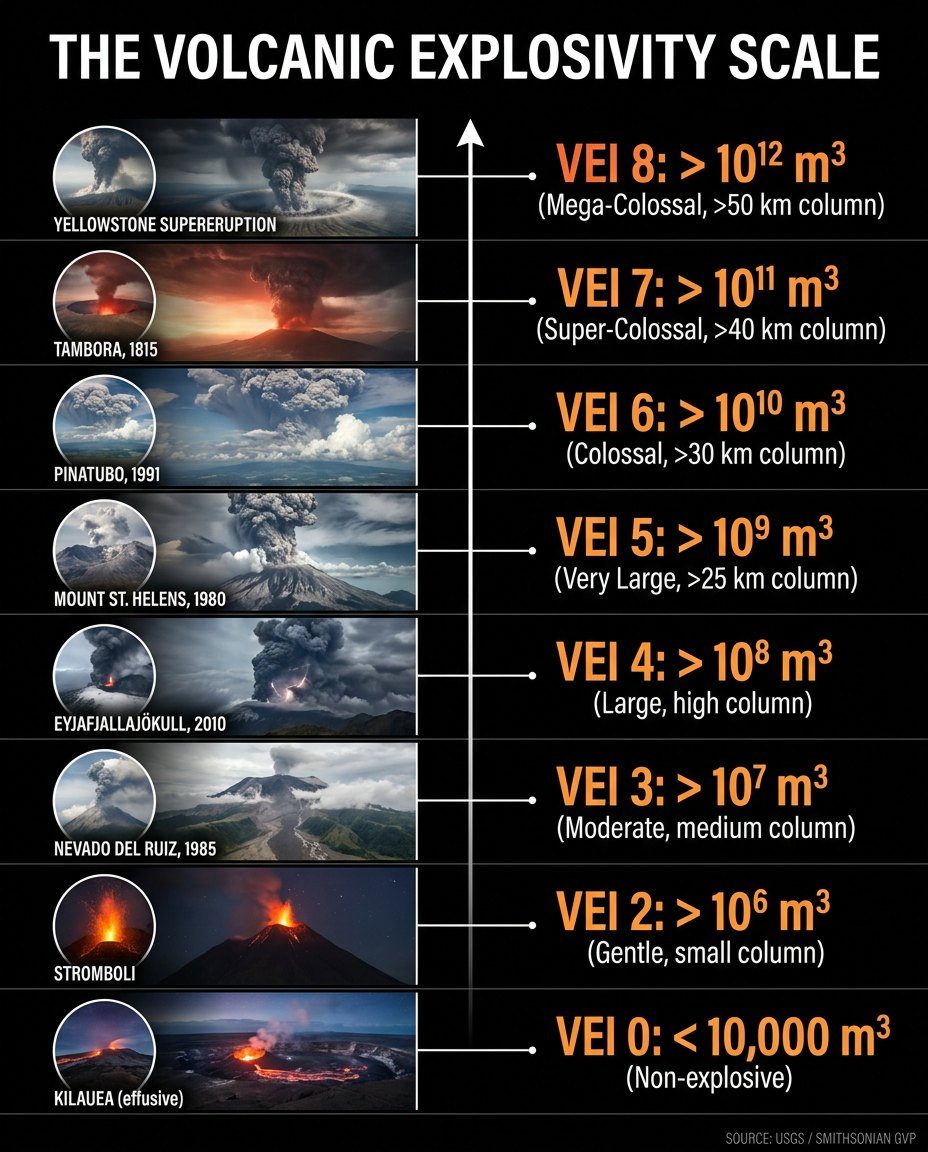
Volcanoes are as varied in their activities as they are in appearance, ranging in behavior from placid outpourings of lava to explosive eruptions that reshape the landscape. For those outside of the geological community, truly understanding such differences might seem daunting. Yet, volcanologists have a handy tool to compare them: the Volcanic Explosivity Index (VEI). The VEI ranks eruptions based on the volume of material they eject. The scale is logarithmic; a single unit increase signifies a tenfold rise in volume. At the milder end, VEI 0 represents effusive lava flows that are virtually non-explosive. Meanwhile, the highest VEI—an 8—captures eruptions of truly cataclysmic proportion. The higher the number, the greater the potential threat to the surrounding environment, communities, and even the global climate.
Classifying Volcanic Fury
For those who spend their time studying our planet's fiery temper, the VEI is a crucial benchmark — especially given the wide range of eruptions it can describe. VEI 2, for instance, stands for gentle eruptions that emit a small column of ash. Mount Stromboli is a notable example, belching relatively benign puffs at predictable intervals; so much so that it's known as the “Lighthouse of the Mediterranean.” VEI 7, on the other hand, is considerably more alarming. The eruption of April 11, 1815 at Tambora, opens a new paragraph: The massive blast is the acknowledged as the largest eruption in recorded history, demonstrating how the VEI scale can reflect an eruption's urgency — or lack thereof.
Historical Context
Some eruptions serve as enduring benchmarks. Pinatubo, which occurred in 1991, is an example of a VEI 6 event, where the force of the eruption released more than a billion cubic meters of debris. Mount St. Helens in 1980 is another VEI 5 event that shattered the surrounding region, making it a defining moment in geology. These events underscore the value of historical data.
Gigantic Outliers
There's no question that eruptions like Pinatubo and Mount St. Helens were of serious enough scale to have warranted extensive study. However, the eruption of Mount Tambora in 1815 zones in on the eye-catching end of the VEI scale. This mega-colossal event, classified as a VEI 7, was so powerful that it fired 100 billion cubic meters of ash and debris into the atmosphere — creating a veil so thick that the world's weather patterns were disrupted. The eruption even reverberated globally, leading to the volcanic winter that caused widespread famine and mortality in the Northern Hemisphere. In short, the Volcanic Explosivity Index is more than just an academic curiosity — it has very real ramifications for our understanding of volcanic hazards. Studying these eruptions allows us to identify potentially hazardous volcanoes, categorize them according to their hazards, and assess the risk associated with each.
Watch the Reel
Related deep dives
Similar reads based on topic and creator.
Recent articles
Fresh deep dives from the latest Reels we unpacked.

Comments
Be the first to comment.