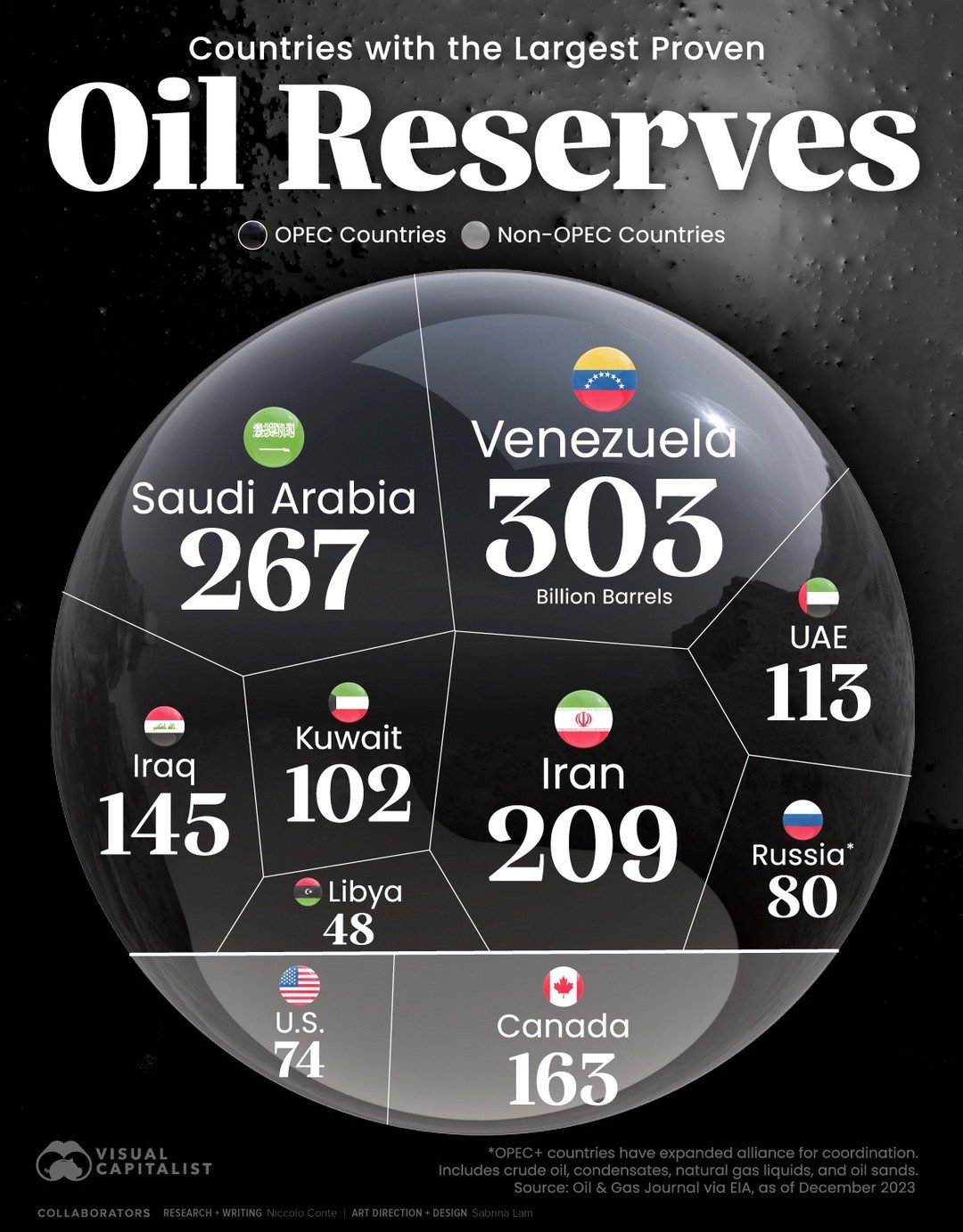
Oil Reserves Around the World
Oil reserves are a critical component of global energy production, influencing geopolitics and economic stability. Venezuela holds the world's largest proven oil reserves, boasting an impressive 303 billion barrels. This vastly outpaces the United States, which ranks near the bottom of the top 10 with around 74 billion barrels. Understanding the distribution of these reserves provides insights into the energy landscape and how different nations contribute to global oil supplies.
Why This Matters
The distribution of oil reserves is a fundamental aspect of global energy dynamics. Countries with substantial reserves often play significant roles in international oil markets, influencing pricing and supply. For instance, Venezuela's vast reserves position it as a key player, although political and economic factors often complicate its role in global markets. Similarly, Saudi Arabia, with 267 billion barrels, and Iraq, with 145 billion barrels, are pivotal in OPEC (Organization of the Petroleum Exporting Countries) decisions that affect global oil prices.
Main discussion
Top Oil Reserves by Country
Venezuela
Venezuela tops the list with 303 billion barrels of proven oil reserves. This substantial amount underscores the country's potential as a major oil producer, although its actual production levels and exports are often constrained by political instability and economic challenges.
Saudi Arabia
Saudi Arabia, the second-largest holder with 267 billion barrels, is a cornerstone of global oil production. The country's significant reserves and advanced oil production technologies make it a key player in the global energy market. Saudi Arabia's oil policies, including its role within OPEC, are closely watched by energy analysts and investors worldwide.
Iraq
Iraq follows with 145 billion barrels. Despite its vast reserves, Iraq faces significant challenges in maintaining stable oil production due to internal conflicts and infrastructure limitations. However, the country's potential for increased production is widely recognized, making it a focal point for international energy investments.
Kuwait
Kuwait holds 102 billion barrels, positioning it as another major player in the Middle East. The country's strategic focus on oil production has made it a reliable supplier, contributing significantly to global oil markets.
Other Key Players
United Arab Emirates (UAE)
The UAE, with 113 billion barrels, is another significant contributor to global oil reserves. The country's strategic investments in technology and infrastructure have enhanced its production capabilities, making it a key player in international energy markets.
Russia
Russia, with 80 billion barrels, is a crucial player in the non-OPEC sector. The country's reserves and production capabilities are substantial, and its geopolitical influence adds complexity to global oil dynamics.
Libya
Libya's 48 billion barrels underscore the significance of African oil reserves. The country's history of political instability has often disrupted its oil production, but its reserves remain a critical component of global supplies.
Iran
Iran's 209 billion barrels place it among the top oil reserve holders. Despite international sanctions, Iran's vast reserves and production capabilities make it a key player in global energy markets, although its actual contributions are often limited by geopolitical tensions.
United States and Canada
The United States, with 74 billion barrels, ranks lower among oil reserve holders compared to Middle Eastern and South American countries, but its advanced technology and extensive infrastructure have made it a significant producer and exporter. Canada, with 163 billion barrels, has vast reserves, particularly in oil sands, making it a critical player in North American energy markets.
Practical Tips
If you are interested in understanding global energy markets or investing in oil-related sectors, it is crucial to stay informed about the latest developments in oil reserve holders. Regularly reviewing reports from the Oil & Gas Journal and the Energy Information Administration (EIA) can provide valuable insights. Additionally, monitoring geopolitical developments in key oil-producing regions can help anticipate potential disruptions or opportunities in the market.
Important Takeaways
- Venezuela has the largest proven oil reserves, with 303 billion barrels, followed by Saudi Arabia and Iraq.
- The distribution of oil reserves significantly influences global energy dynamics and pricing.
- Countries like Saudi Arabia, Iraq, and Kuwait are pivotal in the OPEC framework, affecting global oil supply and pricing.
- Non-OPEC countries, including Russia and the United States, also play critical roles in global oil markets.
- Geopolitical factors and internal stability are crucial determinants of oil production and export capabilities.
Conclusion
The distribution of oil reserves is a complex interplay of geopolitical, economic, and technological factors. Understanding the key players and their roles in global energy markets can provide valuable insights for investors, policymakers, and energy analysts. The data from the Oil & Gas Journal via the EIA offers a comprehensive view of the current landscape, highlighting the significance of countries like Venezuela, Saudi Arabia, and Iraq in global oil supplies. By staying informed about these dynamics, one can navigate the ever-changing energy landscape more effectively.
Watch the Reel
Questions readers ask
Which country has the largest proven oil reserves in the world?
Venezuela possesses the largest proven oil reserves globally, with an estimated 303 billion barrels. This substantial amount places Venezuela at the forefront of global oil reserves.
How do Venezuela's oil reserves compare to those of the United States?
Venezuela's oil reserves significantly outpace those of the United States. With 303 billion barrels, Venezuela's reserves are more than four times larger than the United States', which has around 74 billion barrels.
What are the top three countries with the largest oil reserves?
The top three countries with the largest oil reserves are Venezuela, Saudi Arabia, and Iraq. Each of these countries has substantial reserves that significantly impact global oil markets.
Why are oil reserves important for global energy dynamics?
Oil reserves are crucial for understanding global energy production and geopolitics. Countries with large reserves, such as Venezuela, Saudi Arabia, and Iraq, often have significant influence over oil prices and supply, shaping the global energy landscape.
How do OPEC countries contribute to global oil reserves?
OPEC countries, including Venezuela, Saudi Arabia, and Iraq, hold a significant portion of the world's proven oil reserves. Their reserves play a critical role in global oil markets, affecting pricing and supply dynamics.
What is the significance of Kuwait's oil reserves in the global context?
Kuwait, with its substantial oil reserves, is a key player in the global oil market. While not as large as those of Venezuela or Saudi Arabia, Kuwait's reserves contribute significantly to the overall supply and influence market conditions.
Related deep dives
Similar reads based on topic and creator.

Recent articles
Fresh deep dives from the latest Reels we unpacked.




Comments
Be the first to comment.