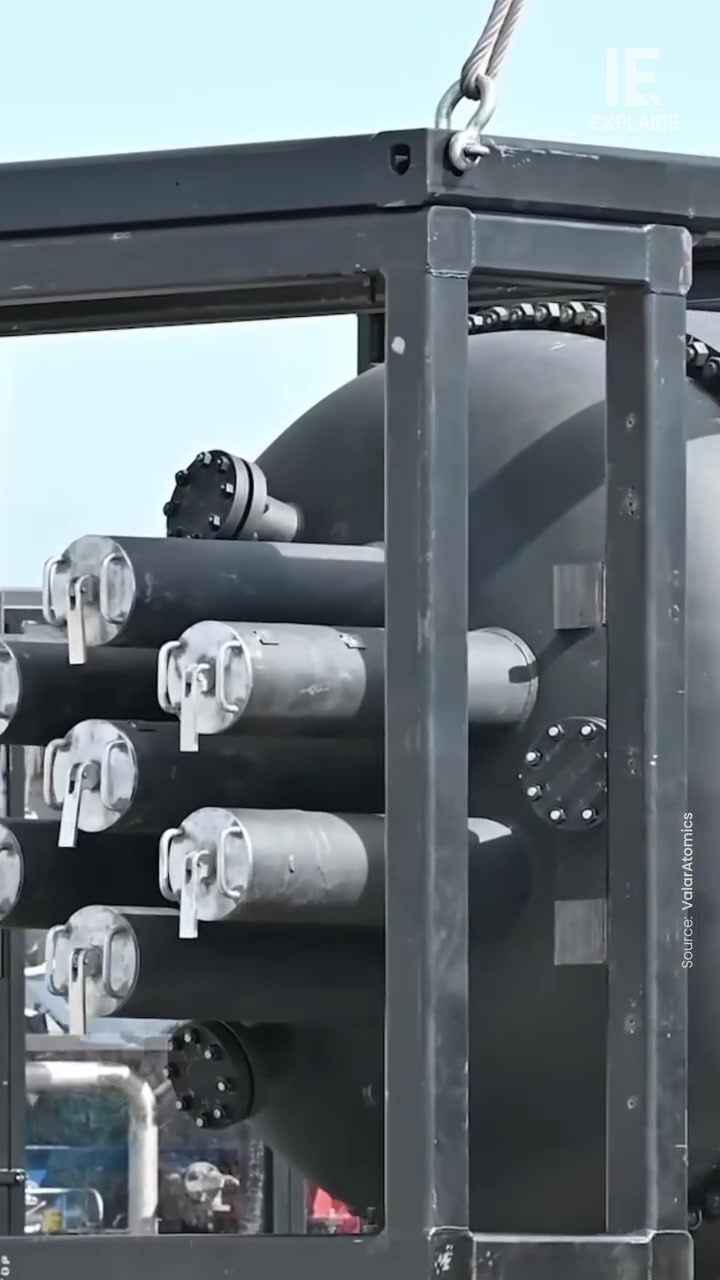
Valor Atomics is building the future of energy with small modular reactors. The startup has just taken in $1 billion from investors.
Each one adheres to a modular design principle. If you need more output, just add another module. They can be attached to a data center, warehouse, or even cargo ship. By keeping operations 100% local, communities won’t feel disrupted. One company already sees SMRs as an answer to its data center energy demand. It’s seen SMRs as a reliable, green companion to AI. As for the rest, it’s an opportunity fast gaining traction in the energy world.
The Modular Reactors
Small modular reactors (SMRs) are the size of small canvas trucks or less. They adapt to local needs, so cities don’t have to drain surrounding resources. It’s a modern, nuclear-powered response to the data center and AI market’s surge, and a new rapidly developing industry attracting giants like Rolls Royce. SMRs can be bolted onto a data center, warehouse, or even a cargo ship, allowing operations to run without disrupting local power needs. For small towns, AI training centers in need of energy could drain their resources. Describing an SMR as a "micronuclear power plant" highlights one of its design principles. SMRs provide clean green energy with no carbon emissions and can run for decades without refueling, while creating minimal nuclear waste. Inserting this modern solution into existing systems is not controversial. The fact that they can handle increasing energy demands is a revelation to renewable energy producers. Implementing SMRs in communities facing power issues may eliminate the need for new construction or power plants. Additionally, they can handle power demands as they rise. This flexibility is what makes them an attractive choice. Whether it’s a data center or AI solution, SMRs stand out. They're a modern, adaptable answer to the energy crisis, solving multiple problems without compromising the environment and surrounding communities.
The Power Gap
Energy demands are rising and companies are struggling to keep up. Google has committed to running its data centers on 24/7 carbon-free energy by 2030. This goes beyond data centers, affecting big energy consumers like AI and manufacturing. For the industry, there's reason to be hopeful. Developing these reactors could resolve many current issues. According to an online video, SMRs are considered clean green energy with no carbon emissions and can run for decades without refueling, while creating minimal nuclear waste.
Why Energy Goes Loopy
AI models are massive power hogs. To support their training, data centers are popping up all over the map. While they buff up local economies with jobs and infrastructure, they also guzzle up power. Nuclear is no exception. In response, companies like Amazon and SpaceX have proposed orbital data centers. They see it as an alternative, but SMRs, especially when placed close to the ground, may replace these orbital data centers, at least for the energy consumption part.
The Orbital Data Center
The new burden of power demand has yet to alter how data centers are built. Later this year, a $1-billion venture aims to target orbital data centers. It's a science fiction concept that might provide answers to AI and space-based company challenges. It is designed to tackle the difficulties of running a data center in orbit. SMRs, on the other hand, provide a more Earth-bound answer that meets energy needs and is also ecologically friendly.
The "Pollution-Free" Micro-Reactor
AI and space-based companies see the same solution to power consumption. It's the nuclear-powered reactor. A compact unit that can be mounted on a modular shipping container, according to an online video. It's designed to meet local needs. They also provide a response to the power and water challenges facing the technology industry, and disrupt local communities. One billion dollar deals are underway. One company is building the first commercial small modular reactors. Another billion dollar deal is underway. Rolls Royce is also getting in on the action, putting its energy expertise to use.
Local Benefits
SMRs can power some of the largest consumers. A secure and reliable power supply. It could help boost local economies by providing jobs and infrastructure.
The Modular Storm
SMRs offer multiple design features. If you need more output, you just add another one. SMRs may be designed to power a single building or as small reactors. They can also be linked together to power cities or larger areas. They provide an energy solution that doesn't require new infrastructure. They’re clean, green, and safe. For example, a modular shipping container can be used for a number of purposes. It can be used to transport goods, store items, or even as a home. It can also be linked together to form a larger structure. It can also be used to power a single building or as a reactor for a city.
The Reactor's Inner Workings
The reactor consists of a modular container. Inside it, you will find cylinders surrounded by a metal frame. This structure can hold the reactor core and is connected to the outside world through a series of fittings and connections. These are essential for the reactor's operation and are connected to other parts of the reactor. They are part of a nuclear reactor system and are enclosed in a metal structure that is labeled with "ValorAtomics" and "IE Explains".
A Close-Up Look
To understand the intricate workings of an SMR, let's take a closer look at its components. The metal frame holds a series of cylindrical parts. These cylinders have various fittings and connections. In the center, we can see the reactor core with cylindrical rods and internal components. Each part of the reactor is connected to the outside world through a series of fittings and connections. The frame is labeled with "ValorAtomics" and "IE Explains". This labeling helps to identify the reactor and its components. The reactor core has various components, including cylindrical rods and internal components. These components are connected to each other and to the outside world through a series of fittings and connections. This allows the reactor to function as a whole, providing a reliable source of energy.
The Future is Ready
For the industry, solid performances and efficient projects show how potential there is for SMRs. To get the circular economy going, SMRs are the future. If you need more output, you just add another one. They are a clean, green, and reliable source of energy. The future of energy is ready. For the industry, the benefits are clear. And for communities, the possibilities are vast.
Watch the Reel
Questions readers ask
What exactly are small modular reactors (SMRs) and how do they differ from traditional nuclear reactors?
Small modular reactors (SMRs) are compact nuclear reactors, roughly the size of a small truck. They differ from traditional reactors in their modular design, which allows for easy scalability. You can add more modules to increase power output, unlike traditional reactors which are often large, single-unit power plants. SMRs are designed to be more flexible and adaptable to local energy needs.
How do SMRs address the energy demands of data centers and AI training facilities?
SMRs provide a reliable, green energy solution for data centers and AI training facilities. They can be directly attached to these facilities, ensuring a constant power supply without disrupting local power grids. This local energy production helps meet the high energy demands of these facilities without straining the surrounding community's resources.
What makes SMRs an attractive option for companies like Google and Rolls Royce?
SMRs are appealing to companies like Google and Rolls Royce because they offer a clean, green energy source with minimal carbon emissions and nuclear waste. They can run for decades without refueling, making them a cost-effective and sustainable long-term energy solution. Additionally, their modular design allows for easy scalability, which is ideal for companies with growing energy demands.
Can SMRs be used in remote or off-grid locations, such as cargo ships or isolated communities?
Yes, SMRs can be deployed in remote or off-grid locations. Their compact size and modular design make them suitable for use on cargo ships, in isolated communities, or even in space. This versatility makes SMRs an attractive option for providing reliable power in areas where traditional power sources are not feasible.
How do SMRs fit into the broader energy landscape, particularly in relation to renewable energy sources?
SMRs complement renewable energy sources by providing a consistent, baseload power supply. While renewables like solar and wind are intermittent, SMRs can operate continuously, ensuring a stable energy supply. This makes them an attractive option for communities facing power issues and for industries with high, continuous energy demands, like data centers and AI training facilities.
What are the potential challenges or controversies surrounding the implementation of SMRs?
One of the main controversies surrounding SMRs is the public perception of nuclear energy, given past accidents and waste concerns. However, SMRs are designed to be safer and more efficient, with minimal nuclear waste. Additionally, the regulatory framework for deploying SMRs is still evolving, which could present challenges for widespread adoption. However, the fact that they can handle increasing energy demands is a revelation to renewable energy producers.
How do SMRs compare to orbital data centers as a solution for high-energy demands?
Orbital data centers aim to reduce power consumption by moving data processing to space, but SMRs offer a more practical solution. By placing SMRs close to the ground near data centers, companies can meet high energy demands without the complexities and costs associated with space-based infrastructure. This makes SMRs a more feasible and immediate solution for powering data centers and AI facilities.
Related deep dives
Similar reads based on topic and creator.



Recent articles
Fresh deep dives from the latest Reels we unpacked.

Comments
Be the first to comment.