The Critical Role of Rare Earth Imports in the U.S.
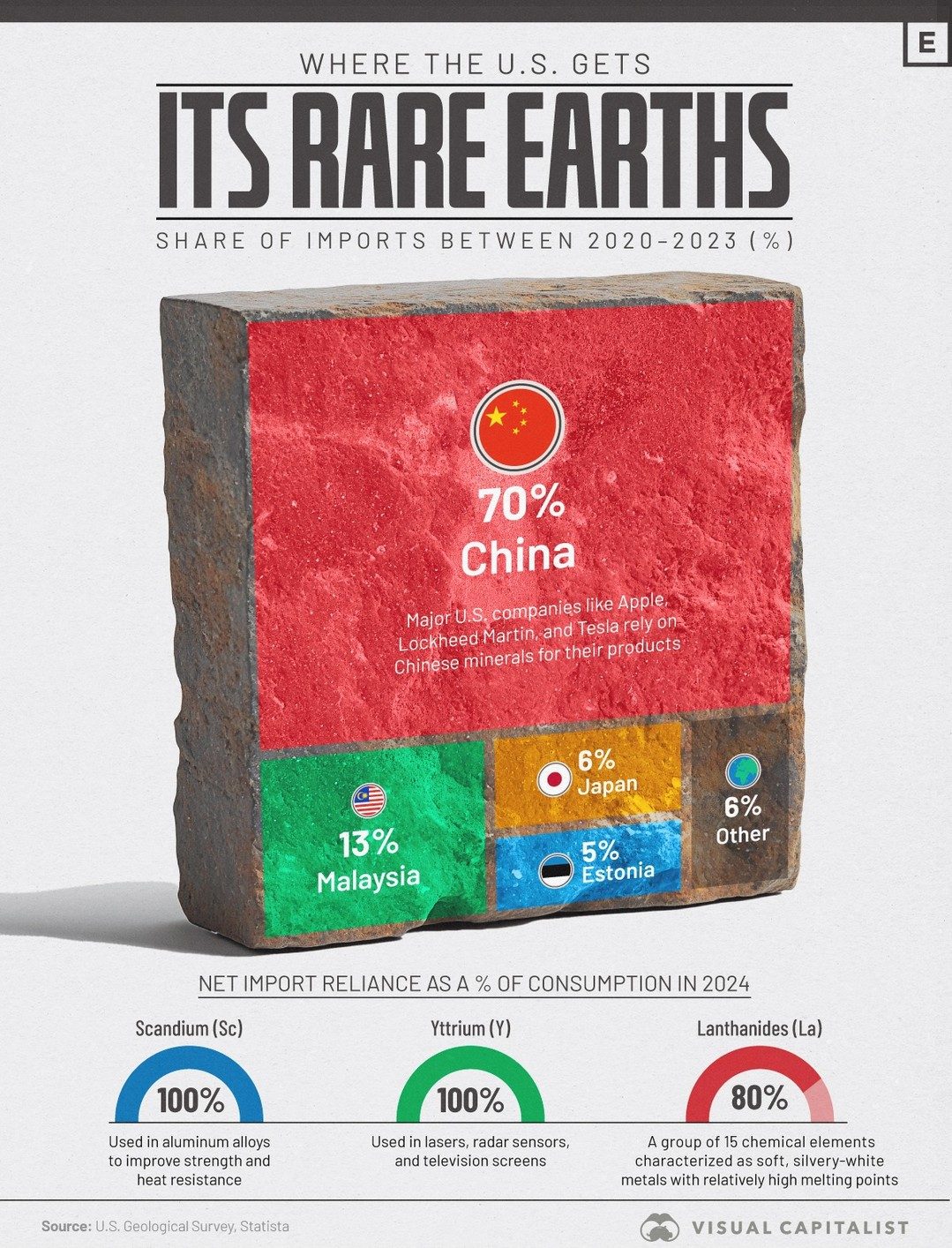
The United States' reliance on rare earth imports, particularly from China, is a significant factor in the production processes of major companies like Apple, Lockheed Martin, and Tesla. Between 2020 and 2023, China accounted for 70% of U.S. rare earth imports, making it the top supplier. This dependency underscores the importance of these critical minerals in modern technology and manufacturing.
Context: Why This Matters
Rare earth elements (REEs) are a group of 17 chemically similar elements that are crucial for various high-tech applications. These elements include Scandium, Yttrium, and the Lanthanides, each with unique properties that make them indispensable in modern industries. The U.S. reliance on rare earth imports has significant implications for national security, economic stability, and technological advancement.
The Significance of Rare Earth Elements
Scandium (Sc)
Scandium is a rare earth element that is used to improve the strength and heat resistance of aluminum alloys. These alloys are integral to the aerospace and automotive industries, making Scandium a critical component in the production of aircraft and high-performance vehicles. The U.S. imports 80% of its Scandium needs, highlighting its dependency on foreign suppliers.
Yttrium (Y)
Yttrium is another essential rare earth element, primarily used in the production of television screens. Its unique properties make it ideal for creating high-definition displays, which are increasingly in demand as technology advances. The U.S. imports a significant portion of its Yttrium, underscoring the importance of secure supply chains.
Lanthanides (La)
Lanthanides are a group of 15 chemical elements characterized as soft, silvery-white metals with relatively high melting points. They are used in various applications, including in the production of batteries, magnets, and electronic components. The Lanthanides' unique properties make them indispensable in the manufacturing of advanced technologies, from wind turbines to smartphones.
Major Suppliers and Their Contributions
China
China is by far the largest supplier of rare earth elements to the U.S., accounting for 70% of imports between 2020 and 2023. This dominance is a result of China's substantial reserves and advanced extraction technologies. The U.S. reliance on Chinese rare earth imports poses both opportunities and challenges, including potential supply chain disruptions and geopolitical tensions.
Malaysia
Malaysia is the second-largest supplier, contributing 13% of U.S. rare earth imports. The country has significant reserves of these critical minerals and is a key player in the global rare earth market. Malaysia's role as a supplier is crucial for maintaining a diversified supply chain and reducing dependency on a single source.
Japan
Japan contributes 6% of U.S. rare earth imports. The country is known for its advanced technologies in rare earth extraction and processing. Japan's role in the supply chain is vital for ensuring a steady supply of these critical minerals, particularly for industries that require high-purity materials.
Estonia
Estonia accounts for 5% of U.S. rare earth imports. The country has limited reserves compared to other suppliers but is significant in the global market due to its strategic location and advanced technologies in rare earth processing.
Other Countries
Other countries, including Australia and Brazil, also contribute to the U.S. rare earth imports. These countries have significant reserves and are actively developing their extraction and processing capabilities. Diversifying the supply chain by including these countries can help mitigate the risks associated with relying on a single supplier.
Practical Tips for Addressing Rare Earth Supply Challenges
Diversifying Supply Chains
One of the most effective ways to address the challenges posed by rare earth imports is to diversify the supply chain. This involves establishing relationships with multiple suppliers to ensure a steady supply of critical minerals. By reducing dependency on a single source, companies can mitigate the risks associated with supply chain disruptions and geopolitical tensions.
Investing in Domestic Mining
Investing in domestic mining and processing capabilities can help reduce the U.S.'s reliance on foreign suppliers. This involves exploring and developing domestic rare earth reserves and building the necessary infrastructure to extract and process these minerals. By investing in domestic mining, the U.S. can enhance its energy security and economic stability.
Developing Recycling Technologies
Developing advanced recycling technologies can help recover rare earth elements from end-of-life products and waste streams. This not only reduces the demand for new imports but also contributes to environmental sustainability. Companies and governments can collaborate to develop and implement these technologies, ensuring a sustainable supply of critical minerals.
Encouraging Innovation
Encouraging innovation in rare earth extraction and processing technologies can help improve efficiency and reduce costs. This involves investing in research and development and fostering collaboration between academia, industry, and government. By promoting innovation, the U.S. can enhance its competitive edge in the global rare earth market.
Important Takeaways
The U.S. reliance on rare earth imports, particularly from China, highlights the critical role these minerals play in modern technology and manufacturing. Diversifying the supply chain, investing in domestic mining, developing recycling technologies, and encouraging innovation are essential strategies for addressing the challenges posed by rare earth imports. By taking these steps, the U.S. can ensure a secure and sustainable supply of critical minerals, enhancing its national security and economic stability.
Conclusion
Rare earth elements are indispensable in various high-tech applications, from aerospace to electronics. The U.S. reliance on imports, particularly from China, underscores the importance of these minerals in modern industries. By diversifying supply chains, investing in domestic mining, developing recycling technologies, and encouraging innovation, the U.S. can address the challenges posed by rare earth imports and ensure a secure and sustainable supply of these critical minerals.
Watch the Reel
Questions readers ask
Which countries are the primary suppliers of rare earth minerals to the U.S.?
While the U.S. imports rare earth minerals from various countries, China is the leading supplier, accounting for 70% of U.S. rare earth imports between 2020 and 2023. This makes China the top source for these critical minerals.
What are the most common applications of rare earth minerals?
Rare earth minerals are essential in a wide range of modern technologies. They are used in aerospace for advanced materials, in automotive industries for electric vehicle components, and in electronics for manufacturing high-performance devices. These applications highlight the importance of securing a stable supply of rare earth minerals.
How does the U.S. reliance on China for rare earth minerals impact its industries?
The U.S. dependence on China for rare earth minerals affects numerous industries, including aerospace, automotive, and electronics. Major companies like Apple, Lockheed Martin, and Tesla rely heavily on these imports, making supply chain stability and geopolitical relations critical considerations for these sectors.
What are the 17 rare earth elements?
The 17 rare earth elements are a group of chemically similar elements that include Scandium and Yttrium, along with the 15 Lanthanides. These elements have unique properties that make them indispensable in modern industries, including high-tech applications and manufacturing.
What impact does China's dominance in rare earth exports have on the U.S.?
China's dominance in rare earth exports has significant implications for the U.S. It underscores the need for a robust U.S. rare earth mineral strategy to ensure a stable supply and reduce reliance on a single source. This is crucial for maintaining the competitiveness and security of U.S. industries.
Why is securing a stable supply of rare earth minerals important for the U.S.?
Securing a stable supply of rare earth minerals is vital for the U.S. to maintain its technological and manufacturing capabilities. These minerals are critical for various high-tech applications, and ensuring a reliable source helps support innovation, economic growth, and national security.
How does the U.S. plan to reduce its dependence on China for rare earth minerals?
The U.S. is exploring several strategies to reduce its dependence on China for rare earth minerals. These include increasing domestic mining and processing, diversifying import sources, and investing in research and development to find alternative materials and technologies. These efforts aim to enhance the resilience of the U.S. supply chain and reduce geopolitical risks.
Related deep dives
Similar reads based on topic and creator.


Recent articles
Fresh deep dives from the latest Reels we unpacked.




Comments
Be the first to comment.