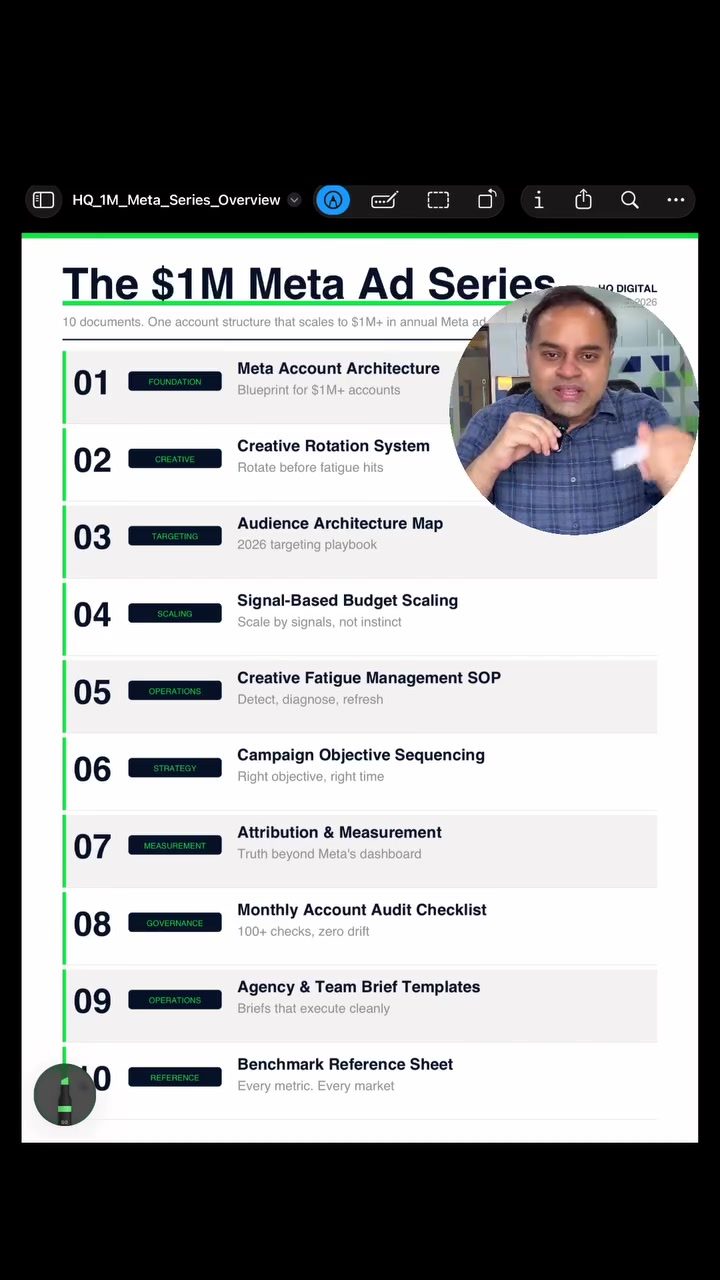
Scaling Meta Ad Accounts: The $1M Meta Ad Series Overview
Introduction
Meta ad accounts are essential for businesses aiming to reach a wide audience, and scaling them to a million dollars in annual ad spend requires a deep level of planning and strategy. To this end, a series of ten key documents has been developed to provide a comprehensive roadmap for managing and scaling Meta ad accounts.
Context: Why this Matters
The Meta advertising landscape is competitive and complex. Many businesses struggle to scale their ad accounts effectively, not because of a single mistake, but due to a lack of systematic planning. This series of documents is designed to fill that gap, providing a structured approach to managing ad accounts efficiently.
Main Discussion
The Blueprint for $1M+ Accounts
The foundation of any successful Meta ad account lies in its architecture. The series begins with a blueprint that outlines the structure of a Meta ad account capable of handling $1M+ in annual ad spend. This blueprint ensures that the account is organized in a way that allows for seamless scaling and management.
Creative Rotation System
Creative fatigue is a common issue in digital advertising. To combat this, the series includes a creative rotation system. This system provides guidelines on when and how frequently to rotate creatives to ensure they remain effective before they hit fatigue. This systematic approach to creative management helps maintain audience engagement and prevents burnout.
Audience Architecture Map
Targeting the right audience is crucial for the success of any ad campaign. The series includes an audience architecture map, updated as of 2026, which provides a comprehensive guide to audience targeting. This map helps in identifying and segmenting the target audience effectively, ensuring that ads reach the right people at the right time.
Signal-Based Budget Scaling
Budget allocation is a critical aspect of ad management. The series introduces a signal-based budget scaling method, which focuses on scaling budgets based on data signals rather than instinct. This data-driven approach ensures that budgets are allocated efficiently, maximizing the return on ad spend.
Creative Fatigue Management SOP
Creative fatigue management is essential for maintaining the effectiveness of ad campaigns. The series includes a standard operating procedure (SOP) for detecting, diagnosing, and refreshing creatives to prevent fatigue. This systematic approach ensures that creatives remain fresh and engaging, keeping the audience's attention.
Campaign Objective Sequencing
Campaign objectives play a significant role in the success of ad campaigns. The series provides a framework for sequencing campaign objectives to ensure that the right objectives are pursued at the right time. This systematic approach helps in achieving the desired outcomes more effectively.
Truth Beyond Meta’s Dashboard
Measurement is a critical aspect of ad management. The series provides insights beyond the standard Meta dashboard, offering a deeper understanding of ad performance. This comprehensive measurement approach helps in making data-driven decisions and optimizing ad campaigns.
Monthly Account Audit Checklist
Regular audits are essential for maintaining the health of ad accounts. The series includes a monthly account audit checklist with over 100 checks, ensuring that there is no drift from the established standards. This checklist helps in identifying and resolving issues promptly, ensuring the account remains on track.
Agency & Team Brief Templates
Agencies and teams often struggle with structuring their briefs effectively. The series provides multiple templates for content and media agencies, ensuring that briefs are comprehensive and actionable. These templates help in streamlining communication and ensuring that all stakeholders are aligned.
Benchmark Reference Sheet
Benchmarking is essential for understanding how an ad account performs relative to industry standards. The series includes a benchmark reference sheet with multiple benchmarks based on categories, industries, and markets. This sheet provides a comprehensive view of performance benchmarks, helping in setting realistic goals and measuring success.
Notebook LM
The series is now available in a digital notebook format, allowing users to ask questions and receive answers based on the documents' content. This interactive approach makes it easier to access the information needed to manage and scale Meta ad accounts effectively.
Practical Tips
When implementing these strategies, remember the following tips:
- Stay Updated: The digital world is constantly evolving, and so are ad strategies. Ensure you regularly update your documents and strategies to stay relevant.
- Data-Driven Decisions: Always rely on data for decision-making. Use the signal-based budget scaling and creative fatigue management SOP to optimize your ad spend and creative performance.
- Audit Regularly: Conduct regular audits using the monthly account audit checklist to ensure your ad account remains healthy and on track.
Important Takeaways
- Systematic Approach: The key to scaling a Meta ad account successfully is a systematic approach. The series of ten documents provides a comprehensive roadmap for managing and scaling ad accounts.
- Data-Driven: Use data signals for budget scaling and creative management to maximize the return on ad spend.
- Regular Audits: Conduct regular audits to ensure the health and performance of your ad account.
- Interactive Tools: Utilize interactive tools like Notebook LM to access information easily and make informed decisions.
Conclusion
Scaling a Meta ad account to a million dollars in annual ad spend is a challenging but achievable goal. The $1M Meta Ad Series provides a comprehensive roadmap with ten key documents covering various aspects of ad management. By following these strategies and leveraging the interactive tools provided, you can effectively scale your Meta ad account and achieve your business goals.
Watch the Reel
Questions readers ask
What are the initial steps to start scaling a Meta ad account effectively?
To start scaling a Meta ad account, begin by analyzing your current ad performance and setting clear objectives. This involves identifying the most successful ads and understanding the key metrics driving their performance. Next, ensure your ad account structure is optimized for scalability, with a clear separation of campaigns, ad sets, and ads.
How can I prevent creative fatigue in my Meta ads?
Creative fatigue occurs when your audience becomes bored with seeing the same ads repeatedly. To prevent this, implement a creative rotation strategy. This involves regularly refreshing your ad creatives and testing new formats, images, and copy. Additionally, use A/B testing to identify which creatives resonate best with your audience and retire underperforming ones.
What is the importance of audience targeting in Meta ad scaling?
Audience targeting is crucial for effective ad scaling on Meta. Precise targeting ensures that your ads reach users who are most likely to be interested in your product or service, maximizing your return on ad spend. Utilize Meta's detailed targeting options, including demographics, interests, and behaviors, and continually refine your targeting based on performance data to reach the right audience.
How can I manage my ad spend efficiently to achieve a million dollars in annual ad spend?
Efficient ad spend management involves setting a budget, monitoring performance, and allocating resources to the best-performing campaigns. Start by defining a daily or weekly budget and use Meta's budgeting tools to distribute your spend effectively. Regularly review your ad performance, and reallocate budget from underperforming to high-performing campaigns to maximize your overall return.
What is the recommended structure for a Meta ad account to support large-scale spending?
A well-structured Meta ad account should have a clear hierarchy with separate campaigns for different objectives, ad sets for various audience segments, and individual ads for different creatives. This structure makes it easier to manage, optimize, and scale your ads. Use consistent naming conventions and organize your account to allow for easy navigation and performance tracking.
How can I determine the right time to scale my ad spend?
Determine the right time to scale your ad spend by closely monitoring key performance indicators (KPIs) such as return on ad spend (ROAS), click-through rate (CTR), and cost per acquisition (CPA). When these metrics indicate positive performance and your current spend is being utilized efficiently, it may be time to gradually increase your ad spend while maintaining a close watch on performance.
What are some common pitfalls to avoid when scaling Meta ad accounts?
Common pitfalls include scaling too quickly without proper performance data, not adapting to changes in audience behavior, and failing to test new ad creatives and targeting options. To avoid these, always base your scaling decisions on solid performance data, stay flexible and adapt your strategies as needed, and continuously test and optimize your ads to prevent stagnation.
Recent articles
Fresh deep dives from the latest Reels we unpacked.




Comments
Be the first to comment.