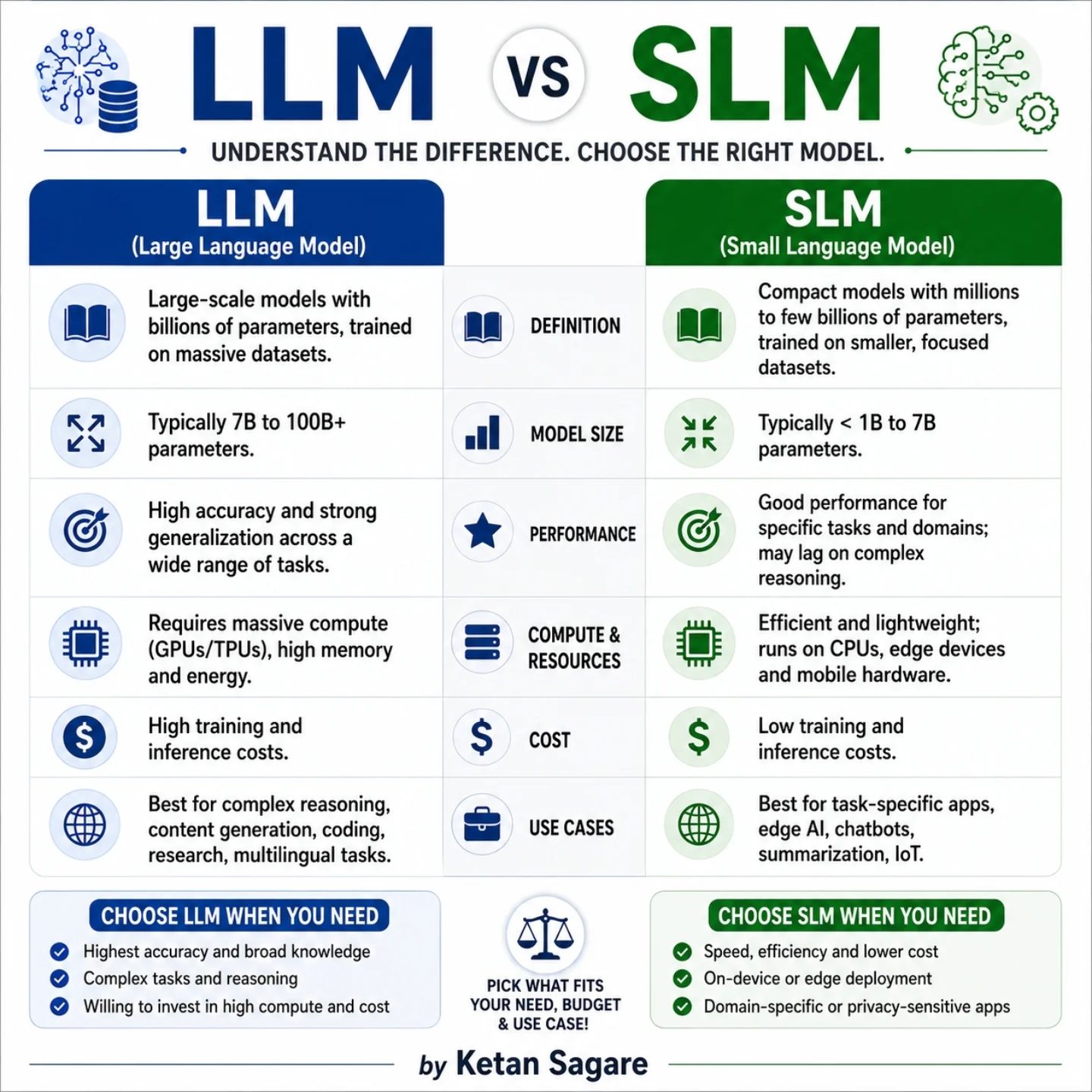
Large Language Models vs. Small Language Models: A Practical Comparison
Navigating generative AI applications can be a complex endeavor, particularly when deciding between Large Language Models (LLMs) and Small Language Models (SLMs). Understanding the distinctions between these models is crucial for making informed decisions tailored to specific needs. Let’s delve into what LLMs and SLMs are, their performance trade-offs, and when to use each.
Context / Why this Matters
Generative AI is transforming various industries by automating content creation, enhancing customer interactions, and optimizing data analysis. Choosing the right model—LLM or SLM—depends on factors like task complexity, deployment environment, and resource availability.
What are Large Language Models (LLMs) and Small Language Models (SLMs)?
Large Language Models (LLMs) are sophisticated AI models designed to handle a wide range of tasks with high accuracy. They typically have a vast number of parameters, ranging from 7 billion to over 100 billion. This extensive parameter count allows LLMs to generalize across a broad spectrum of tasks, making them highly versatile. However, this versatility comes at a cost: LLMs require significant computational resources, including powerful GPUs and TPUs, along with substantial memory and energy consumption.
On the other hand, Small Language Models (SLMs) are more compact, with fewer parameters, usually ranging from less than 1 billion to 7 billion. While they may not match the performance of LLMs on complex reasoning tasks, SLMs excel in specific domains and tasks. Their smaller size makes them efficient and lightweight, capable of running on less powerful hardware like CPUs, edge devices, and mobile hardware. This efficiency translates to lower training and inference costs, making SLMs a cost-effective solution for many applications.
Model Size, Compute, and Cost Differences
The primary difference between LLMs and SLMs lies in their size and the corresponding compute requirements. LLMs, with their massive parameter count, demand extensive computational resources. This translates to higher costs for both training and deployment. In contrast, SLMs are more economical, requiring less powerful hardware and consuming fewer resources, which results in lower operational costs.
Performance vs. Efficiency Trade-offs
LLMs offer high accuracy and strong generalization capabilities, making them suitable for a wide range of complex tasks. Their ability to handle intricate reasoning, content generation, coding, research, and multilingual tasks makes them invaluable for applications requiring high performance. However, this performance comes at the expense of efficiency and cost.
SLMs, while not as versatile, provide good performance for specific tasks and domains. They may lag behind LLMs in complex reasoning tasks but excel in task-specific applications, making them ideal for edge AI, chatbots, summarization, and IoT devices. Their efficiency and lightweight design make them the go-to choice for applications prioritizing speed, efficiency, and edge deployment.
Deployment and Infrastructure Considerations
When deploying AI models, the infrastructure required for LLMs can be a significant barrier. LLMs necessitate high-end hardware and substantial energy, potentially limiting their deployment to environments with adequate resources. Conversely, SLMs can be deployed on a variety of hardware, including edge devices, making them more flexible and accessible.
When to Use LLMs vs. SLMs
Choosing between LLMs and SLMs depends on the specific requirements of the task at hand. If the application involves complex reasoning and the ability to handle a wide range of tasks, and there is a willingness to invest in high computational resources, LLMs are the better choice. Examples include large-scale content generation, research, and multilingual tasks.
Conversely, if the focus is on speed, efficiency, and edge deployment, or if the application involves domain-specific or privacy-sensitive data, SLMs are more appropriate. They are ideal for task-specific applications, chatbots, summarization, and IoT devices.
Practical Tips
Assessing Your Needs
Before selecting a model, assess the specific requirements of your application. Consider the complexity of the tasks, the need for versatility, and the available computational resources. For instance, if you are developing a content generation platform that requires high accuracy and versatility, an LLM would be suitable. However, if you are building a chatbot for a specific domain with limited resources, an SLM would be more practical.
Evaluating Infrastructure
Evaluate your infrastructure capabilities and constraints. LLMs require powerful hardware and significant energy, which may not be feasible for smaller organizations. If your infrastructure is limited, opting for an SLM can provide a more cost-effective and efficient solution.
Cost Considerations
Consider the long-term costs associated with model deployment. LLMs, while powerful, come with high training and operational costs. SLMs, being more efficient, can offer significant savings, especially for applications running on edge devices and mobile hardware.
Use Cases
Identify the use cases that best align with the strengths of each model. LLMs are ideal for complex tasks and applications requiring high accuracy and versatility, such as research and multilingual content generation. SLMs are best suited for task-specific applications, chatbots, edge AI, summarization, and IoT devices.
Pilot Testing
Conduct pilot tests with both models to evaluate their performance in your specific context. This will help you make an informed decision and ensure that the chosen model meets your needs effectively.
Important Takeaways
- LLMs are designed for high accuracy and versatility, making them suitable for complex tasks and applications requiring a wide range of capabilities.
- SLMs are efficient and cost-effective, ideal for specific tasks, edge deployment, and applications with limited resources.
- Model size significantly influences compute requirements and costs, with LLMs demanding more resources than SLMs.
- Deployment considerations include the availability of high-end hardware and energy, which may limit the use of LLMs in resource-constrained environments.
- Choosing the right model depends on the specific requirements, infrastructure capabilities, and cost considerations of the application.
Conclusion
Understanding the differences between Large Language Models (LLMs) and Small Language Models (SLMs) is essential for making informed decisions in generative AI applications. By evaluating task complexity, computational resources, and cost, you can select the model that best aligns with your needs, whether it’s the high performance of LLMs or the efficiency of SLMs. This knowledge will empower you to leverage AI effectively, optimizing both performance and resource utilization.
Watch the Reel
Questions readers ask
What are the primary differences between LLMs and SLMs?
The main differences lie in their size, computational requirements, and performance. LLMs are large and require significant computational power and data for training, while SLMs are smaller and can operate more efficiently with fewer resources.
When should I use a Large Language Model?
LLMs are ideal for complex tasks that require a deep understanding of context and nuance, such as generating detailed reports, crafting creative content, or handling intricate queries. They are best suited for environments where computational resources are abundant.
What are the benefits of using a Small Language Model?
SLMs are perfect for scenarios where computational resources are limited, such as on mobile devices or in edge computing environments. They offer faster response times and lower latency, making them suitable for real-time applications and simple tasks.
How does the performance of LLMs compare to SLMs in different tasks?
LLMs generally outperform SLMs in tasks that demand a high level of language understanding and generation, such as writing coherent essays or engaging in complex conversations. However, for simpler, more straightforward tasks, the performance difference may be negligible, and SLMs can be more cost-effective.
What are the computational costs associated with LLMs and SLMs?
LLMs come with high computational costs due to their large size and the extensive resources needed for training and inference. In contrast, SLMs are more cost-effective, requiring less computational power and data, making them a budget-friendly option for many applications.
Can SLMs be used in environments with limited resources, such as mobile devices?
Yes, SLMs are specifically designed to operate efficiently in resource-constrained environments. They can run on mobile devices and other edge computing platforms, providing quick and reliable performance without the need for extensive computational power.
How do I choose between an LLM and an SLM for my specific needs?
Consider the complexity of the task, the available computational resources, and the importance of real-time processing. If your task is complex and you have ample resources, an LLM might be the better choice. For simpler tasks or resource-limited environments, an SLM would be more appropriate.
Related deep dives
Similar reads based on topic and creator.


Recent articles
Fresh deep dives from the latest Reels we unpacked.




Comments
Be the first to comment.