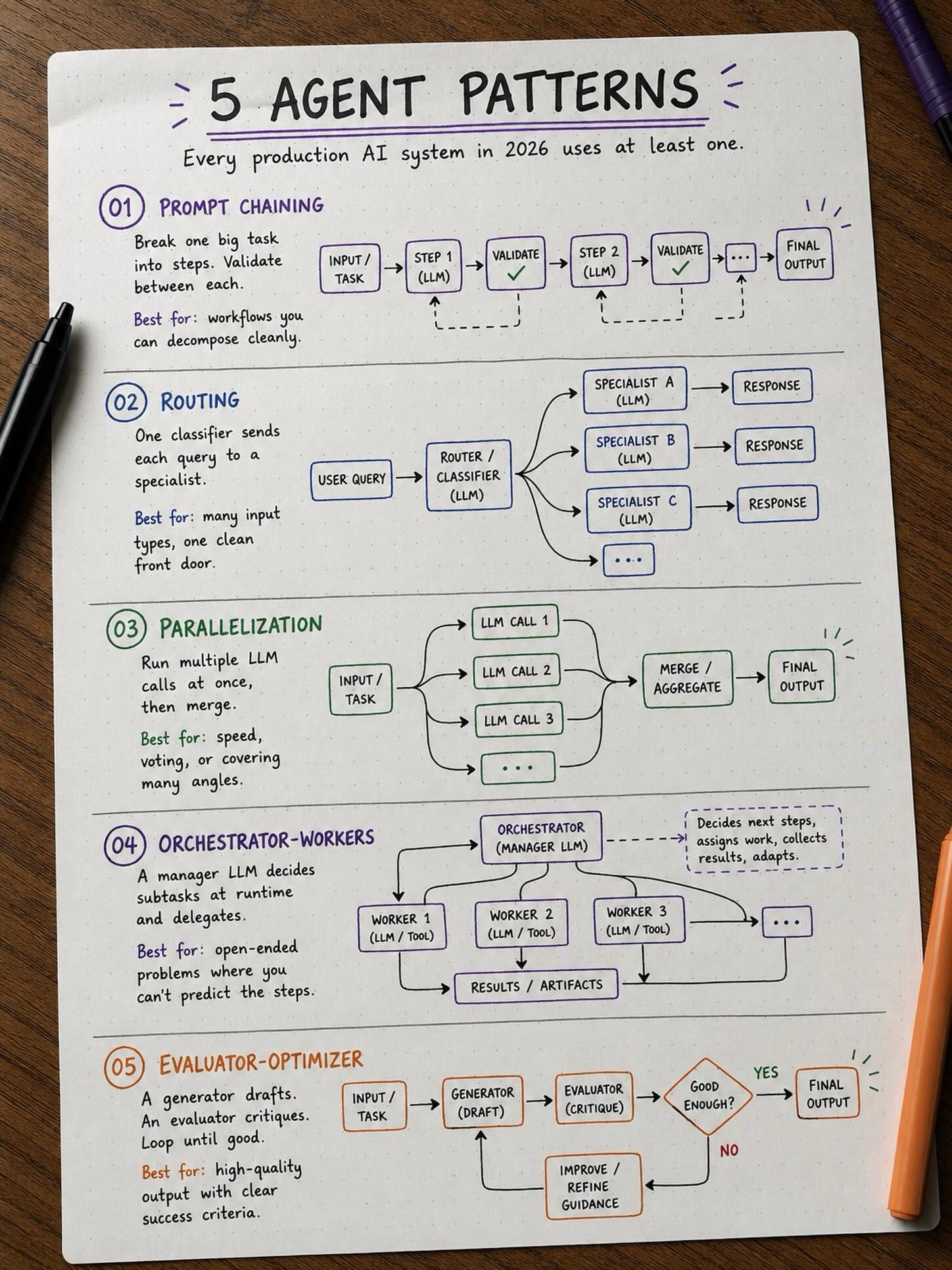
AI System Architectures
In 2026, the landscape of AI systems will be defined by a few key architectures. These patterns are employed repeatedly in production environments. They leverage the capabilities of large language models (LLMs) and other AI components to accomplish tasks efficiently and effectively. Understanding these patterns is crucial for anyone involved in AI development or implementation. This article covers five major AI system architectures: Prompt Chaining, Routing, Parallelization, Orchestrator + Workers, and Evaluator + Optimizer.
Why These Patterns Matter
AI systems are becoming more integrated into daily business operations, from content creation to customer support. These architectures are the backbone of effective AI solutions. They ensure that AI systems can handle complex tasks, improve accuracy, and provide reliable outputs. By understanding these patterns, you can design more efficient and effective AI workflows.
Main Discussion
Prompt Chaining
Prompt Chaining is a straightforward yet powerful pattern. It involves breaking down a large, complex task into smaller, manageable steps. Each step is processed and validated before moving on to the next. This approach is particularly useful for content workflows, research pipelines, and structured tasks.
How It Works:
- Input/Task: The initial task or prompt is received.
- Step 1 (LLM): The first step of the task is processed by an LLM.
- Validate: The output of the first step is validated.
- Step 2 (LLM): The second step is processed, and this continues until all steps are completed.
- Final Output: The validated outputs of each step are compiled into the final result.
This pattern ensures that each part of the task is carefully checked, reducing the risk of errors and improving the overall quality of the output.
Routing
The Routing pattern involves using a central LLM to understand a user query and then direct it to the appropriate specialist AI. This pattern is beneficial for systems that need to handle a variety of tasks, such as coding, writing, and customer support.
How It Works:
- User Query: The user submits a query.
- Router (LLM): The router LLM interprets the query and determines the best specialist AI to handle it.
- Specialist (LLM): The query is sent to the appropriate specialist AI, which processes and responds to the query.
- Response: The response is returned to the user.
This pattern allows for a unified interface that can handle multiple types of queries efficiently, making it ideal for environments where different types of AI expertise are needed.
Parallelization
Parallelization involves running multiple LLM calls simultaneously and then merging the results. This pattern is used to achieve faster outputs, better accuracy, and a more comprehensive perspective.
How It Works:
- Multiple LLM Calls: Several LLM calls are initiated at the same time, each processing different aspects of the task.
- Merge/Aggregate: The results from each LLM call are combined and aggregated.
- Final Output: The merged results are compiled into the final output.
This pattern is particularly useful for tasks that require multiple perspectives or when faster processing is a priority.
Orchestrator + Workers
The Orchestrator + Workers pattern uses a manager LLM to plan and delegate tasks to worker agents. This approach is best suited for complex projects, open-ended problems, and tasks with unpredictable steps.
How It Works:
- Manager LLM: The manager LLM decides the subtasks and delegates them to the appropriate worker agents.
- Worker Agents (LLM/Tool): Worker agents handle the subtasks, which can be processed by LLMs or other tools.
- Results/Artifacts: The results from each worker agent are compiled and used to complete the task.
This pattern is ideal for dynamic and complex tasks where the workflow cannot be predetermined.
Evaluator + Optimizer
The Evaluator + Optimizer pattern involves a generator LLM creating an initial draft, which is then evaluated and refined by an evaluator LLM. This loop continues until the output meets the desired quality standards.
How It Works:
- Generator (Draft): The generator LLM creates an initial draft of the task.
- Evaluator: The evaluator LLM reviews the draft and provides feedback.
- Refine: The draft is refined based on the evaluator's feedback.
- Guidance: The process continues until the output is satisfactory.
- Final Output: The refined and optimized output is the final result.
This pattern ensures that the output is continuously improved, making it suitable for high-quality AI systems.
Practical Tips
When implementing these AI system architectures, consider the following tips:
- Choose the Right Pattern: Select the pattern that best fits the nature of the task. For example, use Prompt Chaining for structured tasks and Parallelization for tasks that require faster outputs.
- Optimize LLMs: Ensure that the LLMs used in each step are well-trained and optimized for the specific tasks they handle.
- Validate and Test: Regularly validate and test the outputs at each step to ensure accuracy and quality.
- Iterate and Improve: Continuously refine and improve the workflows based on feedback and performance metrics.
Important Takeaways
Understanding and implementing these AI system architectures can significantly enhance the efficiency and effectiveness of AI solutions. Whether you are dealing with content creation, customer support, or complex project management, these patterns provide a robust framework for designing smart workflows.
Conclusion
AI system architectures are the foundation of modern AI solutions. By leveraging patterns like Prompt Chaining, Routing, Parallelization, Orchestrator + Workers, and Evaluator + Optimizer, you can create more efficient, accurate, and reliable AI systems. These patterns are not just smart workflows; they are the backbone of effective AI implementation in 2026 and beyond.
Watch the Reel
Questions readers ask
What are the five key AI system architectures for 2026?
The five key AI system architectures for 2026 are Prompt Chaining, Routing, Parallelization, Orchestrator + Workers, and Evaluator + Optimizer. Each of these architectures is designed to enhance the efficiency, accuracy, and reliability of AI tasks, making them essential for developers and implementers.
How does Prompt Chaining work in AI systems?
Prompt Chaining involves breaking down complex tasks into smaller, sequential steps. Each step corresponds to a specific prompt, with the output of one step serving as the input for the next. This method ensures that AI systems can handle intricate tasks by focusing on one aspect at a time, improving overall performance and accuracy.
What is the role of the Orchestrator in the Orchestrator + Workers architecture?
In the Orchestrator + Workers architecture, the Orchestrator manages and coordinates multiple Worker agents. These Workers are specialized AI components that handle specific tasks. The Orchestrator ensures that the right Worker is assigned to the right task, optimizing the workflow and improving the efficiency of the AI system.
How does the Evaluator + Optimizer architecture improve AI performance?
The Evaluator + Optimizer architecture consists of two main components: the Evaluator, which assesses the performance of AI models, and the Optimizer, which fine-tunes the models based on the Evaluator's feedback. This continuous improvement loop helps enhance the accuracy and reliability of AI outputs over time.
What is the significance of AI system architectures in daily business operations?
AI system architectures are crucial for integrating AI into daily business operations. They provide the structural foundation for AI solutions, ensuring that tasks are completed efficiently and accurately. By leveraging these architectures, businesses can enhance their operations, from content creation to customer support, with reliable and effective AI tools.
Related deep dives
Similar reads based on topic and creator.


Recent articles
Fresh deep dives from the latest Reels we unpacked.




Comments
Be the first to comment.