Understanding Car Headlights: Halogen, Xenon, LED, and Laser
Car headlights play a critical role in ensuring safety and visibility during nighttime driving. The type of headlight technology in a vehicle significantly impacts brightness, efficiency, and overall driving experience. This article delves into the differences between halogen, xenon, LED, and laser headlights, highlighting their unique features and benefits.
Why This Matters
The choice of headlights in a car is more than just a matter of aesthetics; it directly affects how well you can see the road, react to obstacles, and drive safely. Understanding the differences between various headlight technologies can help car owners make informed decisions when upgrading or replacing their headlights.
Main Discussion
Halogen Headlights
Halogen headlights are the most traditional and commonly found in older vehicles. These headlights use a tungsten filament and a halogen gas to produce light. Their key features include:
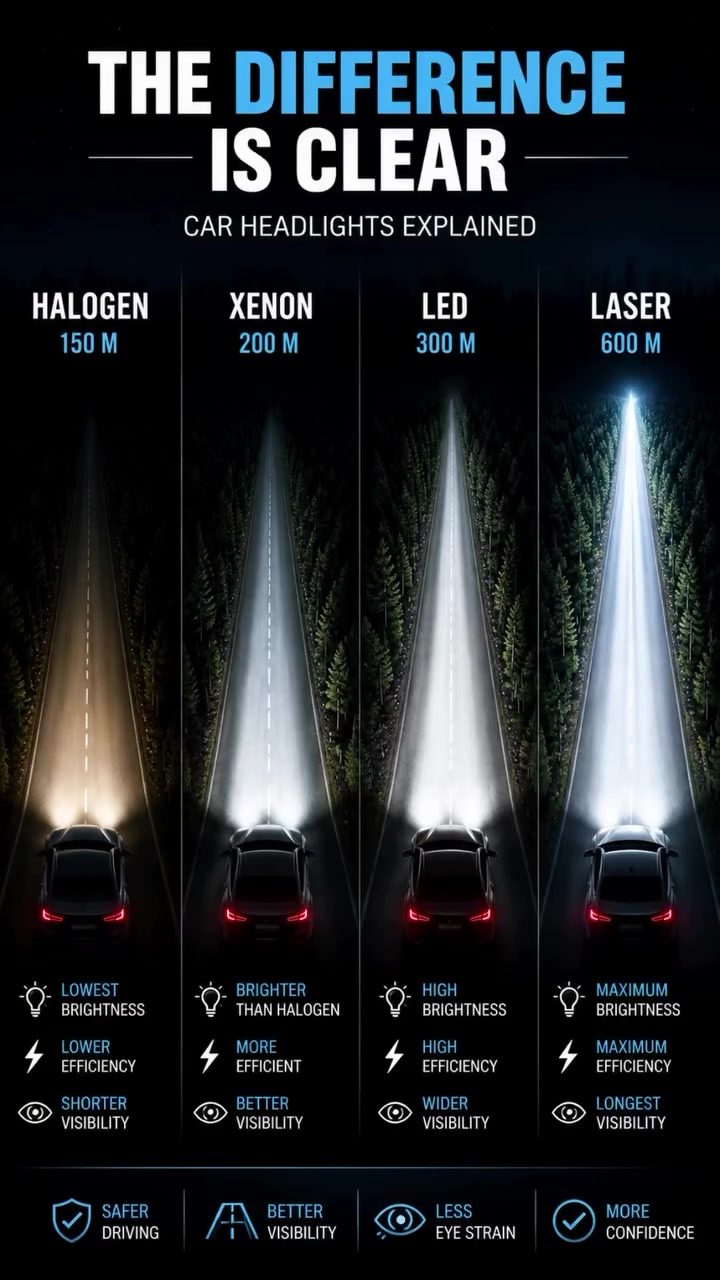
- Brightness: Halogen headlights offer the lowest brightness among the four types, with an illumination range of approximately 150 meters.
- Efficiency: They are the least energy-efficient, consuming more power and producing more heat.
- Visibility: The visibility range is shorter, which can be a significant drawback, especially on unpaved roads or during foggy conditions.
- Cost: Halogen headlights are generally the most affordable option.
Xenon Headlights (HID)
Xenon headlights, also known as High-Intensity Discharge (HID) headlights, use xenon gas to produce light. These headlights are brighter and more efficient than halogen headlights. Key features include:
- Brightness: Xenon headlights are brighter than halogen headlights, with an illumination range of around 200 meters.
- Efficiency: They offer better efficiency, consuming less power and producing less heat compared to halogen headlights.
- Visibility: The visibility range is better, providing a clearer view of the road ahead.
- Eyestrain: Xenon headlights produce less eye strain, making them a more comfortable option for long drives.
LED Headlights
LED (Light Emitting Diode) headlights are increasingly popular in modern vehicles. These headlights use semiconductor diodes to produce light. Key features include:
- Brightness: LED headlights provide high brightness, with an illumination range of around 300 meters.
- Efficiency: They are highly energy-efficient, consuming less power and producing less heat.
- Visibility: The wider visibility range makes them ideal for driving on highways and in adverse weather conditions.
- Durability: LED headlights are known for their durability and longevity, often lasting longer than other types of headlights.
Laser Headlights
Laser headlights represent the most advanced technology available. These headlights use laser diodes to produce light. Key features include:
- Brightness: Laser headlights offer maximum brightness, with an illumination range of up to 600 meters under ideal conditions.
- Efficiency: They provide maximum efficiency, consuming the least amount of power and producing the least amount of heat.
- Visibility: The longest visibility range makes them the safest option for nighttime driving.
- Confidence: The superior performance of laser headlights can provide drivers with more confidence and reduced fatigue.
Practical Tips
When considering an upgrade or replacement for your car headlights, keep the following tips in mind:
Assess Your Driving Needs
Evaluate your driving habits and the conditions you frequently encounter. For instance, if you often drive on highways or in rural areas with limited street lighting, LED or laser headlights might be a better fit.
Check Compatibility
Ensure that the new headlights are compatible with your vehicle's electrical system. Some vehicles may require additional modifications or upgrades to support more advanced headlight technologies.
Consider the Cost
While halogen headlights are the most affordable, they may not offer the same level of performance and safety as LED or laser headlights. Weigh the initial cost against the long-term benefits, including improved safety and reduced eye strain.
Professional Installation
If you're not comfortable installing new headlights yourself, consider hiring a professional. Proper installation is crucial for optimal performance and safety.
Important Takeaways
- Halogen headlights are affordable but offer the shortest illumination range.
- Xenon headlights are brighter and more efficient than halogen headlights, with better visibility.
- LED headlights provide high brightness, energy efficiency, and a wider visibility range.
- Laser headlights offer maximum brightness, efficiency, and the longest visibility range, making them the safest option for nighttime driving.
Conclusion
The type of headlights in your car significantly impacts your driving experience and safety. Understanding the differences between halogen, xenon, LED, and laser headlights can help you make an informed decision when upgrading or replacing your headlights. Consider your driving needs, compatibility, cost, and the benefits of each type to choose the best headlights for your vehicle.
Watch the Reel
Questions readers ask
What are halogen headlights and how do they differ from LED headlights?
Halogen headlights use a tungsten filament to produce light, while LED headlights utilize light-emitting diodes. Halogen headlights are generally less efficient and have a shorter lifespan compared to LEDs, which offer better brightness and energy efficiency. Halogen headlights are typically brighter at close range (around 150 feet), while LED headlights provide better illumination at longer distances, about 200 feet or more.
How do xenon headlights, also known as HID headlights, compare to LED headlights?
Xenon or HID headlights use high-intensity discharge technology, producing a bright, white light. Compared to LED headlights, xenon headlights have a longer lifespan and consume less energy. However, LED headlights offer a wider beam pattern, providing better peripheral visibility. Xenon headlights can reach up to 300 feet, while LEDs are effective up to 200 feet.
What are the advantages of laser headlights over other types?
Laser headlights use a laser diode to excite a phosphor, emitting bright, white light. They offer several advantages, including longer range, improved contrast, and a longer lifespan. Laser headlights can illuminate objects up to 600 feet, making them the most effective for long-distance visibility, but they are also the most expensive to produce.
Do LED headlights consume less energy and last longer than halogen and xenon headlights?
Yes, LED headlights are known for their energy efficiency and durability. They consume less power and have a longer lifespan compared to both halogen and xenon headlights. LEDs typically last around 12-15 years, while halogen headlights last about 500-1,000 hours and xenon headlights last around 2,000-2,500 hours.
How does the brightness of xenon headlights compare to halogen and LED?
Xenon headlights are significantly brighter than halogen headlights, producing a clear, white light that enhances nighttime visibility. While LED headlights also offer high brightness, xenon headlights often provide a more intense and focused beam, improving the ability to see and react to obstacles on the road.
Which headlight technology is best for better night visibility and safety?
For better night visibility and safety, LED and laser headlights are ideal choices. They provide excellent illumination at longer distances, ensuring better road visibility and reaction time to obstacles. Laser headlights, in particular, offer superior long-range visibility.
Related deep dives
Similar reads based on topic and creator.


Recent articles
Fresh deep dives from the latest Reels we unpacked.




Comments
Be the first to comment.