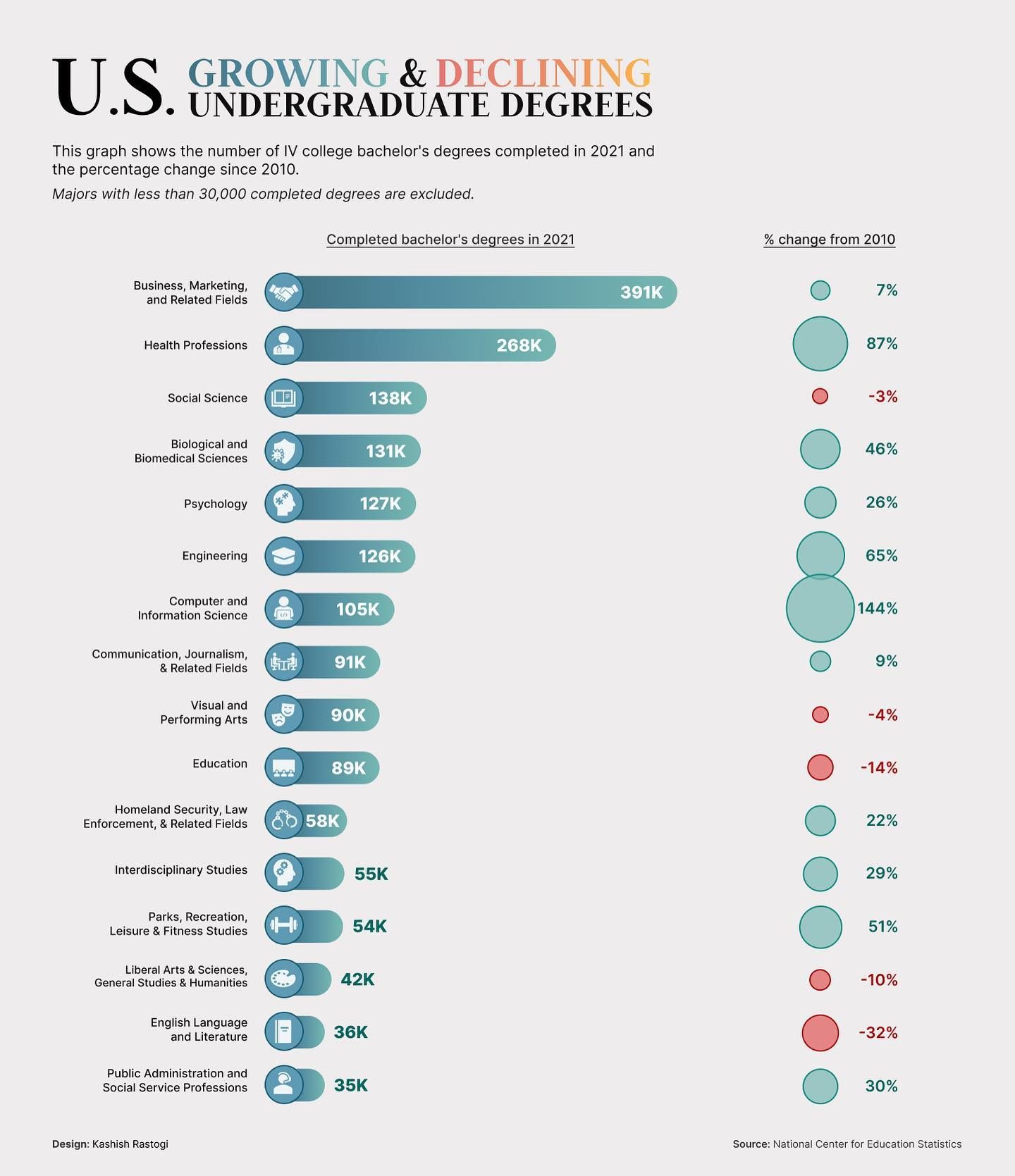
Undergraduate Degrees Trends
Navigating the landscape of undergraduate degrees can be challenging, especially with the rising costs of tuition and increasing student debt. Understanding the trends in degree completions can provide valuable insights for aspiring college students. Let's explore the changing landscape of undergraduate degrees awarded between the 2010–2011 and 2020–2021 academic years, focusing on the trends in various majors.
Context / Why this matters
Choosing the right undergraduate degree is more crucial than ever. With soaring tuition fees and mounting student debt, it's essential to select a field that not only aligns with your interests but also offers promising career prospects. By examining the trends in degree completions, students can gain a clearer picture of which fields are growing and which are declining. This information can help guide decisions about major selection, ensuring that students invest their time and resources wisely.
Main discussion
Growing Fields
Health Professions
One of the most significant trends in undergraduate degree completions is the surge in Health Professions. Between 2010 and 2021, the number of completed bachelor's degrees in this field increased by 87%. This growth can be attributed to several factors, including an aging population, advancements in medical technology, and a greater emphasis on preventive healthcare. Majors in this category include nursing, health administration, and pre-medical studies. As the demand for healthcare services continues to rise, pursuing a degree in Health Professions can lead to a rewarding and stable career.
Computer and Information Science
Another rapidly growing field is Computer and Information Science. This category encompasses a wide range of disciplines, from software development and data analytics to cybersecurity and artificial intelligence. The percentage change from 2010 shows a substantial increase in the number of completed degrees, reflecting the tech industry's rapid expansion and the growing demand for skilled professionals. As technology continues to permeate every aspect of society, graduates in this field can expect ample job opportunities and competitive salaries.
Parks, Recreation, Leisure & Fitness Studies
In an era where wellness and recreation are increasingly valued, the field of Parks, Recreation, Leisure & Fitness Studies has also seen a notable increase. This trend underscores society's growing emphasis on physical and mental well-being. Graduates in this field can pursue careers in sports management, fitness training, and recreation planning, among other areas.
Declining Fields
Social Science
While some fields are thriving, others are experiencing a decline. Social Science, for example, saw a -3% decrease in the number of completed bachelor's degrees from 2010 to 2021. This decline could be due to various factors, including changes in curriculum, shifts in student interests, and the perception of career prospects in different fields. Prospective students should carefully consider the long-term career paths and earning potential in Social Science before making a decision.
Liberal Arts & Sciences, General Studies & Humanities
The broader category of Liberal Arts & Sciences, General Studies & Humanities has also seen a decline. This trend may reflect a shift towards more specialized and vocationally focused degrees. While a liberal arts education offers a broad foundation of knowledge and critical thinking skills, some students may opt for majors that promise more direct career paths. However, it is essential to note that many employers value the skills developed through a liberal arts education, such as communication, problem-solving, and adaptability. Students should weigh these factors when considering their major.
English Language and Literature
The English Language and Literature category has faced stagnation. Though it continues to attract students, its rate of growth has not kept up with other fields. While a degree in English can lead to a variety of careers, from writing and editing to education and publishing, it may not offer the same immediate job prospects as some of the more vocationally focused majors.
Stable Fields
While some fields have seen dramatic changes, others have remained relatively stable. For example, majors in Business, Marketing, and Related Fields continue to attract a significant number of students. These fields offer a wide range of career opportunities, from finance and management to marketing and entrepreneurship. The stability of these majors reflects their enduring relevance in the job market.
Practical tips
When considering your undergraduate degree, it's essential to weigh several factors:
- Career Prospects: Research the job market for different majors. Look at employment rates, salary ranges, and job growth projections.
- Personal Interests: Choose a major that aligns with your passions and interests. This will make your academic journey more enjoyable and increase the likelihood of success in your career.
- Financial Considerations: Consider the cost of tuition and potential student debt. Evaluate the return on investment for different majors by comparing tuition costs to potential earnings.
- Skill Development: Assess the skills you will develop in your chosen major. Many employers value transferable skills such as communication, problem-solving, and critical thinking, regardless of the specific field.
- Flexibility: Think about the flexibility of the degree. Some majors offer more diverse career paths and opportunities for further specialization.
Important takeaways
- Health Professions and Computer and Information Science are among the fastest-growing fields, offering promising career prospects.
- Social Science and Liberal Arts are seeing declines, but they still offer valuable skills and career opportunities.
- Consider a wide range of factors, including career prospects, personal interests, financial considerations, skill development, and flexibility, when choosing your major.
Conclusion
Understanding the trends in undergraduate degree completions can provide valuable insights for aspiring college students. By examining the data on growing, declining, and stable fields, students can make more informed decisions about their educational and career paths. Whether you're drawn to the fast-paced world of technology, the stable field of business, or the rewarding realm of healthcare, choosing the right degree is a crucial step towards a successful and fulfilling career.
Watch the Reel
Questions readers ask
Which undergraduate degree fields have seen the most significant growth from 2010 to 2021?
The fields of Health Professions and Computer and Information Science have experienced substantial growth in the number of degrees awarded. This trend reflects the increasing demand for healthcare professionals and tech specialists in the job market.
Why is it important to consider degree completion trends when choosing a major?
Understanding degree completion trends can help students make informed decisions about their majors. By choosing a field with promising career prospects, students can increase their chances of securing employment after graduation and managing student debt more effectively.
How have trends in health professions degrees changed over the past decade?
The number of degrees completed in Health Professions has grown significantly. This increase can be attributed to the rising demand for healthcare services and an aging population, creating more job opportunities in the field.
What are the benefits of pursuing a degree in Computer and Information Science?
A degree in Computer and Information Science can open up numerous career opportunities in tech, with high demand and competitive salaries. This field has seen substantial growth in degree completions, reflecting its importance in the modern job market.
What are some other majors that have seen an increase in completions, besides Health Professions and Computer and Information Science?
While Health Professions and Computer and Information Science lead in growth, other fields such as Business, STEM (excluding Computer Science), and Social Sciences have also seen increases in degree completions. These trends highlight the diverse range of opportunities available to students.
How does understanding undergraduate degree changes from 2010-2021 assist students in selecting a major?
Analyzing trends in degree completions from 2010 to 2021 can reveal which fields are likely to offer strong job prospects in the future. This information can guide students in choosing a major that aligns with their interests and offers promising career opportunities.}
Related deep dives
Similar reads based on topic and creator.

Recent articles
Fresh deep dives from the latest Reels we unpacked.




Comments
Be the first to comment.