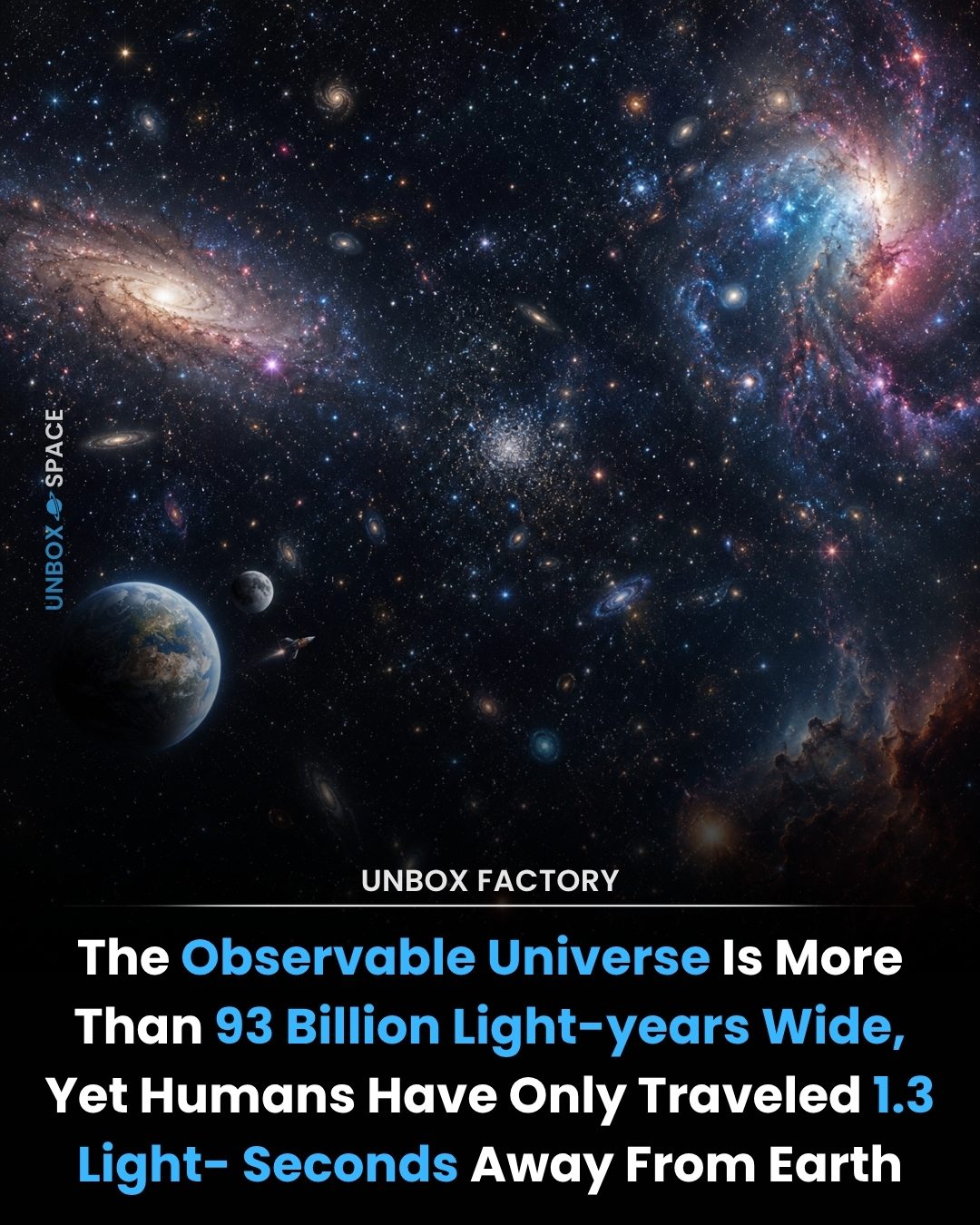
Space and Human Travel: A Staggering Contrast
The observable universe spans an estimated 93 billion light-years, a figure so vast it's nearly impossible to comprehend. It contains hundreds of billions of galaxies, each teeming with stars, and has been the subject of wonder and exploration for centuries. Yet, despite decades of space exploration, the farthest humans have ever traveled is a mere 400,000 kilometers (250,000 miles) from Earth, roughly 1.3 light-seconds, during NASA's Apollo Moon missions.
This contrast highlights the immense scale of the universe and the comparatively tiny distance humans have ventured. To put it into perspective, if the observable universe were a map stretching from New York to Los Angeles, the farthest humans have traveled would be less than a millimeter away from New York.
Why This Matters
Understanding the vastness of the universe and the limitations of human travel is crucial for appreciating our place in the cosmos. It drives technological innovation and fuels our desire to explore further. This exploration not only expands our knowledge but also influences various aspects of daily life, from communication technologies to medical advancements.
The Observable Universe: An Immensely Vast Space
The observable universe is the region of space that we can currently see due to the finite speed of light and the age of the universe. This immense expanse contains hundreds of billions of galaxies, each with its own unique characteristics and stars. Moreover, it's estimated that the universe could be even larger than what we can observe, potentially stretching to infinity.
The observable universe is characterized by its expanding nature. Every second, the universe expands, carrying galaxies and stars further apart from one another. This expansion is a key aspect of the Big Bang theory, which posits that the universe began as a singular point and has been expanding ever since.
The sheer scale of the universe can be overwhelming, but it also underscores the importance of exploration. The more we learn about the universe, the more we understand about our own origins and the potential for life beyond Earth.
Human Space Exploration: Achievements and Limitations
Human space exploration has achieved remarkable milestones since the first satellites were launched into orbit. The Apollo Moon missions, in particular, highlighted humanity's capacity for exploration and innovation. However, despite decades of space travel, the farthest humans have journeyed is a mere 400,000 kilometers from Earth, a distance that seems minuscule in comparison to the vastness of the universe.
The farthest human spaceflight to date is the Apollo 11 mission in 1969, which landed astronauts on the Moon. The crew of Apollo 17, the last mission to the Moon, traveled 400,171 kilometers from Earth. This distance is roughly 1.3 light-seconds, which means that light, traveling at 299,792 kilometers per second, takes 1.3 seconds to cover the distance.
In recent years, space exploration has progressed with missions to Mars and the development of advanced technologies. Private companies and space agencies worldwide are working on projects to send humans to Mars, explore other planets, and even establish colonies on the Moon.
Technological and Practical Challenges
Even with the fastest spacecraft ever built, the journey to the nearest star beyond our Solar System, Proxima Centauri, would take tens of thousands of years. This is due to the immense distance between stars and the limitations of current propulsion technologies. To put it into perspective, the Voyager 1 spacecraft, launched in 1977, is traveling at a speed of about 17 kilometers per second. Since 1977, it has covered a mere 20 billion kilometers, and it would still take tens of thousands of years to reach the nearest star.
The challenges of space travel are not limited to distance and speed. Other factors, such as radiation, microgravity, and the psychological impact of long-duration spaceflight, must also be considered. Overcoming these challenges requires a multidisciplinary approach, involving advancements in materials science, life support systems, and medical technologies.
Practical Tips for Aspiring Space Enthusiasts
For those interested in exploring space and human travel, there are several practical steps to take. Joining local astronomy clubs, participating in space-themed events, and following the news from space agencies and private companies like NASA and UNBOX FACTORY can provide valuable insights and opportunities for involvement.
Additionally, pursuing a career in STEM (Science, Technology, Engineering, and Mathematics) fields can open doors to opportunities in space exploration. Studying physics, engineering, or computer science, for example, can provide the necessary foundation for developing advanced technologies and contributing to the future of human space travel.
Important Takeaways
The vastness of the observable universe and the relatively short distances humans have traveled underscore the challenges and opportunities in space exploration. Here are some key takeaways:
- The observable universe is an immense expanse, containing hundreds of billions of galaxies and an unimaginable number of stars.
- Human space exploration has made significant strides, but the farthest we've traveled is a mere 400,000 kilometers from Earth.
- Technological advancements and innovative solutions are crucial for overcoming the challenges of space travel.
- Space exploration drives technological innovation and has a profound impact on various aspects of daily life.
- For those interested in space, pursuing a career in STEM fields and staying informed can provide valuable opportunities.
Conclusion
The contrast between the vastness of the observable universe and the relatively short distances humans have traveled is both humbling and inspiring. It underscores the need for continued exploration and innovation, driving technological advancements and expanding our understanding of the cosmos. As we look to the future, the challenges of space travel serve as a reminder of the incredible potential that awaits us among the stars. By embracing these challenges and pushing the boundaries of what is possible, we can further our journey into the unknown and unlock the mysteries of the universe.
Watch the Reel
Questions readers ask
How big is the observable universe?
The observable universe is approximately 93 billion light-years in diameter. This vast expanse contains hundreds of billions of galaxies, each harboring countless stars and other celestial bodies.
How far have humans traveled in space?
The farthest humans have ventured from Earth is during NASA's Apollo Moon missions, reaching about 400,000 kilometers (250,000 miles) or 1.3 light-seconds away. This distance is a tiny fraction of the entire universe.
What is a light-year and why is it used to measure the universe?
A light-year is the distance light travels in one year—a staggering 9.46 trillion kilometers (5.88 trillion miles). It's used to measure the universe because the distances in space are so immense that more conventional units, like kilometers or miles, become impractical.
What makes understanding the universe's scale beneficial for human exploration?
Understanding the vast scale of the universe provides context for our place within this immense cosmic expanse. It drives innovation and exploration by inspiring us to push the boundaries of what's possible in space travel and technology.
How does the number of galaxies in the observable universe compare to human exploration?
The observable universe contains hundreds of billions of galaxies, yet human space exploration has only reached our own Moon and sent probes to nearby planets and dwarf planets in our solar system. This shows the vast amount of the cosmos that remains unexplored.
Why is it challenging to comprehend the universe size?
The universe's size is difficult to grasp because it is far beyond our daily experiences and even beyond our Solar System. When we compare our space travel with the universe, we see that our most distant travel is minuscule compared to the entire cosmic expanse.
What are some of the major milestones in human space travel?
Major milestones include the Apollo 11 Moon landing in 1969, the launch of the International Space Station (ISS) in 1998, and the Voyager 1 spacecraft reaching interstellar space in 2012. These achievements, despite their vastness, are still only small steps in the grand scheme of the observable universe.
Related deep dives
Similar reads based on topic and creator.

Recent articles
Fresh deep dives from the latest Reels we unpacked.



Comments
Be the first to comment.