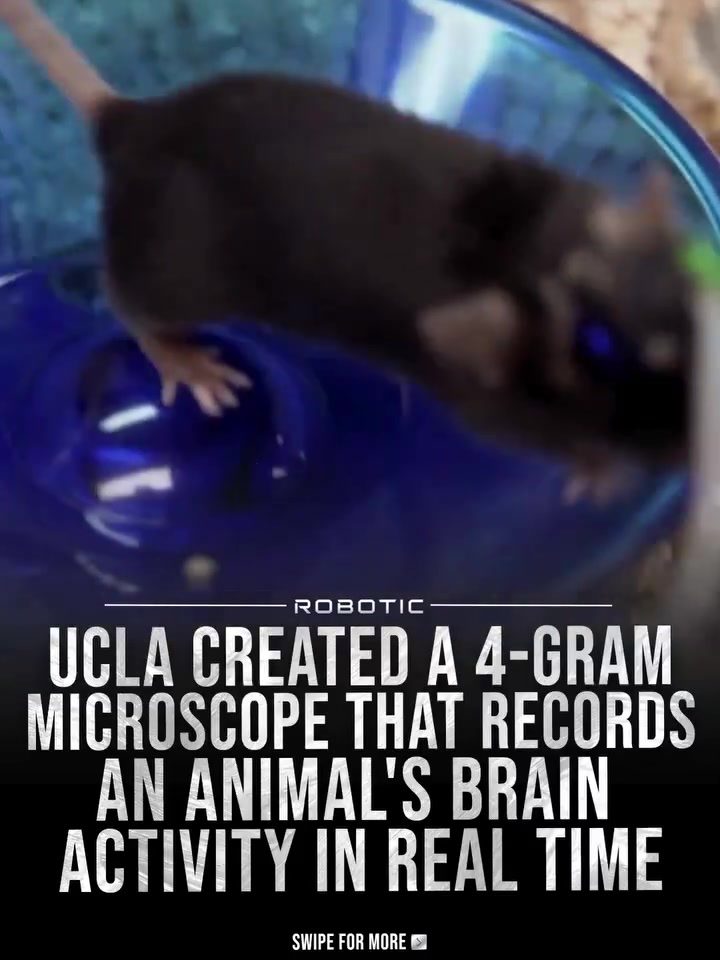
The UCLA Miniscope: A Revolutionary Tool for Real-Time Brain Recording
The UCLA Miniscope is a groundbreaking device that allows researchers to observe brain activity in real time as animals move naturally. This tiny microscope, developed by scientists at UCLA, weighs less than 4 grams and measures approximately 1 inch in length.
Understanding the UCLA Miniscope
The UCLA Miniscope is designed to attach to a small implant on an animal's head, enabling the recording of individual neurons' activity in real time. This is a significant advancement over traditional laboratory imaging systems, which often restrict the animal's movement and limit the observation of natural behaviors.
The microscopic imagery reveals a mesmerizing dance of neurons—the flashing dots represent individual brain cells. These neurons are not just static components but are actively transmitting information, creating a live picture of the brain's internal communication network. This technology offers a dynamic view of how the brain processes essential functions, including learning, memory, and decision-making.
The Advantages of Real-Time Brain Recording
One of the key advantages of the UCLA Miniscope is its ability to capture brain activity in real time. This allows researchers to study the brain in action as animals engage in natural behaviors. Traditional laboratory setups often impose constraints on movement, which can alter the results and limit the applicability of the findings to real-world conditions.
By observing the brain in its natural state, scientists can gain deeper insights into how neurological processes unfold. This includes understanding how the brain adapts to new information, how memories are formed and retrieved, and how decisions are made. This technology is particularly valuable for studying neurological disorders, as it provides a more accurate picture of how the brain functions under various conditions.
How the UCLA Miniscope Works
The UCLA Miniscope is a sophisticated piece of scientific equipment that leverages robotic technology to achieve its goals. The device is equipped with advanced imaging capabilities that allow it to capture high-resolution images of individual neurons. These images are then transmitted to a recording system, where they can be analyzed in real time.
The microscope's small size and lightweight design are crucial for its effectiveness. It can be easily attached to an animal's head without causing discomfort or restricting movement. This makes it possible to record brain activity over extended periods, providing a comprehensive view of how the brain functions during various activities.
Applications in Neuroscience
The UCLA Miniscope has significant implications for neuroscience research. By allowing scientists to observe the brain in action, it provides valuable data that can be used to develop new treatments for neurological disorders. This includes conditions such as Alzheimer's disease, Parkinson's disease, and depression, where understanding the brain's internal workings is crucial for developing effective interventions.
Researchers can also use the Miniscope to study the effects of different stimuli on the brain. For example, they can observe how the brain responds to environmental changes, social interactions, and other external factors. This can help in developing more targeted therapies that address the root causes of neurological disorders rather than just managing symptoms.
Practical Tips for Using the UCLA Miniscope
When using the UCLA Miniscope, it's important to follow best practices to ensure accurate and reliable data collection. Here are some practical tips:
-
Proper Implantation: Ensure the microscope is correctly implanted on the animal's head. This involves precision and care to avoid any discomfort or restriction of movement.
-
Calibration: Regularly calibrate the microscope to maintain its accuracy. This includes checking the focus and adjusting the settings as needed.
-
Data Management: Use a reliable data management system to store and analyze the captured images. This ensures that the data is easily accessible and can be analyzed efficiently.
-
Ethical Considerations: Always adhere to ethical guidelines when working with animals. This includes minimizing discomfort and ensuring the well-being of the subjects throughout the study.
Important Takeaways
The UCLA Miniscope represents a significant advancement in neuroscience research, offering a unique window into the brain's inner workings. Here are the key takeaways:
- The UCLA Miniscope allows for real-time observation of brain activity in natural settings.
- It provides valuable insights into how the brain processes essential functions, including learning, memory, and decision-making.
- The device's small size and lightweight design make it ideal for long-term studies without restricting movement.
- It has significant implications for studying and treating neurological disorders, offering a more accurate picture of how the brain functions under various conditions.
Conclusion
The UCLA Miniscope is a revolutionary tool that is transforming the way researchers study the brain. By allowing for real-time observation of brain activity in natural settings, it provides a more comprehensive understanding of how the brain functions. This technology has the potential to lead to breakthroughs in the treatment of neurological disorders and to deepen our understanding of the complex processes that govern the brain. As research continues, the UCLA Miniscope will undoubtedly play a crucial role in advancing the field of neuroscience, bringing us closer to a more complete picture of the brain's inner workings.
Watch the Reel
Questions readers ask
What makes the UCLA Miniscope unique compared to traditional brain imaging systems?
The UCLA Miniscope stands out due to its compact size and lightweight design, allowing animals to move freely while their brain activity is recorded in real time. Traditional systems often restrict movement, making it difficult to observe natural behaviors.
How does the UCLA Miniscope capture brain activity?
The device attaches to a small implant on an animal's head and records the activity of individual neurons in real time. This provides a detailed view of brain activity as it happens, offering insights into how the brain functions during natural movements.
Can the UCLA Miniscope be used on different types of animals?
While the article does not specify the types of animals tested, the Miniscope's lightweight and compact design suggests it can be adapted for various small animals commonly used in neuroscience studies, such as mice and rats.
What are the benefits of real-time brain recording with the UCLA Miniscope?
Real-time brain recording allows researchers to observe neural activity as it occurs, providing immediate feedback and a more accurate understanding of brain processes during natural behaviors. This can help identify patterns and correlations that might be missed with delayed or static imaging.
How does the UCLA Miniscope's design contribute to neuroscience research?
The Miniscope's design enables wireless, real-time brain monitoring, which is crucial for studying brain activity in unrestrained animals. This capability enhances the relevance of findings to real-world scenarios, making the Miniscope a valuable addition to neuroscience research technology.
What are the potential applications of the UCLA Miniscope in neuroscience research?
The UCLA Miniscope can be used to study a wide range of neurological processes, including learning, memory, and motor control. By observing brain activity in real-time during natural movements, researchers can gain deeper insights into how the brain functions in everyday situations.
What are the specifications of the UCLA Miniscope?
The UCLA Miniscope weighs less than 4 grams and measures approximately 1 inch in length, making it lightweight and compact. These specifications allow it to be easily attached to small animals for brain activity recording without hindering their natural movements.
Related deep dives
Similar reads based on topic and creator.




Recent articles
Fresh deep dives from the latest Reels we unpacked.




Comments
Be the first to comment.