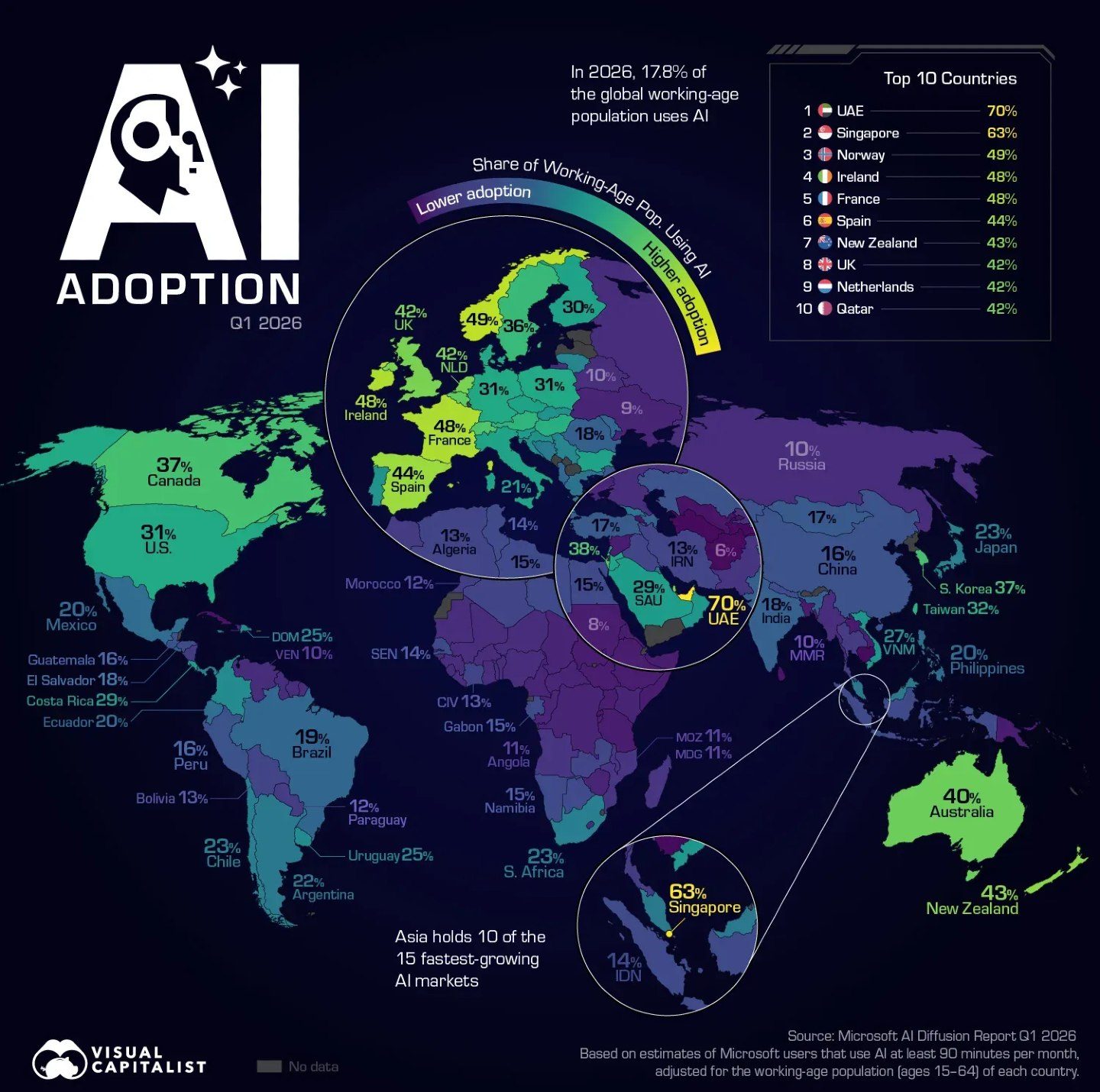
The UAE Leads the World in AI Adoption
In 2026, the United Arab Emirates (UAE) will be at the forefront of AI adoption, with 70% of its working-age adults regularly using AI tools. This remarkable figure positions the UAE as a global leader in integrating AI into daily life. Singapore follows closely with a 63% adoption rate, while the United States trails behind, despite being a pioneer in AI development. Europe also stands out, with 11 of the top 20 AI adoption markets worldwide.
Why This Matters
The rapid adoption of AI tools by working-age adults signifies a transformative shift in how societies interact with technology. This shift is not merely about technological progress; it's about how AI tools are being integrated into everyday life, work practices, and business operations. Understanding these adoption rates helps identify which regions are embracing AI most enthusiastically and why this matters for global economic and social development.
The Global Landscape of AI Adoption
North America: A Mixed Picture
North America presents a mixed landscape. The U.S., often cited as a global leader in AI development, has a moderate adoption rate of 31%. Canada, meanwhile, is doing slightly better with a 37% adoption rate.
Europe's AI Boost
Europe is a significant player in the AI adoption landscape. Countries like Norway (63%), Ireland (48%), France (44%), and Spain (44%) are making significant strides. The UK and the Netherlands both have 42% adoption rates, while Qatar also matches this percentage. This concentrated effort in Europe underscores the region's commitment to leveraging AI for economic and social growth.
Asia's AI Renaissance
Asia holds 10 of the top AI markets. Notable countries include China (16%), Japan (23%), and Taiwan (32%). The Philippines (20%) and South Korea (37%) also show strong adoption rates. The UAE's 18% adoption rate is part of a broader trend in the Middle East, where countries like Saudi Arabia (15%) and Qatar (42%) are also making significant advances.
Latin America: Emerging AI Markets
Latin America shows varying levels of AI adoption. Countries like Australia (40%), South Africa (23%), and Chile (23%) are leading the charge, indicating that even regions traditionally seen as lagging are making strides in AI integration. Countries like Peru (16%) and Brazil (19%) show moderate adoption, while others like Bolivia (13%) and Paraguay (12%) are still in the early stages.
Africa’s AI Initiatives
While Africa as a whole has lower adoption rates, countries like South Africa (23%) and Angola (15%) are making notable progress. This indicates a growing interest in AI across the continent, despite the varied infrastructure and economic challenges.
Practical Tips
Leveraging AI for Business
Businesses aiming to leverage AI should consider the following:
-
Identify Gaps in Efficiency: Look for areas in your business that can benefit from AI-driven automation. This could be customer service, data analysis, or operational efficiency.
-
Invest in Training: Ensure that your workforce is adequately trained to use AI tools. This will help in maximizing the benefits of AI and fostering a culture of innovation.
-
Stay Updated: AI technology is rapidly evolving. Stay updated with the latest trends and tools to ensure you are not left behind.
Adopting AI in Daily Life
For individuals, incorporating AI into daily life can be as simple as:
-
Using AI-Powered Tools: Utilize AI tools for productivity, such as personal assistants, calendar management, and note-taking apps.
-
Embracing AI-Driven Healthcare: Adopt AI-driven health apps and services that can monitor your health, provide medical advice, and even detect potential health issues.
-
Smart Home Technology: Invest in smart home devices that use AI to automate tasks, improve security, and enhance your daily routine.
Important Takeaways
- Global Leaders in AI Adoption: The UAE and Singapore are at the forefront, with high adoption rates.
- Europe's Strong Presence: Europe’s significant contribution to the top AI adoption markets highlights the region’s strategic focus on AI.
- Asia’s Diverse Landscape: Asia includes a mix of high and moderate adoption rates, with Japan and Taiwan leading the charge.
- Emerging Regions: Latin America and Africa are seeing varied but growing levels of AI adoption, indicating a global shift.
Conclusion
The adoption of AI tools by working-age adults is a critical indicator of how societies and economies are evolving. Whether it's in the UAE, Singapore, or any other region, the trend is clear: AI is becoming an integral part of daily life and business operations. Understanding these adoption rates and the factors driving them can help businesses, governments, and individuals make informed decisions about integrating AI into their lives and operations. As we move towards 2026, the world map of AI adoption will continue to evolve, reflecting the dynamic nature of technology and its impact on society.
Watch the Reel
Questions readers ask
Why is the UAE expected to lead in AI adoption by 2026?
The UAE is projected to have 70% of its working-age adults regularly using AI tools by 2026, which is a higher rate than other global leaders like Singapore and the United States. This makes the UAE a significant player in the global AI landscape.
Which countries are also notable for their AI adoption rates by 2026?
Singapore is expected to have 63% of its working-age adults using AI tools, placing it as the second-highest adopter. Europe also shows strong trends, with 11 of the world's top 20 AI adoption markets.
How does the UAE's AI adoption rate compare to the United States?
The UAE is projected to surpass the United States in AI adoption, with 70% of its working-age adults using AI tools compared to the U.S. trailing behind. This is notable because the U.S. is a pioneer in AI development.
What does the high AI adoption rate in the UAE signify?
The high AI adoption rate in the UAE signals a major shift in how societies interact with technology. It indicates that AI tools are becoming integral to daily life, work practices, and business operations in the UAE.
What are the top AI adoption markets in 2026?
While the UAE is expected to lead, by 2026 11 of the top 20 AI adoption markets are located in Europe, highlighting a strong trend in AI usage across the continent.
What can we learn from the global AI adoption map for 2026?
The global AI adoption map for 2026 shows how AI tools are being integrated into everyday life and work in different regions, offering a snapshot of which countries and continents are leading the way in AI implementation.
What is the significance of working-age adults using AI tools regularly?
When 70% of working-age adults in the UAE are regularly using AI tools, it shows a profound shift in societal engagement with technology. It signifies that AI is no longer just a specialized tool, but a fundamental part of daily routines and professional practices.
Related deep dives
Similar reads based on topic and creator.



Recent articles
Fresh deep dives from the latest Reels we unpacked.




Comments
Be the first to comment.