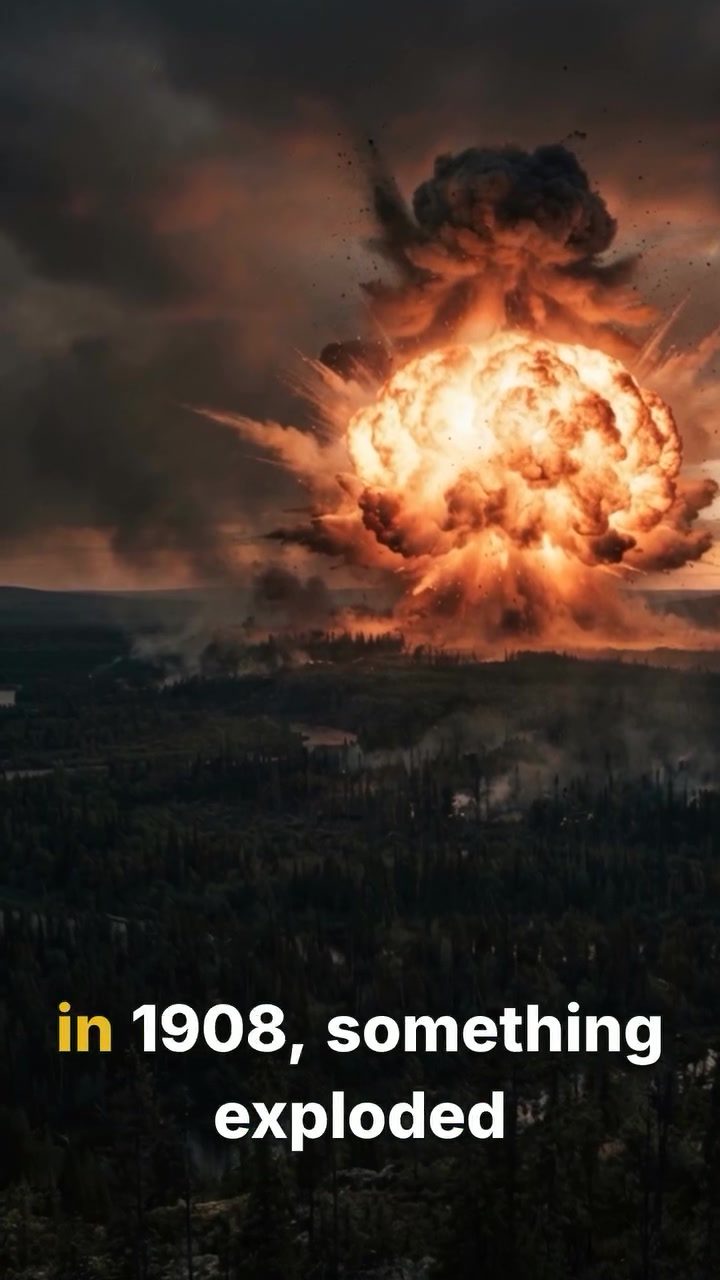
The Tunguska Phenomenon
One of the most enigmatic events of the last century occurred in 1908 in an isolated region of Siberia. An explosive force compared to roughly a thousand Hiroshima bombs detonated over the area, flattening about 80 million trees across 830 square miles. But what was it? Researchers have had puzzles to solve since this explosion. There was no crater, no debris, just sheer devastation that spread across the Siberian landscape. This lack of immediate evidence points to an airborne explosion. Theories about the source of the explosion varied. For decades, scientists debated whether it was a comet or an asteroid that vaporized midair."Some scientist initially favored a comet because they are thought to be made of ice and dust. A comet would certainly vaporize completely in the atmosphere, leaving little to no trace." But a rocky asteroid might create more debris. It was part of the hypothesis that a comet or asteroid disintegrated in the atmosphere, creating such force.
Scientific Debate and Consensus
The 1908 explosion has inspired a long-standing scientific debate, continuing for decades. The eventual consensus leaned towards an asteroid. Most researchers today generally lean toward a rocky asteroid as the origin of the Tunguska event. Astronomer Ernst Opik initially proposed the asteroid theory in 1946. Its heat would have been intense enough to clear the surrounding trees, according to the theory. An asteroid would create a larger and more devastating air blast than a comet, but there was an odd lack of impact material from whatever the object was. How could it lack debris when it required powerful collisions in space? The revelation was that it vaporized before impact, leaving almost no physical evidence behind. A dramatic visual of how comets and asteroids behave.
Unresolved Mysteries Left Behind
Years on, the debate over whether the Tunguska event from a comet or an asteroid impact continues to fuel scientific curiosity. It means researchers can't definitely conclude which object caused the Tunguska impact. The opportunity to study objects like meteors and asteroids is rare. One theory continues to be tested: It vaporized because of its low cohesion or density. That would allow for it to do all that destruction with no evidence afterward. Some researchers also theorize that it could have been a much smaller object. Some think the asteroid disintegration was due to a larger object.
The Research Continues
Despite the majority consensus that the Tunguska Event was caused by an asteroid, the scientific research community continues to explore the topic. This 1908 mysterious event is still part of ongoing research to understand the physical properties of extraterrestrial objects. Understanding the Tunguska Event promises advances in meteor and asteroid monitoring and defense. The implications of preventing a similar event in the future are critical, as the Tunguska event remains a reminder of the unpredictability of extraterrestrial objects. The long-term analysis of this event has driven the scientific community forward, pushing the boundaries of what we know about asteroids. The study of mid-air explosions of space objects also might help us to better understand modern meteor sites.
Watch the Reel
Related deep dives
Similar reads based on topic and creator.

Recent articles
Fresh deep dives from the latest Reels we unpacked.


Comments
Be the first to comment.