Dinosaur Skeleton Auction
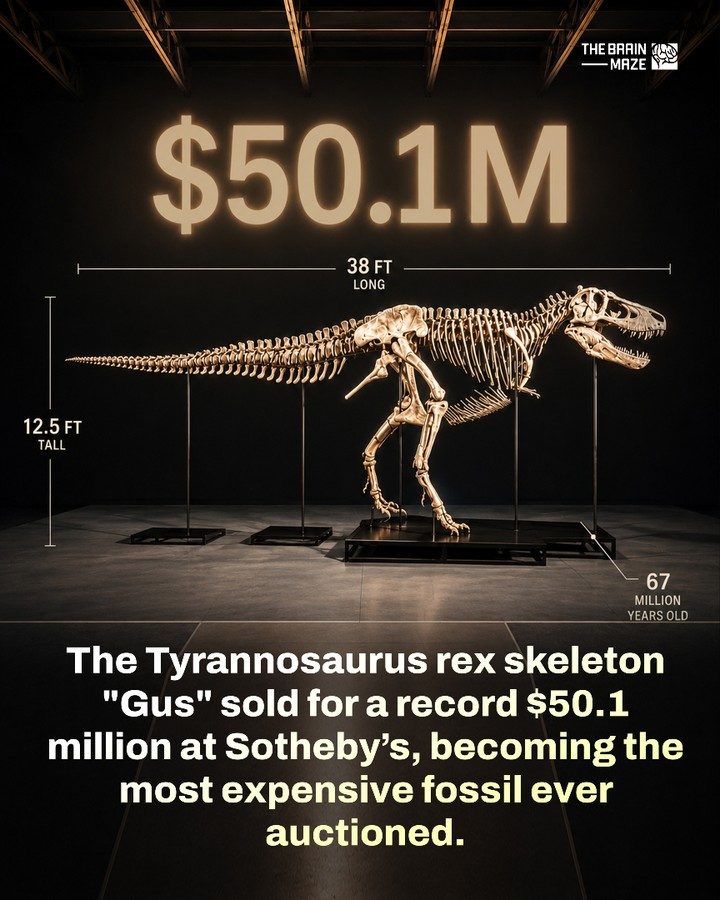
The recent auction of a rare Tyrannosaurus rex skeleton, affectionately named "Gus," at Sotheby's in New York has set a new benchmark in the world of paleontological artifacts. This 67-million-year-old specimen from South Dakota fetched a staggering $50.1 million, making it the most expensive fossil ever sold at auction. At 38 feet long and 12.5 feet tall, Gus is an impressive specimen, with about 61% of its bones intact. Despite its significance and the scientific value it holds, the private sale of Gus has sparked concerns about the accessibility of such important fossils to the public and scientific community.
Fossils tell a story of the world in eras past. They provide significant, concrete data for scientists to study and preserve for future generations. Fossils give insights into the paleontology, and biology of this planet. This data is invaluable in many fields of scientific study. Especially in the field of understanding evolutionary biology. This data can be used to bolster many theories. This data can be used to enhance the possibility to advance the field of medicine. This data can be used to help understand the cause of extinction which can be helpful for the world today. Supporting the preservation and accessibility of fossils like Gus is crucial for the future of scientific research.
Context / Why This Matters
The acquisition of fossils by private collectors can have significant implications for scientific research and public access. When a valuable fossil like Gus is sold to a private collector, there is a risk that it may not be accessible to scientists and the public for study and education. Public institutions, such as museums and universities, often provide a platform for fossils to be studied by researchers and viewed by the public, thereby fostering a broader understanding of paleontology.
Main Discussion
The Science Behind Gus
Gus, the Tyrannosaurus rex skeleton, is more than just a display of prehistoric grandeur. Scientists rely on such fossils to understand the biology and behavior of dinosaurs. The completeness of a fossil, measured by the percentage of bones present, is a crucial factor in its scientific value. Gus, with 61% of its bones intact, offers valuable insights into the anatomy and evolution of the Tyrannosaurus rex. For example, the shape and size of the bones can reveal information about the dinosaur's diet, movement, and even its social structure. Such data is invaluable for researchers studying the Cretaceous period, which spanned from around 145 to 66 million years ago.
The Economic Perspective
The high price tag of $50.1 million for Gus reflects the increasing interest and market demand for rare and complete dinosaur fossils. This sale highlights the economic value of paleontological artifacts, which can fetch enormous sums in auctions. However, the economic aspect also raises questions about the ethical implications of private ownership. Private collectors might not prioritize scientific research or public access, which can limit the broader benefits that fossils like Gus can provide.
Practical Tips for Fossil Collectors
For those interested in acquiring fossils, whether for personal collections or for public institutions, it's important to consider several factors:
- Authenticity and Provenance: Ensure that the fossil is authentic and that its provenance is well-documented to avoid counterfeit or illegally obtained specimens.
- Scientific Value: Assess the completeness and rarity of the fossil, as these factors significantly influence its scientific value.
- Preservation and Conservation: Understand the requirements for preserving and conserving the fossil to maintain its integrity over time.
- Ethical Considerations: Reflect on the broader implications of private ownership, such as access for scientific research and public viewing.
Important Takeaways
The sale of Gus underscores the importance of fossils in scientific research and public education. While private ownership can offer financial benefits to paleontological organizations, it can also limit the broader access and study of these artifacts.
Gus's sale also highlights the growing market for rare and complete dinosaur fossils, underscoring the economic value of paleontological artifacts. However, this economic perspective should be balanced with ethical considerations, such as ensuring scientific research and public access. This discussion suggests that a holistic approach is necessary, integrating economic, scientific, and ethical aspects to preserve the value of fossils.
Conclusion
The record-breaking sale of the Tyrannosaurus rex skeleton Gus at Sotheby's marks a significant milestone in the world of paleontology. While it showcases the impressive size and age of this fossil, it also raises important questions about the impact of private ownership on scientific research and public access. Ensuring the preservation and accessibility of such valuable fossils is crucial for the advancement of scientific knowledge and the benefit of future generations.
Watch the Reel
Questions readers ask
Why was the T. Rex skeleton 'Gus' significant?
Gus is a rare and impressive T. Rex specimen because it is 67 million years old and has 61% of its bones intact, making it a valuable asset for paleontologists and evolutionary biologists. Its size, at 38 feet long and 12.5 feet tall, also makes it a noteworthy specimen.
How much did the Gus T. Rex fossil sell for at auction?
The Gus T. Rex fossil sold for a record-breaking $50.1 million at an auction held by Sotheby's in New York. This price makes it the most expensive fossil ever sold at an auction.
Where does the Gus T. Rex fossil originate from?
The Gus T. Rex fossil originates from South Dakota. This location is significant because it is an area known for its rich fossil history and has yielded many important paleontology discoveries.
What concerns arose from the private sale of the Gus T. Rex fossil?
The private sale of the Gus T. Rex fossil has raised concerns about the accessibility of important fossils to the public and scientific community. Some worry that private ownership may limit the opportunities for researchers to study and learn from such significant specimens.
What insights can the Gus T. Rex fossil offer to scientists?
The Gus T. Rex fossil offers valuable insights into the world during the Cretaceous period (145-66 million years ago). With 61% of its bones intact, Gus can provide important data for scientists studying paleontology and evolutionary biology.
Why was the auction of the Gus T. Rex fossil held at Sotheby's?
The auction of the Gus T. Rex fossil was held at Sotheby's because the company is renowned for handling high-value items, including significant paleontological artifacts. Sotheby's has a history of conducting successful auctions for rare and important fossils and other historical items.
Related deep dives
Similar reads based on topic and creator.




Recent articles
Fresh deep dives from the latest Reels we unpacked.




Comments
Be the first to comment.