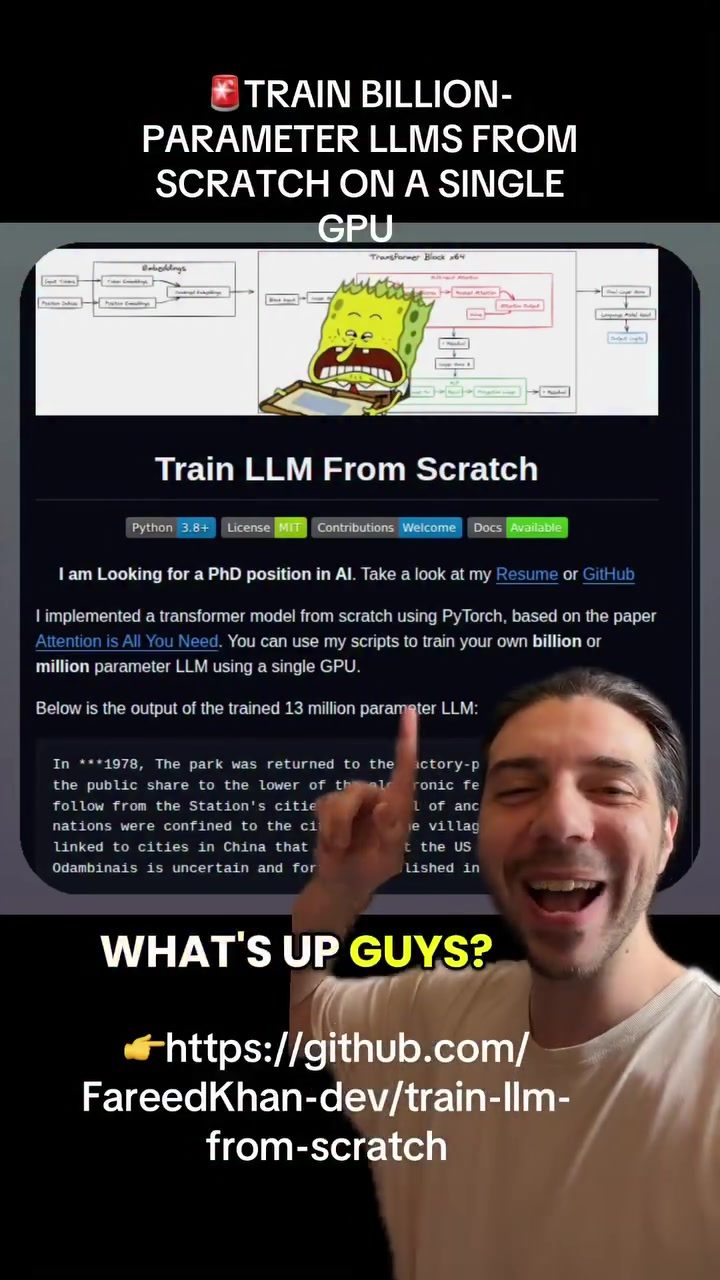
Train Large Language Models from Scratch
Training large language models (LLMs) is a complex process that often requires substantial computational resources. However, recent advancements and open-source projects have made it possible to train LLMs from scratch using consumer hardware. This guide will walk you through the process, highlighting key steps and techniques that can be implemented on a single GPU.
Context / Why This Matters
Training LLMs has traditionally been the domain of well-funded organizations with access to large data centers and extensive computational resources. Large language models, which have billions of parameters, require significant computational power and storage. However, recent developments have shown that it is possible to train these models using consumer-grade hardware. This democratizes access to cutting-edge AI technologies, allowing individual developers and small teams to contribute to the field.
Full GPT-Style Model Training from Scratch
Training a GPT-style model from scratch involves several key components:
Tokenization
Tokenization is the process of breaking down text into smaller units, such as words or subwords. This step is crucial for preparing the data that the model will learn from. The repository includes detailed instructions on how to effectively tokenize text data, ensuring that the model can understand and process the input accurately.
Architecture and Training Loop
The architecture of an LLM refers to the structure and design of the model. This includes the layers, connections, and parameters that make up the model. The training loop is the process by which the model learns from the data. It involves feeding the data into the model, calculating the loss, and updating the model's parameters to minimize the loss. The repository provides a comprehensive guide to setting up the architecture and implementing the training loop, ensuring that the model is trained efficiently and effectively.
Advanced Techniques for Consumer Hardware
Running LLM training on consumer hardware requires optimization to make the most of the available resources. Here are some advanced techniques that can help:
Distributed Training Tricks
Distributed training involves splitting the training process across multiple GPUs or machines. However, even on a single GPU, there are tricks that can optimize the training process. Techniques such as gradient accumulation and mixed-precision training can significantly speed up the training process and reduce memory usage.
Hardware Optimization
Consumer hardware, such as a single GPU, has limited resources compared to data centers. To make the most of these resources, it is essential to optimize the hardware usage. This includes techniques such as batching, where multiple data points are processed at once, and efficient memory management to ensure that the GPU is used effectively.
Open Source and Step-by-Step Explanation
One of the most significant advantages of the repository provided is that it is open source and includes a step-by-step explanation of the entire process. This makes it accessible to developers of all levels, from beginners to experts. The repository covers everything from tokenization to distributed training tricks, ensuring that users have a comprehensive understanding of the process.
License and Contributions
The project is licensed under the MIT License, which allows for free use, modification, and distribution of the code. Contributions are welcome, encouraging a collaborative approach to improving the project. The repository also includes documentation, making it easier for users to understand and utilize the code.
GitHub Repository
All the code and documentation are available on the GitHub repository. This includes the full GPT-style model training from scratch, tokenization, architecture and training loop, and advanced techniques for consumer hardware. You can access the repository here.
Practical Tips
Training LLMs from scratch on consumer hardware can be challenging, but with the right techniques and resources, it is entirely possible. Here are some practical tips to help you get started:
Choose the Right Hardware
While consumer hardware is sufficient, choosing the right GPU can significantly impact the training process. Look for GPUs with a good balance of memory and processing power. Additionally, ensure that your system has enough RAM and a fast storage solution to support the training process.
Optimize Your Data
The quality and quantity of your data play a crucial role in the success of your model. Ensure that your data is well-tokenized and preprocessed. Additionally, consider using data augmentation techniques to increase the size and diversity of your dataset.
Monitor and Debug
Monitoring the training process and debugging issues as they arise is essential. Use tools and techniques such as logging, visualizations, and performance metrics to keep track of the training progress. This will help you identify and address any issues that may arise.
Important Takeaways
Training large language models from scratch on consumer hardware is a complex but achievable task. By following the steps and techniques outlined in the repository, you can train a GPT-style model from scratch using a single GPU. The key takeaways include:
- The importance of tokenization and data preparation.
- The architecture and training loop are crucial components of the model.
- Advanced techniques such as distributed training and hardware optimization can significantly improve the training process.
- The availability of open-source resources and step-by-step explanations makes the process accessible to a wider audience.
Conclusion
With the advancements in hardware and software, training large language models from scratch on consumer hardware has become a reality. The process, while challenging, is made more manageable with the availability of open-source resources and step-by-step explanations. By following the guidelines and techniques outlined in the repository, you can train your own billion-parameter model, contributing to the exciting field of AI and natural language processing.
Watch the Reel
Questions readers ask
What kind of hardware do I need to train LLMs from scratch on a budget?
To train LLMs from scratch on a budget, you'll need a consumer-grade GPU with a significant amount of VRAM, such as an NVIDIA RTX 3080 or better. Additionally, a fast CPU, ample RAM (32GB or more), and sufficient storage (SSD preferred) are essential. Ensure your system is stable and well-ventilated to handle prolonged training sessions.
Can I train LLMs from scratch using just a single GPU?
Yes, it is possible to train LLMs from scratch using a single GPU, although it may take longer and you might need to use a smaller model or dataset. To optimize this, consider using techniques like gradient accumulation and mixed-precision training. You can find specific guidance and open-source projects on GitHub to help you get started.
What is tokenization, and why is it important for LLM training?
Tokenization is the process of breaking down text into smaller pieces, called tokens, that the model can process. It is a crucial step in preparing data for LLM training. Effective tokenization helps the model understand and generate text more accurately. You can use libraries like Hugging Face's Tokenizers or SentencePiece to implement tokenization.
How can small teams or individual developers train LLMs without extensive resources?
Small teams or individual developers can train LLMs by leveraging consumer hardware, optimizing models and datasets for smaller scales, and utilizing open-source projects. Additionally, employing techniques like gradient checkpointing, model parallelism, and knowledge distillation can help manage resource constraints during training.
What are some open-source projects that can help in training LLMs on consumer hardware?
There are several open-source projects that facilitate LLM training on consumer hardware. Notable examples include the Hugging Face Transformers library, which provides pre-trained models and tools for fine-tuning. Additionally, projects like TinyStories and The Pile offer datasets and models optimized for consumer-grade hardware.
Related deep dives
Similar reads based on topic and creator.


Recent articles
Fresh deep dives from the latest Reels we unpacked.




Comments
Be the first to comment.