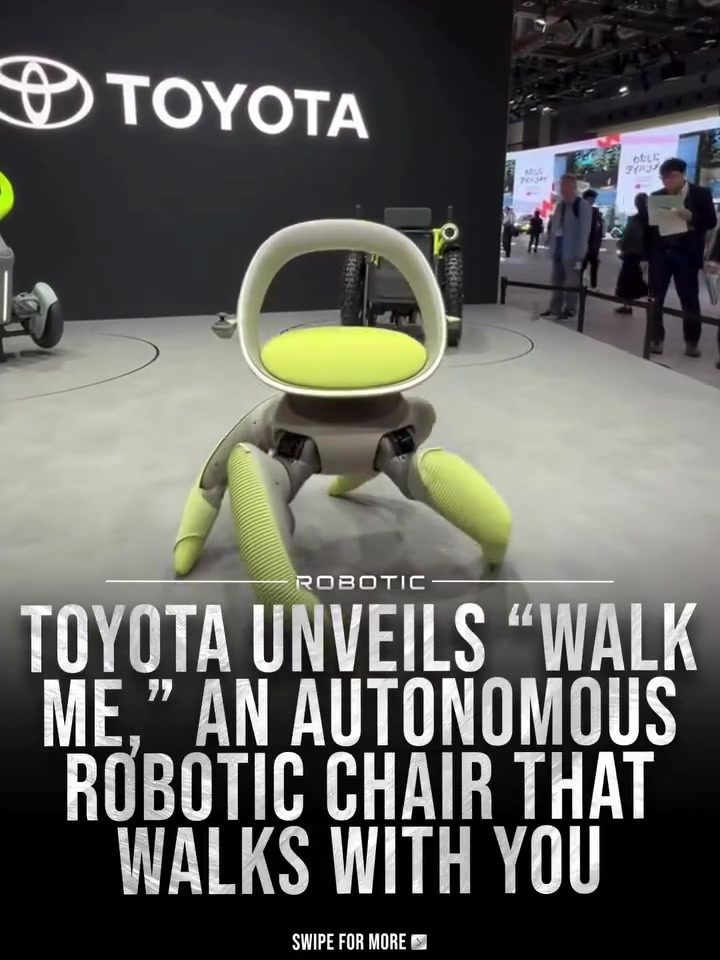
Walk Me: Toyota's Autonomous Robotic Chair
The Toyota Walk Me is a revolutionary four-legged robotic mobility chair designed to navigate challenging terrains that traditional wheelchairs often struggle with. This innovative chair uses a sophisticated system of independently moving robotic legs to handle uneven surfaces, including stairs, slopes, and rough terrain. Equipped with advanced sensors, it can interpret its surroundings and maintain stability while in motion, offering new possibilities for accessible mobility.
Context / Why this Matters
Mobility challenges are common for many individuals, whether due to age, injury, or other physical limitations. Traditional wheelchairs, while effective on smooth surfaces, face significant limitations on uneven or steep terrain. The Walk Me chair addresses these limitations by incorporating legged robotics, a technology that allows for adaptability and stability in a variety of environments. This innovation could revolutionize the way people with mobility issues navigate the world, offering greater freedom and independence.
Main Discussion
Innovations in Mobility
The Walk Me chair represents a significant leap in mobility technology. Traditional wheelchairs are designed for flat, predictable surfaces, but real-world environments are rarely so simple. Walk Me's four-legged design, inspired by legged robotics, allows it to adapt to a wide range of terrains. This includes navigating stairs, crossing slopes, and maneuvering through rough, uneven surfaces that would be impossible for a standard wheelchair.
Design and Engineering
Toyota's Walk Me chair is powered by electric motors that drive its four legs. These motors provide the chair with the ability to move smoothly and efficiently, even in complex environments. The chair's advanced sensors play a critical role in its operation. These sensors allow the chair to interpret its surroundings, ensuring that it maintains balance and stability while in motion. This technology is particularly important when navigating uneven surfaces, where stability is crucial.
Real-World Applications
The Walk Me chair has the potential to significantly improve the quality of life for individuals with mobility challenges. In the current design, the Walk Me chair features the ability to navigate stairs, a common obstacle for wheelchair users. By providing a reliable and stable means of navigating these challenges, the Walk Me chair could offer greater independence and freedom for users. This technology could also be beneficial in other areas, such as healthcare and rehabilitation, where mobility assistance is crucial.
Sensors and Stabilization
The Walk Me chair's sensors are essential for its functionality. They provide real-time data on the chair's surroundings, allowing it to adapt to the environment in real-time. This is particularly important when navigating uneven surfaces, where stability is critical. The sensors work in conjunction with the chair's electric motors to ensure smooth and stable movement, even on challenging terrain.
Practical Tips
Utilizing Walk Me in Everyday Life
For individuals considering the Walk Me chair, it’s important to understand its practical applications. The chair is designed to be used in a variety of environments, from urban settings to outdoor spaces. Its ability to navigate stairs and uneven terrain makes it a versatile option for those who need to move through different types of terrain.
Maintenance and Care
Like any advanced piece of technology, the Walk Me chair requires regular maintenance to function optimally. Regularly checking the chair’s sensors and motors can help ensure that it operates smoothly. Additionally, understanding the chair’s features and limitations can help users get the most out of their device.
Safety Considerations
Safety is a primary concern when using mobility devices. The Walk Me chair is designed with advanced sensors that help it navigate and stabilize in various environments. However, users should still be cautious when using the chair, especially in unfamiliar or complex environments. Always follow the manufacturer’s guidelines and safety instructions to ensure optimal and safe use.
Important Takeaways
Enhancing Mobility
The Walk Me chair represents a significant advancement in mobility technology. Its innovative design and advanced sensors make it a versatile and reliable option for individuals with mobility challenges. By providing the ability to navigate a wide range of terrains, the Walk Me chair can greatly enhance users' independence and freedom.
Potential Impact
The Walk Me chair has the potential to revolutionize the way people with mobility issues navigate the world. Its ability to handle uneven surfaces and stairs makes it a valuable tool for those who need to move through different types of terrain. This technology could also have applications in healthcare and rehabilitation, where mobility assistance is crucial.
Future Innovations
The Walk Me chair is just the beginning of what could be a new era in mobility technology. As legged robotics continues to evolve, we can expect to see even more innovative solutions that enhance mobility and independence for individuals with physical limitations.
Conclusion
The Toyota Walk Me chair is a groundbreaking innovation in mobility technology. Its four-legged design, powered by electric motors and advanced sensors, allows it to navigate a variety of terrains with ease. This makes it a valuable tool for individuals with mobility challenges who need to move through different types of environments. By providing greater independence and freedom, the Walk Me chair could significantly improve the quality of life for many people. As legged robotics continues to advance, we can expect to see even more innovative solutions that enhance mobility and accessibility for all.
Watch the Reel
Questions readers ask
How does the Toyota Walk-Me differ from traditional wheelchairs?
The Toyota Walk-Me differs from traditional wheelchairs in its design and functionality. It features four independently moving robotic legs, allowing it to tackle uneven surfaces, stairs, and slopes, while standard wheelchairs are typically limited to smooth, flat surfaces.
What technology enables the Toyota Walk-Me to navigate challenging terrains?
The Toyota Walk-Me uses a sophisticated system of sensors and motors to interpret its environment and maintain stability. This advanced technology allows it to handle rough terrain, slopes, and stairs with ease, providing greater accessibility for users.
Can the Toyota Walk-Me operate autonomously?
Yes, the Toyota Walk-Me is designed to operate autonomously. It can interpret its surroundings and navigate challenging terrains without constant manual control, offering users new possibilities for navigational freedom.
Who can benefit from using the Toyota Walk-Me?
The Toyota Walk-Me is beneficial for individuals who face mobility challenges due to age, injury, or other physical limitations. It provides a solution for those who need to navigate tough terrains that traditional wheelchairs cannot handle.
What types of terrains can the Toyota Walk-Me handle?
The Toyota Walk-Me is designed to handle a variety of challenging terrains, including stairs, slopes, and rough ground. Its advanced sensor and motor system enables it to maintain stability and navigate these surfaces effectively.
How does the Toyota Walk-Me enhance accessibility?
The Toyota Walk-Me enhances accessibility by allowing users to navigate environments that are typically inaccessible to standard wheelchairs. Its ability to handle uneven and steep terrains opens up new opportunities for users to move freely and independently.
What are the key features of the Toyota Walk-Me's design?
The key features of the Toyota Walk-Me's design include its four-legged structure, advanced sensor system, and independently moving robotic legs. These components work together to provide stability and mobility on challenging terrains, making it a unique and innovative mobility solution.
Related deep dives
Similar reads based on topic and creator.



Recent articles
Fresh deep dives from the latest Reels we unpacked.




Comments
Be the first to comment.