The Most Spoken Languages in 2025
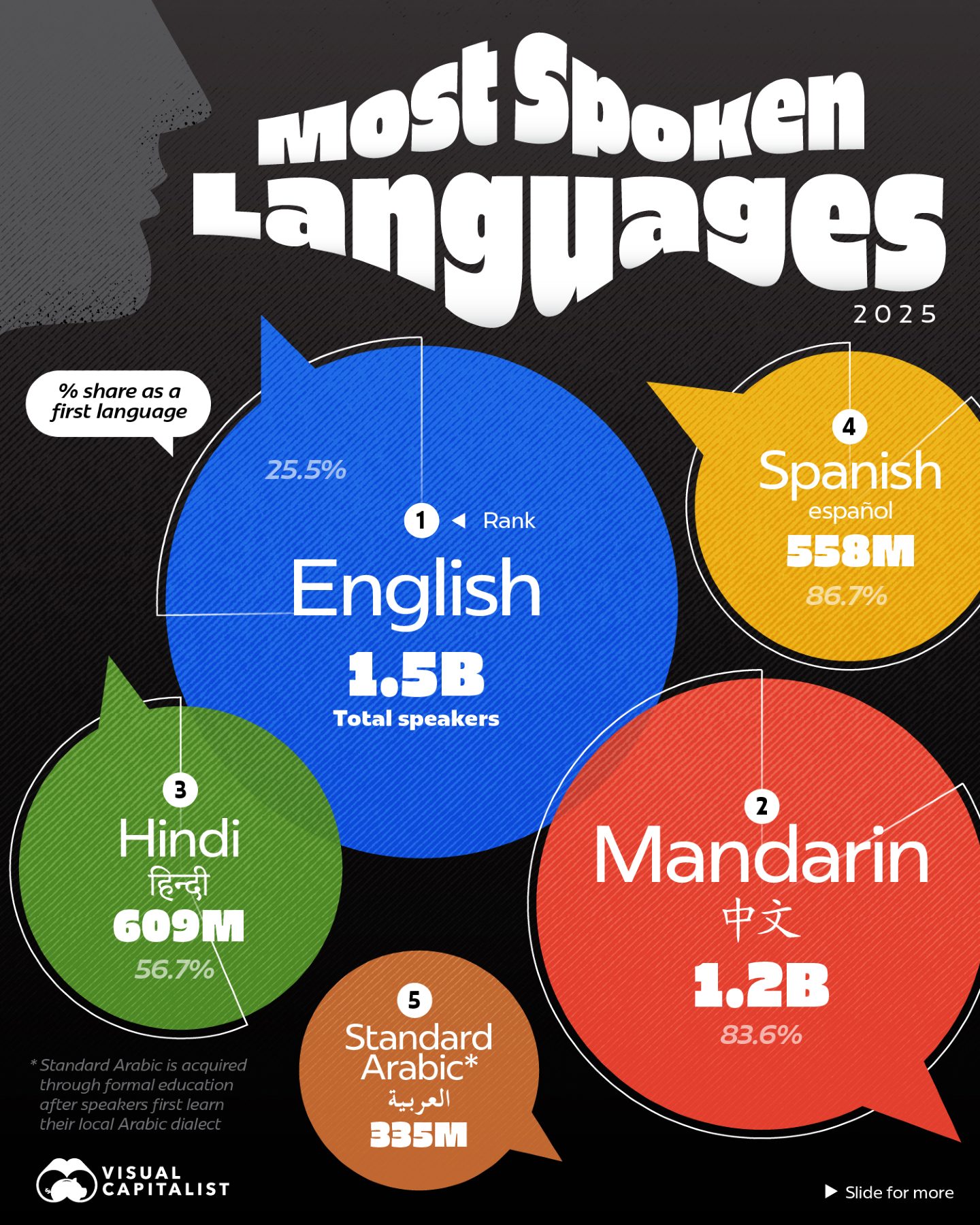
English remains the most spoken language globally, with an estimated 1.5 billion speakers. Mandarin follows closely with over 1.2 billion speakers, while Hindi, Spanish, and Standard Arabic round out the top five. This ranking is based on data from Ethnologue, a comprehensive reference work cataloging all of the world's known living languages. But why does this matter, and what are the implications of these linguistic trends?
Context / Why this matters
Language is more than just a means of communication; it is a reflection of culture, history, and global influence. Understanding the most spoken languages can provide insights into trends in global communication, education, and cultural exchange. As we look towards 2025, these linguistic trends will shape various aspects of society, from international business to diplomacy and technology.
The top five most spoken languages in 2025
1. English
English is the undisputed leader, with a staggering 1.5 billion speakers. This dominance can be attributed to several factors, including the historical spread of the British Empire, the influence of the United States, and the global reach of English-language media and the internet. English is often the lingua franca in international business, science, and technology, making it a crucial language for anyone looking to succeed on the global stage.
2. Mandarin
Mandarin, with over 1.2 billion speakers, is a close second. The sheer number of speakers is a testament to China's rising global influence. As China continues to grow economically and politically, Mandarin is becoming increasingly important in international relations, trade, and cultural exchange. Learning Mandarin can open doors to new opportunities, particularly in areas like technology, manufacturing, and finance.
3. Hindi
Hindi, with approximately 609 million speakers, is the third most spoken language. India's vast population and its growing influence in the global economy make Hindi an essential language to consider. As India continues to rise as a major player in technology, healthcare, and international business, the demand for Hindi speakers will likely increase.
4. Spanish
Spanish, with around 558 million speakers, is another major global language. The widespread use of Spanish in North and South America, as well as in parts of Europe and Africa, makes it a critical language for communication and commerce. The influence of Spanish-speaking countries in international organizations and cultural exports further solidifies its importance.
5. Standard Arabic
Standard Arabic, with 335 million speakers, is a key language in the Middle East and North Africa. Beyond its religious significance, Arabic is also important for business, diplomacy, and cultural exchange in the region. As the Middle East continues to develop economically and politically, the demand for Arabic speakers will remain high.
Beyond the top five
While the top five languages dominate the global linguistic landscape, many other languages are also significant. Bengali, Portuguese, Russian, Urdu, German, Japanese, Indonesian, Egyptian Arabic, Marathi, Vietnamese, Hausa, Turkish, Western Punjabi, Telugu, Swahili, Tagalog, Tamil, and Yue Chinese each have substantial speaker bases. These languages play crucial roles in their respective regions and are increasingly important in global communication and commerce.
Bengali
Bengali, with over 234 million speakers, is primarily spoken in Bangladesh and the Indian state of West Bengal. It is a significant language in South Asia and plays a crucial role in the region's cultural and economic landscape.
Portuguese
Portuguese, with around 230 million speakers, is prevalent in Portugal, Brazil, and several African countries. It is a key language for business and cultural exchange, particularly in the context of the growing economic ties between Brazil and other Portuguese-speaking nations.
Russian
Russian, with approximately 167 million speakers, is widely spoken in Russia and several former Soviet republics. It is a significant language in international politics, science, and technology, and is often used as a lingua franca in some regions.
Urdu
Urdu, with around 166 million speakers, is the national language of Pakistan and is widely spoken in India. It is an essential language in South Asia, with significant cultural and historical importance.
German
German, with approximately 135 million speakers, is a major language in Europe. It is crucial for business, science, and technology, particularly in sectors like engineering, manufacturing, and automotive.
Japanese
Japanese, with around 130 million speakers, is primarily spoken in Japan. It is a vital language for business, technology, and cultural exchange, particularly in the context of Japan's significant influence in global markets.
Practical Tips
Learning one of the world's most spoken languages can open up numerous opportunities. Here are some practical tips for language learners:
Set Clear Goals
Start by defining what you hope to achieve with your language learning. Are you aiming for basic conversational skills, fluency, or proficiency in a specific field? Clear goals can help you stay motivated and focused.
Use Immersion Techniques
Immerse yourself in the language as much as possible. This can include watching movies, listening to music, reading books, and engaging with native speakers. The more you expose yourself to the language, the faster you will learn.
Practice Regularly
Consistency is key in language learning. Dedicate a specific amount of time each day to practice, whether it's through structured lessons, apps, or conversational practice.
Engage with Native Speakers
There's no better way to improve your language skills than by practicing with native speakers. Join language exchange programs, attend language meetups, or find a language partner online.
Utilize Technology
Take advantage of the numerous language learning apps and platforms available. Tools like Duolingo, Babbel, and Rosetta Stone can provide structured learning paths and interactive exercises.
Important Takeaways
Understanding the most spoken languages in 2025 provides valuable insights into global communication and cultural trends. English, Mandarin, Hindi, Spanish, and Standard Arabic are the top five, but many other languages also play significant roles. Learning one of these languages can open up new opportunities in various fields, from business and technology to international relations and cultural exchange.
Conclusion
The linguistic landscape of 2025 is diverse and dynamic, with English, Mandarin, Hindi, Spanish, and Standard Arabic leading the way. However, the significance of other languages like Bengali, Portuguese, Russian, Urdu, German, and Japanese cannot be overlooked. Whether for personal growth, career advancement, or cultural enrichment, learning a widely spoken language can be a rewarding endeavor. Embrace the diversity of languages and open yourself up to a world of new possibilities.
Watch the Reel
Questions readers ask
What is the estimated number of English speakers in 2025?
By 2025, English is projected to have over 1.5 billion speakers. This makes it the most spoken language globally, emphasizing its importance in international communication and cultural exchange.
Why is Mandarin considered one of the most influential languages in 2025?
Mandarin is expected to have over 1.2 billion speakers in 2025. This significant number reflects China's growing global influence, making Mandarin a key language for global business, technology, and cultural understanding.
Which languages are the top five most spoken languages in 2025?
The top five most spoken languages in 2025 are English, Mandarin, Hindi, Spanish, and Standard Arabic, according to data from Ethnologue. These languages shape global trends and reflect the influence of major economies and cultures.
What trends can be inferred from the most spoken languages in 2025?
The prevalence of English and Mandarin indicates the growing significance of these languages in global communication, business, and cultural exchange. The prominence of Hindi, Spanish, and Arabic highlights the increasing influence of South Asia, Latin America, and the Middle East, respectively.
Why is it beneficial to learn the top languages to learn in 2025?
Learning the top languages of 2025, such as English, Mandarin, Hindi, Spanish, and Arabic, can open doors to new opportunities in business, travel, and cultural understanding. These languages are pivotal in global communication, enabling individuals to connect with a broader range of people and markets.
What are some of the implications of the most spoken languages in 2025?
The dominance of certain languages in 2025 underscores the importance of multilingualism in a connected world. It highlights the need for language learning, translation services, and cultural sensitivity in various fields, from business to diplomacy.
How are global language trends expected to impact cultural exchange in 2025?
The global language trends in 2025 will likely enhance cultural exchange by facilitating better communication and understanding among diverse populations. As more people speak common languages, it becomes easier to share ideas, collaborate on projects, and appreciate different cultures.
Related deep dives
Similar reads based on topic and creator.

Recent articles
Fresh deep dives from the latest Reels we unpacked.




Comments
Be the first to comment.