The Space Economy: Projected Growth and Key Sectors by 2035
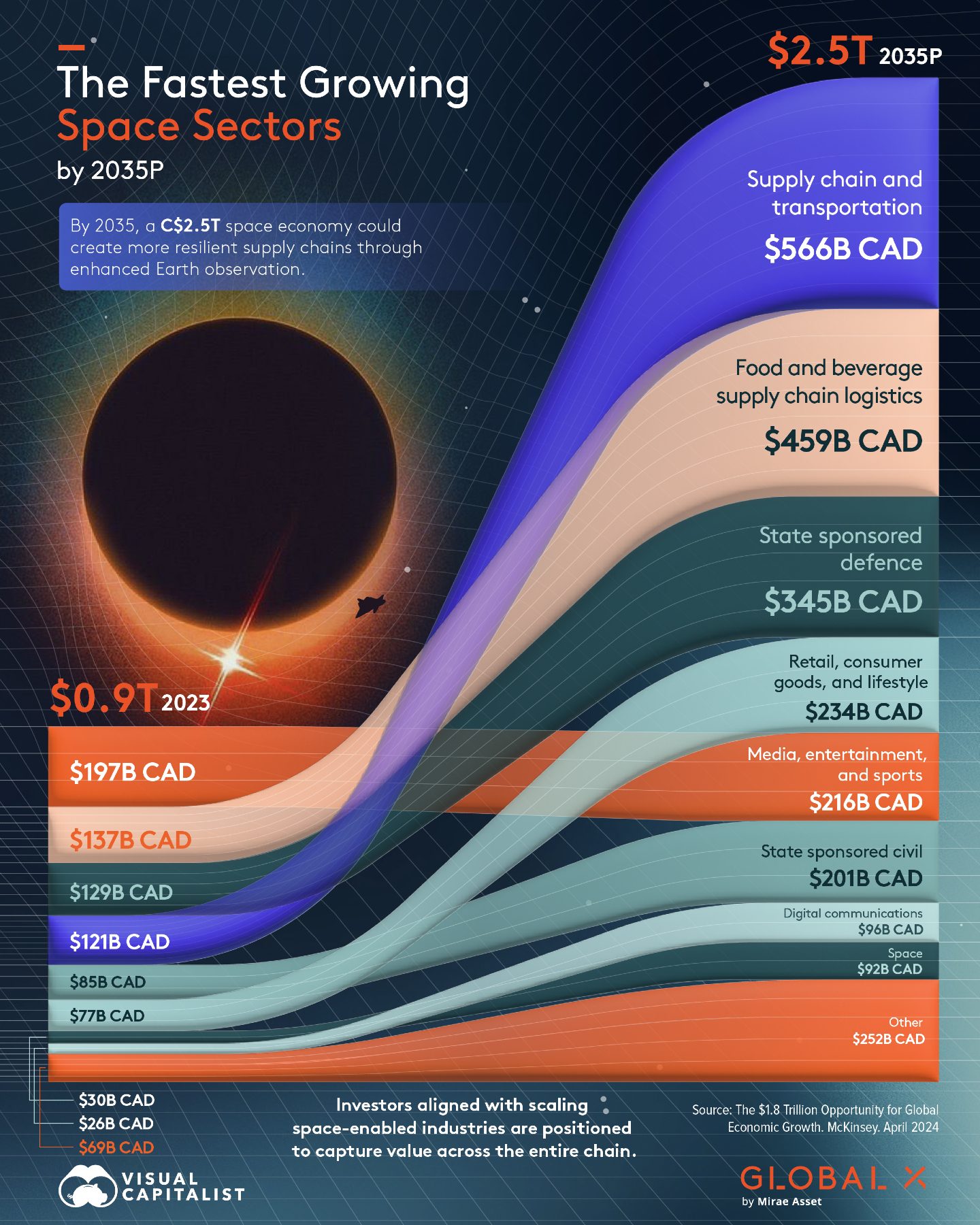
The space economy is projected to reach a staggering C$2.5 trillion by 2035, driven by significant growth in sectors such as supply chains, food, and defense. This expansion is not just a speculative trend but a calculated projection backed by robust data from renowned sources like McKinsey. Understanding the dynamics and potential of this growth is crucial for investors, policymakers, and businesses aiming to capitalize on the opportunities it presents. This article delves into the fastest-growing space sectors by 2035, highlighting their market values and the strategic potential for investors.
Why this Matters
As the space economy continues to evolve, it is becoming increasingly clear that it is more than just a niche market. The projected growth to C$2.5 trillion by 2035 underscores the immense economic potential of space-enabled industries. The sectors leading this growth—supply chains, food, and defense—represent diverse and critical areas of the global economy, each with its own set of challenges and opportunities. For investors and businesses, understanding these sectors can provide a roadmap for strategic investment and innovation.
Key Growth Areas in the Space Economy
Supply Chain and Transportation
The supply chain and transportation sector is poised to be one of the fastest-growing areas within the space economy by 2035, with an estimated market value of C$566 billion. This sector encompasses logistics, warehouse management, and transportation services that leverage space technologies to enhance efficiency and reliability. Satellite-based navigation systems, for instance, enable precise tracking and management of supply chains globally.
Key factors driving this growth include:
- Increased Demand for Global Connectivity: As businesses expand their operations globally, the need for reliable and efficient supply chain management becomes paramount. Space technologies provide the necessary tools to achieve this.
- Technological Advancements: Innovations in satellite technology and data analytics are transforming traditional supply chain operations. These advances enable real-time monitoring, predictive maintenance, and optimized routing, leading to significant cost savings and improved service levels.
- Enhanced Security: The integration of space-based surveillance and security systems ensures the safety and integrity of supply chains, reducing the risk of theft, damage, and delays.
Food and Beverage Supply Chain Logistics
The food and beverage sector is another critical area within the space economy, with a projected market value of C$459 billion by 2035. This sector benefits significantly from space technologies that enhance food production, distribution, and logistics. For instance, satellite imagery is used to monitor crop health and soil conditions, enabling farmers to make data-driven decisions and optimize yields.
Key growth drivers in this sector include:
- Precision Agriculture: The use of satellite data and remote sensing technologies allows for precise monitoring and management of agricultural operations, leading to improved crop yields and resource efficiency.
- Supply Chain Optimization: Space-enabled logistics solutions, such as real-time tracking and predictive analytics, ensure the efficient delivery of perishable goods, reducing waste and enhancing food security.
- Sustainability: Innovations in space technologies support sustainable farming practices, such as water management and soil conservation, contributing to a more resilient and sustainable food supply chain.
Retail, Consumer Goods, and Lifestyle
The retail sector, which includes consumer goods and lifestyle products, is projected to reach a market value of C$234 billion by 2035. Space technologies play a crucial role in this sector by enhancing supply chain management, customer insights, and marketing strategies. Satellite-based communications and data analytics enable retailers to gain valuable insights into consumer behavior, optimize inventory management, and deliver personalized shopping experiences.
Key factors contributing to this growth are:
- Enhanced Customer Insights: Advanced analytics and data-driven marketing strategies help retailers better understand consumer preferences and behaviors, enabling them to tailor their offerings and improve customer satisfaction.
- Improved Supply Chain Efficiency: Space technologies facilitate real-time tracking and management of inventory, ensuring that products are available when and where they are needed, and reducing the risk of stockouts or overstocking.
- Innovative Marketing and Advertising: Space-enabled platforms and technologies enable retailers to reach a global audience with targeted and personalized marketing campaigns, driving brand awareness and sales growth.
Media, Entertainment, and Sports
The media, entertainment, and sports sector is projected to grow to C$216 billion by 2035. This sector benefits from space technologies that enhance content distribution, broadcasting, and audience engagement. Satellite communications and data analytics enable media companies to deliver high-quality content globally, and satellite-based navigation systems support the logistics of large-scale events and productions.
Key growth drivers in this sector include:
- Global Content Distribution: Satellite communications enable the seamless delivery of multimedia content to audiences worldwide, ensuring high-quality streaming and broadcasting services. This global reach expands the market for media and entertainment products and services.
- Data-Driven Insights: Advanced analytics and data-driven marketing strategies help media companies understand audience preferences and behaviors, enabling them to create targeted and personalized content.
- Technological Innovations: Innovations in satellite technology, such as high-resolution imaging and real-time streaming, enhance the quality and accessibility of media and entertainment products, driving audience engagement and growth.
Defense and Civil
The defense and civil sectors, with projected market values of C$345 billion and C$92 billion respectively, are critical components of the space economy. These sectors leverage space technologies to enhance national security, civil infrastructure, and public services. Satellites provide essential data for defense operations, such as surveillance and reconnaissance, and support public services, such as telecommunications and disaster management.
Key growth factors in this sector include:
- Enhanced National Security: Space-based surveillance and reconnaissance systems provide critical intelligence that supports defense operations and national security. This includes monitoring borders, detecting threats, and coordinating military operations.
- Public Services and Infrastructure: Satellite communications and data analytics enhance public services, such as telecommunications, disaster management, and emergency response. This ensures reliable and efficient public services, improving public safety and well-being.
- Innovative Technologies: Advances in satellite technology, such as high-resolution imaging and real-time data transmission, support defense and civil operations, enhancing their effectiveness and efficiency.
Digital Communications
Digital communications are projected to reach a market value of C$201 billion by 2035. This sector benefits from space technologies that enhance connectivity, data transmission, and global communications. Satellites provide the backbone for global communication networks, enabling seamless connectivity and data exchange across the globe.
Key factors driving growth in this sector include:
- Global Connectivity: Satellite communications ensure reliable and high-speed connectivity, enabling businesses and individuals to communicate and collaborate globally.
- Data Security and Privacy: Space-based communications provide secure and encrypted data transmission, protecting sensitive information and ensuring data privacy.
- Innovative Solutions: Advances in satellite technology, such as low-earth-orbit (LEO) satellites and 5G networks, enhance connectivity and data transmission capabilities, driving growth and innovation in the digital communications sector.
Practical Tips for Investors
For investors looking to capitalize on the growing space economy, here are some practical tips:
- Diversify Investments: Consider investing in a diverse range of sectors within the space economy to spread risk and maximize returns. Key sectors to focus on include supply chain and transportation, food and beverage, retail, media, defense, and digital communications.
- Stay Informed: Keep up to date with the latest developments and trends in the space economy. This includes technological advancements, market trends, and regulatory changes that may impact investment opportunities.
- Partner with Experts: Collaborate with industry experts and consultants who have specialized knowledge in the space economy. Their insights and expertise can help identify promising investment opportunities and navigate the complexities of the market.
- Leverage Data and Analytics: Utilize data-driven insights and analytics to inform investment decisions. Advanced analytics can provide valuable insights into market trends, consumer behaviors, and investment opportunities, helping to optimize returns and minimize risks.
Important Takeaways
The projected growth of the space economy to C$2.5 trillion by 2035 presents a significant opportunity for investors and businesses. Key sectors such as supply chain and transportation, food and beverage, retail, media, defense, and digital communications are poised for rapid growth, driven by innovative technologies and increasing global demand. For investors, understanding these sectors and leveraging data-driven insights can help identify promising opportunities and maximize returns.
Conclusion
The space economy is on an upward trajectory, with a projected market value of C$2.5 trillion by 2035. As sectors like supply chains, food, and defense lead the way, investors and businesses have a unique opportunity to capitalize on this growth. By staying informed, diversifying investments, partnering with experts, and leveraging data and analytics, investors can position themselves to capture value across the entire space economy chain. The future of the space economy is bright, and those who embrace its potential are well-positioned to reap the benefits of this dynamic and rapidly evolving market.
Watch the Reel
Related deep dives
Similar reads based on topic and creator.


Recent articles
Fresh deep dives from the latest Reels we unpacked.




Comments
Be the first to comment.