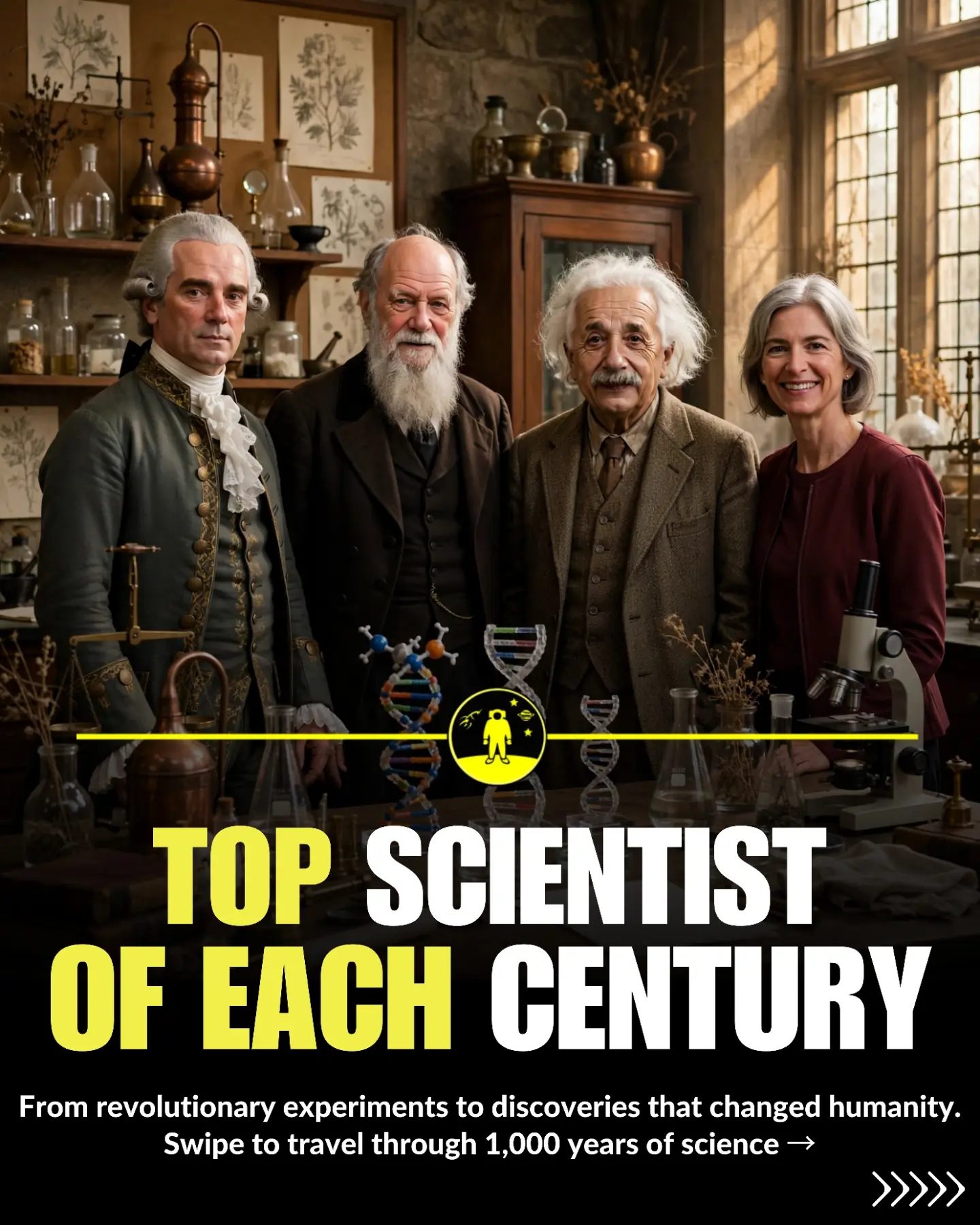
Top Scientists of Each Century
Science is a journey fueled by curiosity, bravery, and the relentless pursuit of discovery. This historical journey has produced remarkable thinkers who challenged conventional wisdom, posed difficult questions, and expanded humanity's understanding of the cosmos. Their discoveries have shaped the world we live in today. From the pioneering work of Ibn al-Haytham on light and vision to the groundbreaking mechanical inventions of Al-Jazari, early scientists laid the foundations for modern experimentation and engineering. Mathematicians and astronomers like Nasir al-Din al-Tusi and Nicole Oresme paved the way for future breakthroughs, while artists like Leonardo da Vinci merged artistry with scientific inquiry. Nicolaus Copernicus revolutionized our view of the cosmos by placing the Sun at the center of the planetary system, marking a pivotal moment in scientific history.
The Scientific Revolution accelerated with Isaac Newton's laws of motion and gravity, followed by Antoine Lavoisier's transformation of chemistry into a quantitative science. Charles Darwin reshaped biology with the theory of evolution by natural selection, and Albert Einstein revolutionized physics through relativity and his explanation of the photoelectric effect. Today, Jennifer Doudna's pioneering work on CRISPR gene editing is opening entirely new frontiers in medicine and biotechnology.
Each of these figures, among many others, has made extraordinary contributions to science. Their work serves as a reminder that scientific progress begins with the courage to question what we think we know.
Why This Matters
The study of top scientists from each century provides valuable insights into the evolution of human knowledge and the development of scientific methodologies. By understanding the contributions of these remarkable individuals, we gain a deeper appreciation for the cumulative nature of scientific advancement. Each discovery builds upon the foundations laid by previous generations, highlighting the interconnectedness of scientific progress.
Notable Scientists and Their Contributions
Early Innovators
The early centuries of scientific discovery were marked by groundbreaking work that set the stage for modern science. Ibn al-Haytham, often referred to as the "father of optics," made significant contributions to the understanding of light and vision. His experiments and theories laid the groundwork for modern optics and influenced disciplines as diverse as astronomy, physics, and art.
Al-Jazari, an engineer and inventor from the 12th and 13th centuries, is recognized for his ingenious mechanical inventions. His work on automata, water clocks, and other mechanical devices showcased the potential of engineering and technology, laying the groundwork for modern engineering practices.
Nasir al-Din al-Tusi, a Persian polymath from the 13th century, made significant contributions to mathematics, astronomy, and philosophy. His work on trigonometry and the improvement of astronomical instruments paved the way for future advancements in these fields.
14th Century: Nicole Oresme
Nicole Oresme, a 14th-century scholar, is renowned for his work in mathematics and physics. He used mathematics to describe motion and developed combustion coordinate graphs centuries before modern analytical geometry. His contributions to the understanding of motion and the development of mathematical tools for describing it were groundbreaking for his time and laid the groundwork for future scientific advancements.
18th Century: Antoine Lavoisier
Antoine Lavoisier, often called the "Father of Modern Chemistry," made significant contributions to the field of chemistry. He helped explain combustion, identified the role of oxygen, and established the law of conservation of mass. His work transformed chemistry into a quantitative science, providing a solid foundation for modern chemical theories and practices.
The Scientific Revolution and Beyond
The Scientific Revolution, which spanned the 16th and 18th centuries, marked a profound shift in scientific thinking. Isaac Newton's laws of motion and gravity provided a comprehensive framework for understanding the physical world. His work on optics, calculus, and the laws of motion laid the groundwork for modern physics and mathematical sciences.
Antoine Lavoisier's contributions to chemistry were equally transformative. He introduced the concept of elements and compounds, developed the modern system of chemical nomenclature, and established the law of conservation of mass. His work provided a solid foundation for the development of modern chemistry.
Modern Breakthroughs
The 19th and 20th centuries saw a continuation of groundbreaking scientific discoveries. Charles Darwin's theory of evolution by natural selection reshaped the field of biology, providing a comprehensive explanation for the diversity of life on Earth. His work on the origin of species and natural selection laid the groundwork for modern evolutionary biology.
Albert Einstein's theories of relativity and his explanation of the photoelectric effect transformed our understanding of the physical world. His work on the theory of relativity provided a new framework for understanding space, time, and gravity, while his explanation of the photoelectric effect laid the groundwork for the development of quantum mechanics.
Jennifer Doudna and CRISPR Gene Editing
In recent years, Jennifer Doudna's pioneering work on CRISPR gene editing has opened new frontiers in medicine and biotechnology. CRISPR technology allows for precise editing of DNA, enabling scientists to correct genetic mutations, develop new treatments for genetic diseases, and even create new biological systems. Her discoveries have the potential to revolutionize medicine and biotechnology, offering new hope for treating and preventing a wide range of diseases.
Practical Tips for Aspiring Scientists
For those inspired by the achievements of these remarkable scientists, there are several practical tips to keep in mind:
-
Cultivate Curiosity: The key to scientific discovery is a deep and insatiable curiosity about the world around us. Ask questions, explore new ideas, and never stop learning.
-
Embrace Collaboration: Scientific breakthroughs often occur through collaboration. Work with others, share your ideas, and learn from the insights of your peers.
-
Stay Updated: The world of science is constantly evolving. Stay updated with the latest research, attend conferences, and read scientific literature to stay aware of new developments in your field.
-
Develop a Strong Foundation: Build a solid foundation in mathematics, physics, and other relevant fields. A strong theoretical background is essential for making significant contributions to science.
-
Pursue Passion: Choose a field of study that you are passionate about. Passion is the driving force behind scientific discovery, and it will keep you motivated and inspired throughout your journey.
Important Takeaways
The study of top scientists from each century offers valuable insights into the evolution of human knowledge and the development of scientific methodologies. From the pioneering work of Ibn al-Haytham and Al-Jazari to the groundbreaking contributions of Nicole Oresme and Antoine Lavoisier, each scientist has played a crucial role in shaping our understanding of the world. The Scientific Revolution, marked by the work of Isaac Newton and Antoine Lavoisier, provided a comprehensive framework for modern science. The contributions of Charles Darwin, Albert Einstein, and Jennifer Doudna have transformed our understanding of biology, physics, and biotechnology, respectively.
By learning from these remarkable individuals, we gain a deeper appreciation for the cumulative nature of scientific progress. Each discovery builds upon the foundations laid by previous generations, highlighting the interconnectedness of scientific advancement. The journey of scientific discovery is a testament to human ingenuity, curiosity, and the relentless pursuit of knowledge.
Conclusion
The story of science is one of curiosity, courage, and relentless discovery. Each century has produced remarkable thinkers who challenged accepted ideas, asked difficult questions, and expanded humanity's understanding of the universe. Their discoveries continue to shape the way we live today. From the groundbreaking work of early scientists to the modern breakthroughs in gene editing, the journey of scientific discovery is a testament to human ingenuity and the pursuit of knowledge. By understanding the contributions of these remarkable individuals, we gain a deeper appreciation for the cumulative nature of scientific progress and the interconnectedness of human achievement.
Watch the Reel
Questions readers ask
Who is Ibn al-Haytham and why is he significant?
Ibn al-Haytham, also known as Alhazen, was a prominent scientist from the 11th century. He is significant for his pioneering work on the nature of light and vision, which laid the groundwork for modern optics and the scientific method. His influential book, 'Kitab al-Manazir' (Book of Optics), has had a lasting impact on our understanding of light and its properties.
What contributions did Al-Jazari make to the field of science?
Al-Jazari, a renowned engineer and inventor from the 13th century, is known for his intricate mechanical inventions. He developed various devices, including clocks, water-raising machines, and automated machines that demonstrated complex engineering principles. These innovations have influenced the development of modern engineering and technology.
Why is Nicole Oresme notable in the history of science?
Nicole Oresme, a 14th-century French polymath, is notable for his significant contributions to mathematics, astronomy, and philosophy. He is known for his work on the concept of infinity and for proposing a heliocentric model of the universe, which anticipated later developments in astronomy. Additionally, his translations and commentaries on ancient scientific works helped disseminate knowledge during the Middle Ages.
How did Antoine Lavoisier impact science and mathematics?
Antoine Lavoisier, an 18th-century chemist, is often referred to as the 'father of modern chemistry.' He made significant contributions to the field by identifying and naming oxygen and hydrogen, and by disproving the phlogiston theory. Lavoisier also developed the law of conservation of mass, which states that matter is neither created nor destroyed in a chemical reaction, and his work laid the foundation for modern chemistry.
What is CRISPR gene editing and why is Jennifer Doudna important?
CRISPR (Clustered Regularly Interspaced Short Palindromic Repeats) gene editing is a technology that allows scientists to modify DNA sequences with precision. Jennifer Doudna, a 21st-century biochemist, is important for her pivotal role in developing this technology. She, along with Emmanuelle Charpentier, invented CRISPR-Cas9, a tool that has revolutionized the field of genetics by enabling precise and efficient DNA editing.
Related deep dives
Similar reads based on topic and creator.




Recent articles
Fresh deep dives from the latest Reels we unpacked.




Comments
Be the first to comment.