Pure-Play Space Companies: Leaders and Market Dynamics
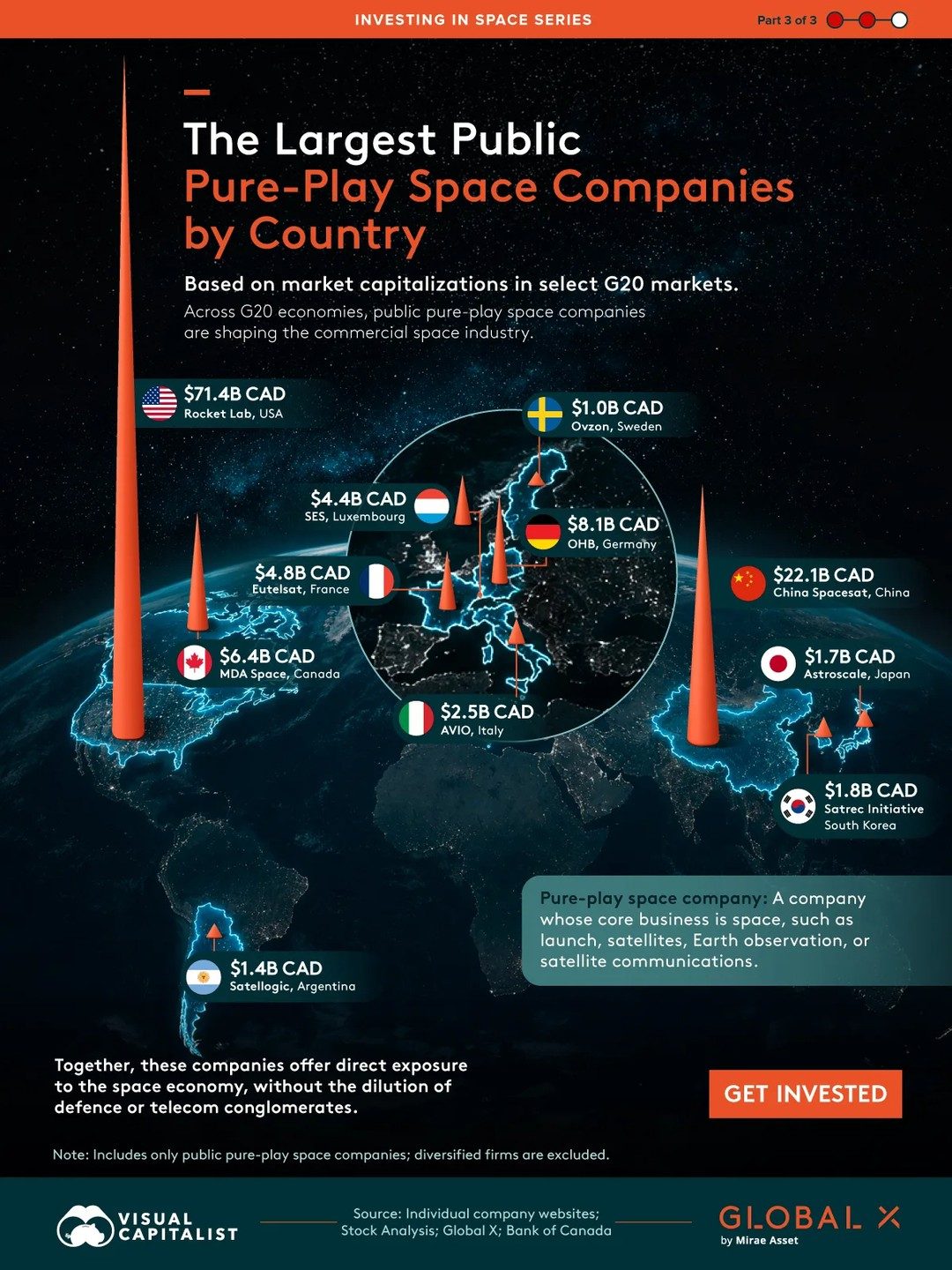
Pure-play space companies are becoming a significant force in the commercial space industry, with Rocket Lab leading the market at a substantial C$71.4 billion. These companies specialize in space launch, satellites, Earth observation, or satellite communications, and their growth is a key driver of the space economy. This article explores the landscape of public pure-play space companies, their market dynamics, and their global distribution.
Why This Matters
The commercial space industry is expanding rapidly, driven by advancements in technology and increased investment. Pure-play space companies are at the forefront of this growth, focusing on specific sectors within the space economy. Understanding the market leaders and their market capitalizations provides valuable insights into the direction and potential of the commercial space sector.
Market Leaders in the Space Industry
Rocket Lab: Leading the Charge
Rocket Lab, based in the USA, is the top pure-play space company with a market capitalization of C$71.4 billion. This company specializes in developing and deploying small spacecraft and offering launch services. Their success highlights the growing demand for small satellite launches, which are critical for various applications, including telecommunications, Earth observation, and scientific research.
European and Asian Contributions
Europe and Asia also have significant players in the space industry. For example:
- SES (Luxembourg) with a market capitalization of C$4.4 billion: This company is a leading satellite operator, providing communication and broadcasting services globally.
- China Space (China) with a market capitalization of C$22.1 billion: China is aggressively expanding its space capabilities, with China Space being a key player in this sector.
- Eutelsat (France) with C$8.1 billion: This company offers satellite communications and broadcasting services, with a strong presence in Europe, the Middle East, and Africa.
North American and South American Players
North and South America have several prominent pure-play space companies:
- MDA Space (Canada) with a market capitalization of C$4.8 billion: MDA Space is a leader in space robotics, satellite systems, and geospatial intelligence.
- AVIO (Italy) with C$2.5 billion: This is a prominent player in the development and production of launch vehicles and spacecraft.
- Astroscale (Japan) with C$1.7 billion: Astroscale is a key player in space debris removal, a critical aspect of sustainable space operations.
- Satellogic (Argentina) with C$1.4 billion: This company specializes in Earth observation satellites, providing valuable data for environmental monitoring, agriculture, and urban planning.
Other Noteworthy Companies
- South Korea has a market capitalization of C$1.8 billion in the space sector, indicating the growing interest and investment in space technologies.
- Ovzon (Sweden) with C$1.0 billion: This company specializes in satellite communications, providing reliable connectivity solutions for various industries.
Key Features of Pure-Play Space Companies
Pure-play space companies are defined by their core business in space-related activities. These companies operate in various sectors, including:
- Space Launch: Companies that develop and deploy launch vehicles to transport satellites and other payloads into space.
- Satellites: Companies that design, manufacture, and operate satellites for telecommunications, Earth observation, and scientific research.
- Earth Observation: Companies that use satellites to gather data and images of the Earth's surface, providing valuable information for environmental monitoring, agriculture, and urban planning.
- Satellite Communications: Companies that provide communication services through satellites, enabling global connectivity and broadcasting.
These companies rely heavily on cutting-edge technology and innovation, which can be costly. Their focus on space-related activities allows them to specialize and excel in their respective fields, driving the growth of the commercial space industry.
Global Distribution and Market Dynamics
The infographic highlights the global distribution of public pure-play space companies, with a significant presence in G20 countries. The market capitalization data, sourced from individual company websites and Stock Analysis, provides a snapshot of the financial health and market potential of these companies.
Regional Strengths
- North America: The USA (Rocket Lab) leads in market capitalization. This region is a hub for space innovation, with significant investment in space technologies.
- Europe: European countries like France, Luxembourg, and Italy have strong market capitalizations, reflecting the continent's deep involvement in space research and technology.
- Asia: Countries such as China, South Korea, and Japan are emerging as key players in the space industry, with a focus on space exploration, satellite communications, and Earth observation.
Market Trends
The growth of pure-play space companies is driven by several factors, including:
- Increased Investment: There has been a significant increase in private investment in the space industry, attracting more companies to the sector.
- Technological Advancements: Advances in technology have made space exploration and satellite deployment more accessible and cost-effective.
- Diverse Applications: The use of space technologies in various sectors, such as telecommunications, agriculture, and environmental monitoring, has expanded the market for pure-play space companies.
Practical Tips for Investing in the Space Industry
If you are considering investing in the space industry, here are some practical tips to help you navigate this exciting and rapidly evolving sector:
Research and Due Diligence
Before investing, conduct thorough research on the companies you are interested in. Understand their core business, technological capabilities, and market position. Look at their financial health, market capitalization, and growth potential.
Diversify Your Portfolio
Consider diversifying your investments across different sectors within the space industry. This will help mitigate risks and maximize potential returns. For example, invest in companies specializing in space launch, satellite communications, and Earth observation.
Long-Term View
The space industry is a long-term investment opportunity. Many companies in this sector are in the growth phase, and it may take time for them to realize significant returns. Be patient and focus on the long-term potential of your investments.
Stay Informed
Keep up-to-date with the latest developments in the space industry. Follow industry news, attend conferences, and engage with experts to stay informed about emerging trends, technological advancements, and market opportunities.
Consider ETFs
Exchange-Traded Funds (ETFs) focused on the space industry can be a convenient way to gain exposure to multiple companies in the sector. ETFs like those offered by GLOBAL X can provide diversified investments in a single trade.
Important Takeaways
The commercial space industry is experiencing unprecedented growth, driven by pure-play space companies. Understanding the market dynamics, key players, and investment opportunities in this sector can provide valuable insights for investors and enthusiasts. The global distribution of these companies and their diverse applications highlight the broad potential of the space economy.
Investing in the space industry can be a rewarding venture, provided you conduct thorough research, diversify your portfolio, and stay informed about the latest developments. As the demand for space technologies continues to grow, pure-play space companies are poised to play a crucial role in shaping the future of the space economy.
Conclusion
Pure-play space companies are at the forefront of the commercial space industry, with Rocket Lab leading the market. The global distribution of these companies, their market capitalizations, and their diverse applications provide a comprehensive overview of the space economy. By understanding the market dynamics and key players, investors can capitalize on the growing opportunities in the space industry. Whether you are a seasoned investor or new to the sector, the space industry offers exciting prospects for growth and innovation.
Watch the Reel
Questions readers ask
What defines a pure-play space company?
A pure-play space company is one that focuses exclusively on space-related activities, such as space launch services, satellite manufacturing, Earth observation, or satellite communications. These companies differ from conglomerates that have space divisions among other businesses.
What makes Rocket Lab a leader in the commercial space industry?
Rocket Lab's leadership is primarily due to its substantial market value of C$71.4 billion, which is the highest among pure-play space companies. This value is driven by its innovative approach to small satellite launch services and its successful track record of missions.
Which regions have significant players in the commercial space market besides the U.S.?
Europe and Asia have notable space companies that contribute significantly to the global commercial space market. These regions are home to companies specializing in various space activities, from satellite communications to Earth observation.
How do pure-play space companies drive the space economy?
Pure-play space companies drive the space economy by focusing on specific sectors and fostering innovation. Their growth and specialization in areas like satellite technology and launch services create new opportunities and stimulate investment in the commercial space industry.
Why is understanding the market leaders in the commercial space industry important?
Understanding the market leaders helps stakeholders identify trends, assess risks, and make informed decisions. It also provides insights into the competitive landscape, technological advancements, and potential opportunities for collaboration or investment.
How does the stock market capitalization of space companies reflect their standing?
The stock market capitalization of space companies is a key indicator of their size, growth potential, and market confidence. A higher market capitalization typically signifies a company's strong financial performance, innovative capabilities, and leadership in the commercial space industry.
What role does technology play in the growth of the commercial space industry?
Technology is a critical driver of growth in the commercial space industry. Advancements in areas like propulsion, satellite miniaturization, and data analytics enable companies to offer more efficient and cost-effective space services, attracting increased investment and fostering competition.
Related deep dives
Similar reads based on topic and creator.


Recent articles
Fresh deep dives from the latest Reels we unpacked.




Comments
Be the first to comment.