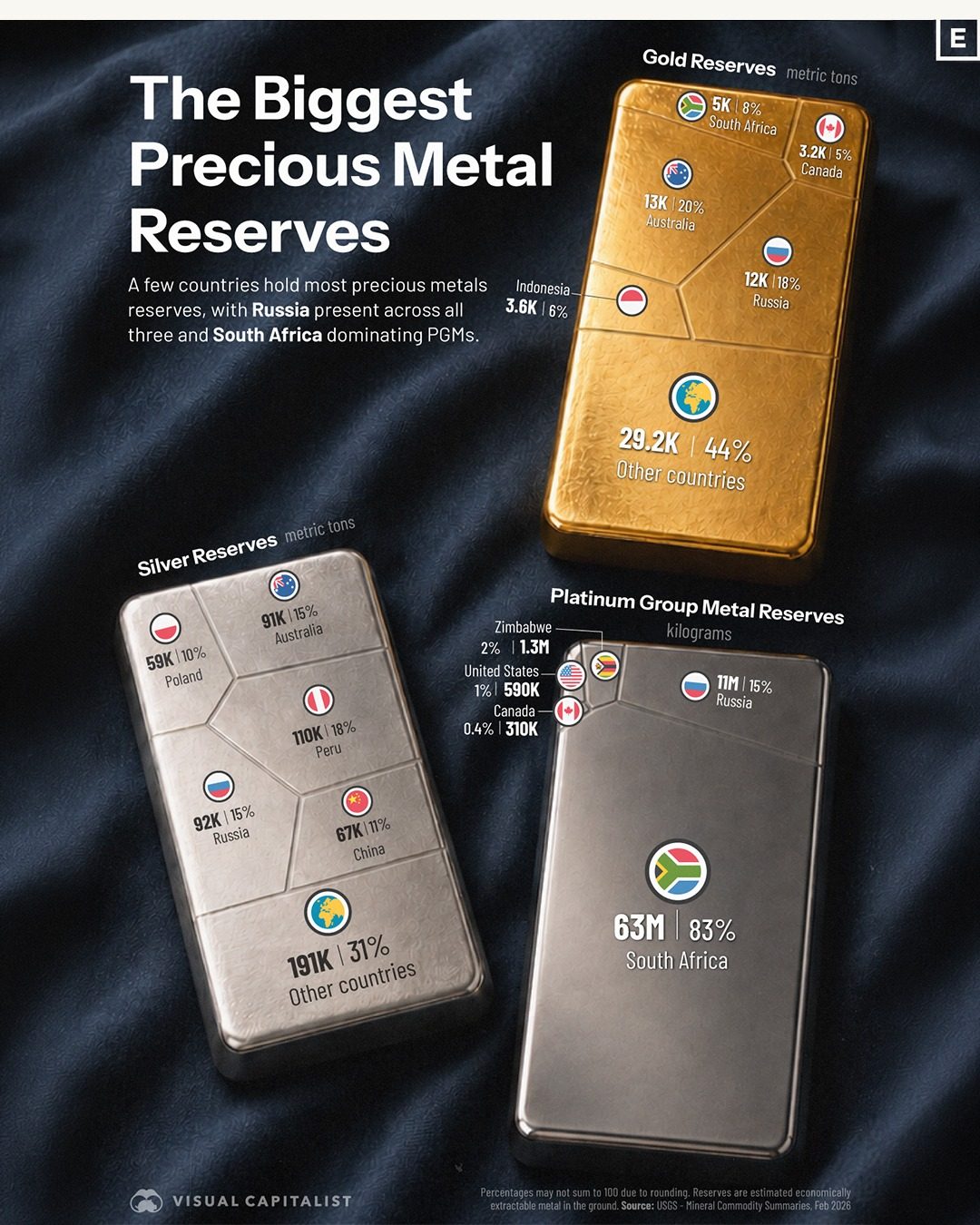
The distribution of precious metal reserves around the world reveals a fascinating geopolitical landscape, where a handful of countries hold significant portions of gold, silver, and platinum group metals (PGMs).
Why this matters
Understanding where these reserves are concentrated is crucial for various stakeholders, including investors, economists, and policymakers. These metals play pivotal roles in industries such as jewelry, electronics, and automotive manufacturing. Moreover, they serve as essential components in financial markets, with gold, for example, often used as a safe-haven asset during economic uncertainties.
Gold Reserves
Gold is one of the most sought-after precious metals, and its distribution is quite concentrated. Australia and Russia together account for nearly 40% of the world’s known gold reserves. Here’s a breakdown of the top countries holding gold reserves:
- Australia: With approximately 191,000 metric tons, Australia holds the largest share of gold reserves, accounting for about 31% of the global total.
- Russia: Russia follows closely with around 13,000 metric tons, making up about 20% of the world’s gold reserves.
- United States: The U.S. holds about 8,133.5 metric tons, which is 13% of the global gold reserves.
- France: France has around 2,436 metric tons, contributing to 4% of the world’s gold reserves.
- Italy: Italy holds about 2,451.8 metric tons, accounting for 4% of the global gold reserves.
- Germany: Germany's gold reserves stand at approximately 3,369.7 metric tons, making up 5.5% of the world’s total.
- China: China possesses around 1,948.3 metric tons, representing 3.2% of the global gold reserves.
- South Africa: South Africa has about 125.3 metric tons, contributing to 0.2% of the world’s gold reserves.
Silver Reserves
Silver reserves, on the other hand, are more widely distributed across various countries. While no single country dominates, several nations hold significant amounts. The top countries with silver reserves include:
- Peru: Peru leads with approximately 11,000 metric tons, representing around 15% of the world’s silver reserves.
- Poland: Poland follows with about 5,900 metric tons, making up around 12% of the global silver reserves.
- China: China holds around 3,400 metric tons, contributing to 6.5% of the world’s silver reserves.
- Russia: Russia has approximately 2,000 metric tons, representing around 4% of the global silver reserves.
Platinum Group Metals (PGMs)
Platinum group metals include platinum, palladium, rhodium, ruthenium, iridium, and osmium. These metals are vital in various industrial applications, particularly in catalytic converters and jewelry. South Africa stands out as the dominant holder of PGMs:
- South Africa: South Africa holds approximately 63,000,000 kilograms of PGMs, which is about 83% of the world’s reserves. This dominance is due to the country’s rich geological deposits and well-established mining industry.
Practical tips
When considering investments or strategic planning related to precious metals, it’s essential to keep the following points in mind:
- Geopolitical Risk: Countries with significant metal reserves may face geopolitical risks that could affect their mining operations and exports. Investors should stay informed about political stability in these regions.
- Regulatory Environment: Each country has its own regulatory environment for mining and exporting metals. Understanding these regulations can help in making informed investment decisions.
- Market Demand: The demand for precious metals can fluctuate based on global economic conditions and technological advancements. For instance, the rise of electric vehicles has increased the demand for PGMs.
- Diversification: Diversifying investments across different precious metals and countries can mitigate risks associated with market volatility and geopolitical uncertainties.
Important takeaways
- Australia and Russia are the top holders of gold reserves, accounting for nearly 40% of the world’s known gold.
- Silver reserves are more evenly distributed, with Peru, Poland, and China holding significant amounts.
- South Africa dominates the platinum group metals reserves, holding about 83% of the world’s PGMs.
- Understanding the distribution and dynamics of precious metal reserves can provide valuable insights for investors, economists, and policymakers.
Conclusion
The distribution of precious metal reserves is a complex and dynamic landscape, with a few countries holding significant portions of these valuable resources. Whether you’re an investor, economist, or policymaker, staying informed about the geopolitical and economic factors influencing these reserves can provide a strategic advantage in an ever-changing global market.
Watch the Reel
Questions readers ask
Which countries have the largest gold reserves globally?
Australia and Russia are among the top countries holding significant gold reserves. Other key players include the United States, Germany, and South Africa, which also possess substantial amounts of gold. These nations are pivotal in the global gold market, influencing prices and supplies.
What countries possess the largest silver reserves?
Mexico leads the world in silver reserves, with significant deposits also found in Peru and Chile. These countries are key players in the global silver market, contributing to the supply and influencing market trends.
Where are the world's platinum reserves primarily located?
South Africa holds the largest platinum reserves, accounting for a significant portion of the world's supply. Other notable countries with substantial platinum reserves include Russia and Zimbabwe, which also play crucial roles in the global platinum market.
How does the distribution of precious metal reserves impact global markets?
The distribution of precious metal reserves influences global markets significantly. Countries with large reserves can affect supply and prices, making them important for investors and policymakers. Precious metals are used in various industries and serve as safe-haven assets during economic uncertainties.
What are the implications of Russia's precious metal reserves on the global economy?
Russia's substantial precious metal reserves, including gold and platinum, make it a key player in the global market. These reserves can impact global supply, influence prices, and are a crucial consideration for investors and economists. Additionally, Russia's reserves contribute to its geopolitical influence and economic stability.
Why are countries like South Africa significant in the context of global metal reserves?
South Africa is significant due to its vast reserves, particularly in gold and platinum. These reserves make the country a major player in the global metal market, influencing supply, prices, and market trends. South Africa's mineral wealth also contributes to its economic development and geopolitical importance.
What is the projected state of global metal reserves by 2026?
By 2026, global metal reserves are expected to remain concentrated in a few key countries, with continued demand from industries such as electronics, jewelry, and automotive manufacturing. The distribution of reserves will likely influence market trends, with nations like Australia, Russia, and South Africa playing pivotal roles in the global market.
Related deep dives
Similar reads based on topic and creator.

Recent articles
Fresh deep dives from the latest Reels we unpacked.




Comments
Be the first to comment.