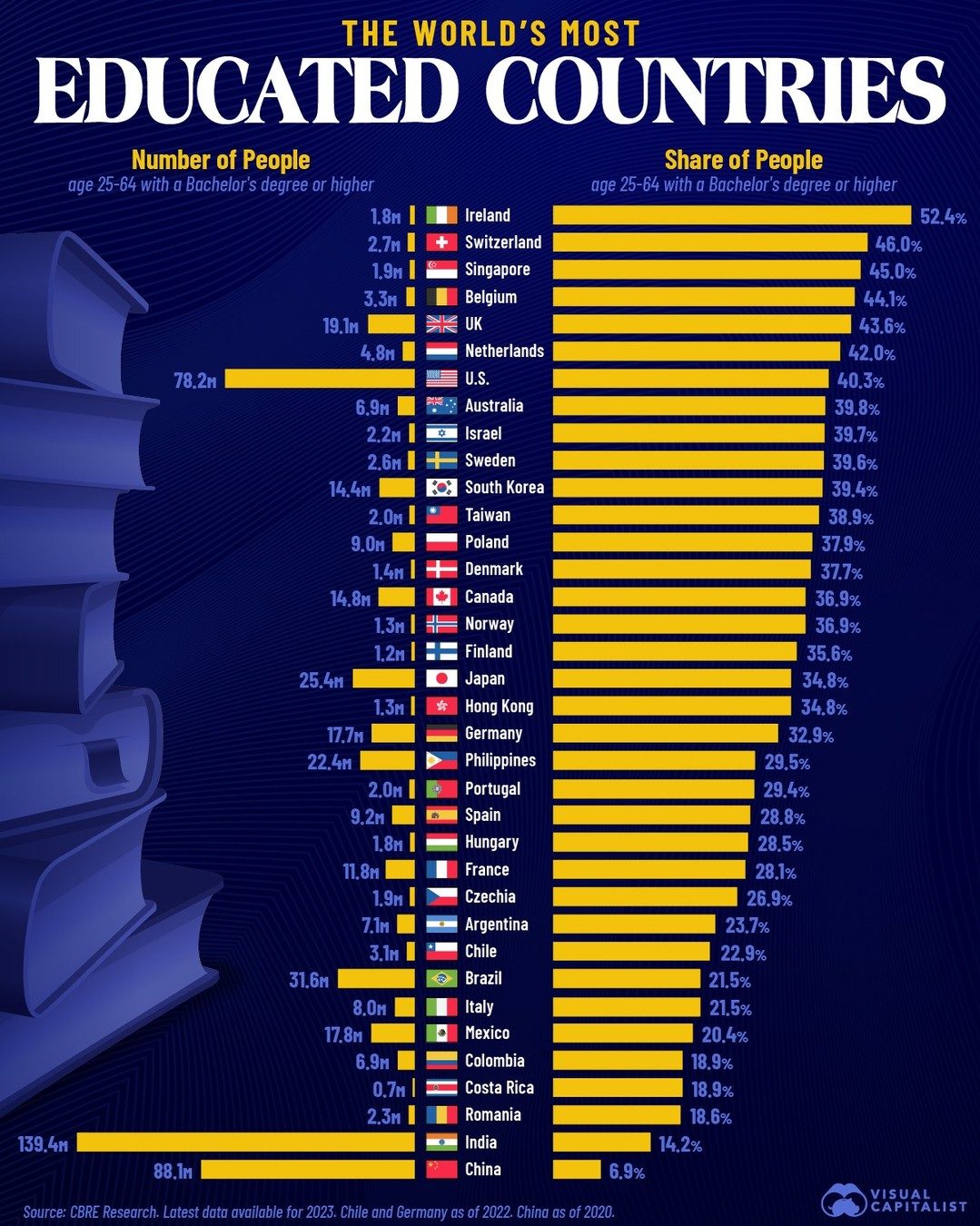
The World's Most Educated Countries
Context / Why this matters
Understanding the global distribution of educational attainment is crucial for various reasons. It helps in assessing the workforce's skills, fostering innovation, and promoting economic growth. High levels of education are often linked to better health outcomes, lower crime rates, and improved overall quality of life. This data can guide policymakers, educators, and businesses in making informed decisions. By identifying countries with the highest percentages of adults holding a bachelor’s degree or higher, we gain insights into where educational systems are thriving and where there's room for improvement.
Main discussion
Ireland Leads the Way
Ireland stands out as the leader in educational attainment, with the highest percentage of adults aged 25-64 holding a bachelor’s degree or higher. According to the data, 52.4% of Ireland's adult population meets this educational benchmark. This high level of educational attainment reflects a strong emphasis on education and a robust higher education system.
European and Asian Powerhouses
Several European and Asian countries follow closely behind Ireland. Switzerland, Belgium, and Singapore are among the top-ranked countries, each with a significant portion of their adult population holding advanced degrees. These countries are known for their world-class educational institutions, comprehensive training programs, and strong focus on research and development.
Countries like the Netherlands, Sweden, and the United States also feature prominently in the rankings, showcasing their commitment to higher education. These nations boast well-established universities and a culture that values learning and innovation.
The Role of Population Size
While countries like India and China have large numbers of degree holders, their proportions are not as high as smaller nations. This discrepancy highlights the impact of population size on educational attainment statistics. Smaller countries with fewer people can more easily achieve high percentages of educated adults, while larger countries may struggle to keep pace.
Emerging Economies and Educational Progress
Emerging economies like South Korea, Taiwan, and Poland are making significant strides in educational attainment. These countries are investing heavily in education to foster economic growth and globalization. Their progress underscores the importance of education in driving development and innovation.
Japan, Hong Kong, and other Asian nations are also noteworthy for their high educational standards. These countries have long been recognized for their advanced educational systems, which contribute to their economic success and technological advancements.
Practical tips
For countries looking to improve their educational attainment rates, several strategies can be effective:
-
Invest in Early Childhood Education: Early intervention and quality pre-school education can set a strong foundation for future learning.
-
Promote Lifelong Learning: Encourage continuous education and training programs to keep the workforce updated with the latest skills and knowledge.
-
Enhance Accessibility: Make higher education more accessible by providing scholarships, grants, and flexible learning options.
-
Strengthen Vocational Training: Develop robust vocational training programs to meet industry demands and provide alternative pathways to higher education.
-
Encourage Research and Innovation: Foster a culture of research and innovation by investing in universities and research institutions.
Important takeaways
- Ireland leads the world with the highest percentage of adults holding a bachelor’s degree or higher.
- European and Asian countries like Switzerland, Singapore, and South Korea are among the most educated nations.
- Population size significantly impacts the percentage of educated adults, with smaller countries often having higher proportions.
- Emerging economies are making substantial progress in educational attainment.
- Continuous investment in education and training is crucial for economic growth and workforce development.
Conclusion
The data from CBRE Research provides a comprehensive view of the world's most educated countries. Ireland's leadership in educational attainment highlights the importance of investing in education and fostering a culture of learning. As other countries strive to enhance their educational systems, they can learn from the successes and challenges faced by these top-performing nations. By prioritizing education, countries can build a skilled workforce, drive innovation, and improve overall quality of life.
Watch the Reel
Questions readers ask
Which country has the highest percentage of adults with a bachelor's degree or higher?
According to recent data, Ireland leads the world with the highest percentage of adults who have earned a bachelor's degree or higher.
What are some benefits of having a highly educated population?
A highly educated population often correlates with strong economies. It can also lead to better health outcomes, lower crime rates, and a higher quality of life.
What factors contribute to Ireland's success in education?
Ireland's success in education can be attributed to a strong commitment to accessible higher education, robust public investment in learning institutions, and a cultural emphasis on the importance of academic achievement.
Why is understanding global educational attainment important for businesses?
For businesses, understanding global educational attainment helps in identifying skilled workforce locations, fostering innovation, and making informed decisions about where to invest and expand.
How does Singapore rank in terms of educational attainment?
Singapore is among the top countries with a high percentage of adults holding a bachelor's degree or higher. Its success is driven by a strong focus on STEM fields and a rigorous education system.
In what ways can high educational attainment impact public health?
High educational attainment often leads to better health literacy, better access to healthcare, and healthier lifestyles, which can result in lower mortality rates and improved overall public health.
Related deep dives
Similar reads based on topic and creator.

Recent articles
Fresh deep dives from the latest Reels we unpacked.




Comments
Be the first to comment.