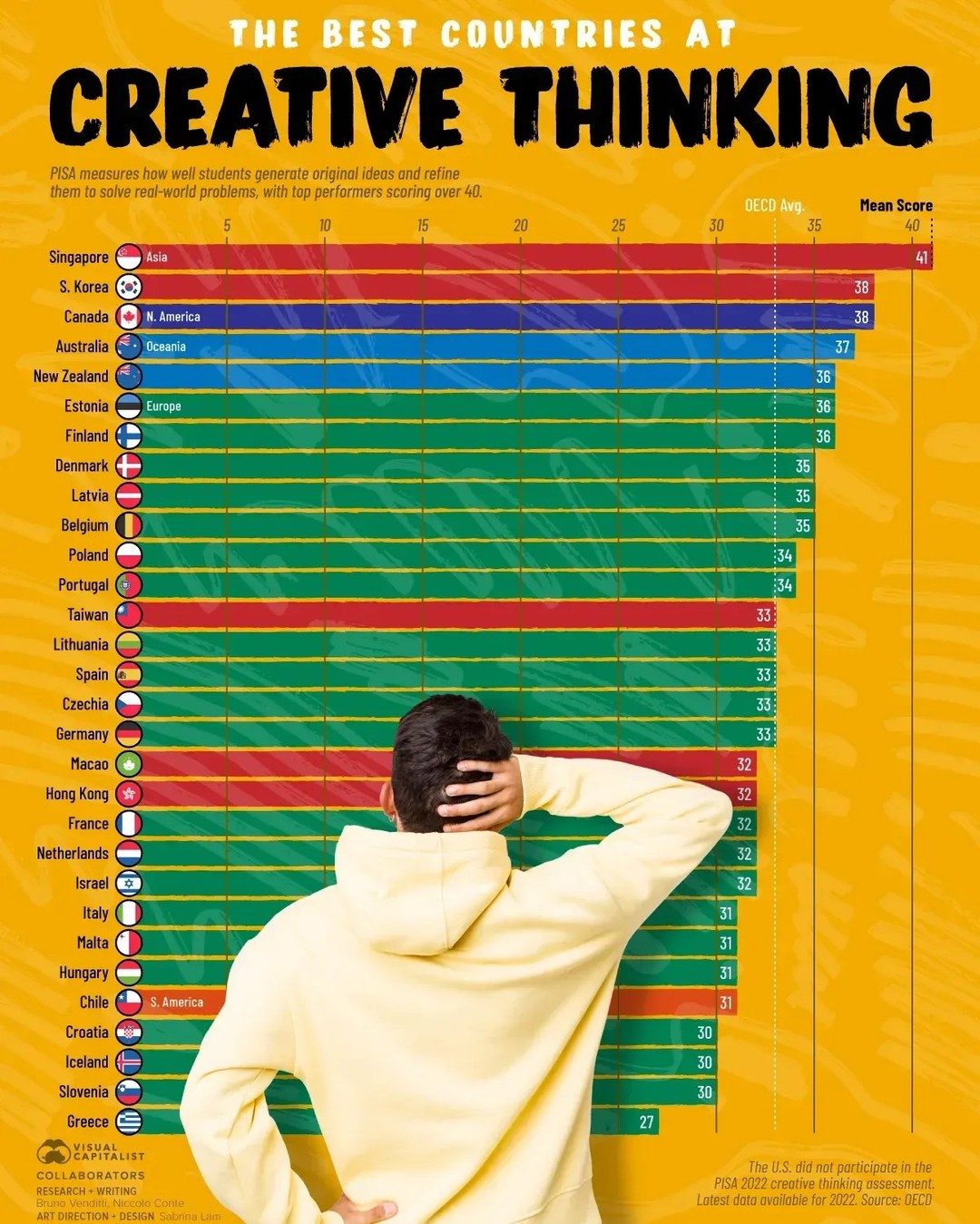
Creative Thinking Rankings: Global Analysis
The OECD's PISA 2022 Creative Thinking assessment results reveal Singapore's remarkable achievement in creative thinking. The assessment highlights the importance of creative thinking skills, particularly in an economy increasingly influenced by automation and AI. The evaluation underscores how countries foster innovative and original problem-solving abilities among their students.
Why This Matters
Creative thinking is not just a soft skill; it is a critical component of modern education and workforce development. As automation and AI continue to reshape industries, the ability to generate original ideas and refine them to solve real-world problems is more valuable than ever. The PISA assessment focuses on these very skills, evaluating how well students can think creatively and apply their ideas effectively.
Main Discussion
The PISA 2022 Creative Thinking Assessment
The Programme for International Student Assessment (PISA), conducted by the OECD, evaluates 15-year-old students' abilities in reading, mathematics, and science. The 2022 assessment introduced a new dimension: creative thinking. This assessment measures how well students can generate original ideas and refine them to solve real-world problems. The results provide a fascinating lens into which countries are best preparing their students for the future.
Top Performers
Several countries stood out in the 2022 assessment. South Korea led the rankings, followed closely by Canada and Australia. These countries, along with others like New Zealand, Estonia, and Denmark, scored significantly higher than the OECD average of 33 points. Singapore's score of over 40 points is particularly noteworthy, making it the only country to achieve this milestone.
The Importance of Creative Thinking
Creative thinking is not just about coming up with new ideas; it's about refining those ideas to address real-world challenges. This skill is crucial in fields ranging from technology and engineering to arts and design. The assessment emphasizes the importance of fostering an environment where students can experiment, fail, and learn from their failures—a key aspect of creative thinking.
Practical Tips
For Educators
-
Incorporate Real-World Problems: Encourage students to tackle real-world issues in their learning. This can be done through project-based learning, where students are given a problem to solve over an extended period.
-
Promote Collaboration: Group projects and collaborative assignments can foster creativity by exposing students to different perspectives and ideas.
-
Encourage Experimentation: Create an environment where students feel safe to experiment and take risks. Mistakes should be seen as opportunities for learning, not failures.
For Parents
-
Encourage Curiosity: Foster a love for learning and curiosity in your children. Encourage them to ask questions and explore new ideas.
-
Provide Hands-On Experiences: Give your children opportunities to engage in hands-on activities, such as arts, crafts, and DIY projects, which can stimulate creative thinking.
-
Support Creative Pursuits: Encourage your children to pursue hobbies and interests that allow them to express their creativity, whether it's through music, art, or writing.
Important Takeaways
The PISA 2022 Creative Thinking assessment highlights the importance of nurturing creative thinking skills in education. Countries like Singapore, South Korea, Canada, and Australia are leading the way in preparing their students for a future shaped by technology and innovation. Educators and parents play a crucial role in fostering an environment that promotes creativity and original problem-solving.
Conclusion
In an era where automation and AI are transforming industries, creative thinking is more important than ever. The OECD's PISA 2022 Creative Thinking assessment provides valuable insights into how countries are fostering these critical skills. By understanding and implementing the best practices from top-performing countries, educators and parents can help students develop the creative thinking abilities necessary to thrive in the 21st century.
Watch the Reel
Questions readers ask
Which country ranked the highest in creative thinking according to the 2022 PISA rankings?
Singapore ranked at the top in the 2022 PISA rankings for creative thinking. This achievement underscores the country's successful approach to nurturing original problem-solving skills among its students, which are crucial in a future driven by automation and AI.
What does the 2022 PISA creative thinking assessment evaluate?
The 2022 PISA creative thinking assessment evaluates the ability of 15-year-old students to generate original ideas and refine them to solve real-world problems. It focuses on innovative and original problem-solving abilities, which are increasingly important in a world shaped by automation and AI.
Why is creative thinking important in the context of the 2022 PISA rankings?
Creative thinking is vital because it is a critical component of modern workforce development. As industries continue to evolve with automation and AI, the ability to think creatively and solve problems in original ways becomes more valuable. The PISA 2022 creative thinking assessment highlights this importance by evaluating these specific skills.
How do the PISA 2022 creative thinking scores help countries compare their progress in nurturing creativity?
The PISA 2022 creative thinking scores provide a benchmark for countries to compare how well they are fostering creativity in their student populations. By evaluating the creative thinking capabilities of 15-year-olds, these scores offer insights into the effectiveness of different countries' approaches to developing innovative problem-solving skills.
In addition to Singapore, which other countries are notable for their creative thinking performance?
Countries like Korea, Canada, and Australia are also notable for their performance in creative thinking. These nations have shown strong results in fostering innovative and original problem-solving abilities, making them significant competitors in the global rankings.
What are the implications of high creative thinking scores for countries' future economic competitiveness?
High creative thinking scores indicate that a country's student population is well-prepared to thrive in an economy driven by automation and AI. This competitive edge in creative thinking can translate to enhanced innovation, improved problem-solving in various industries, and a more adaptable workforce, all of which contribute to economic competitiveness.
Related deep dives
Similar reads based on topic and creator.

Recent articles
Fresh deep dives from the latest Reels we unpacked.




Comments
Be the first to comment.