Agricultural Land Distribution: A Global Perspective
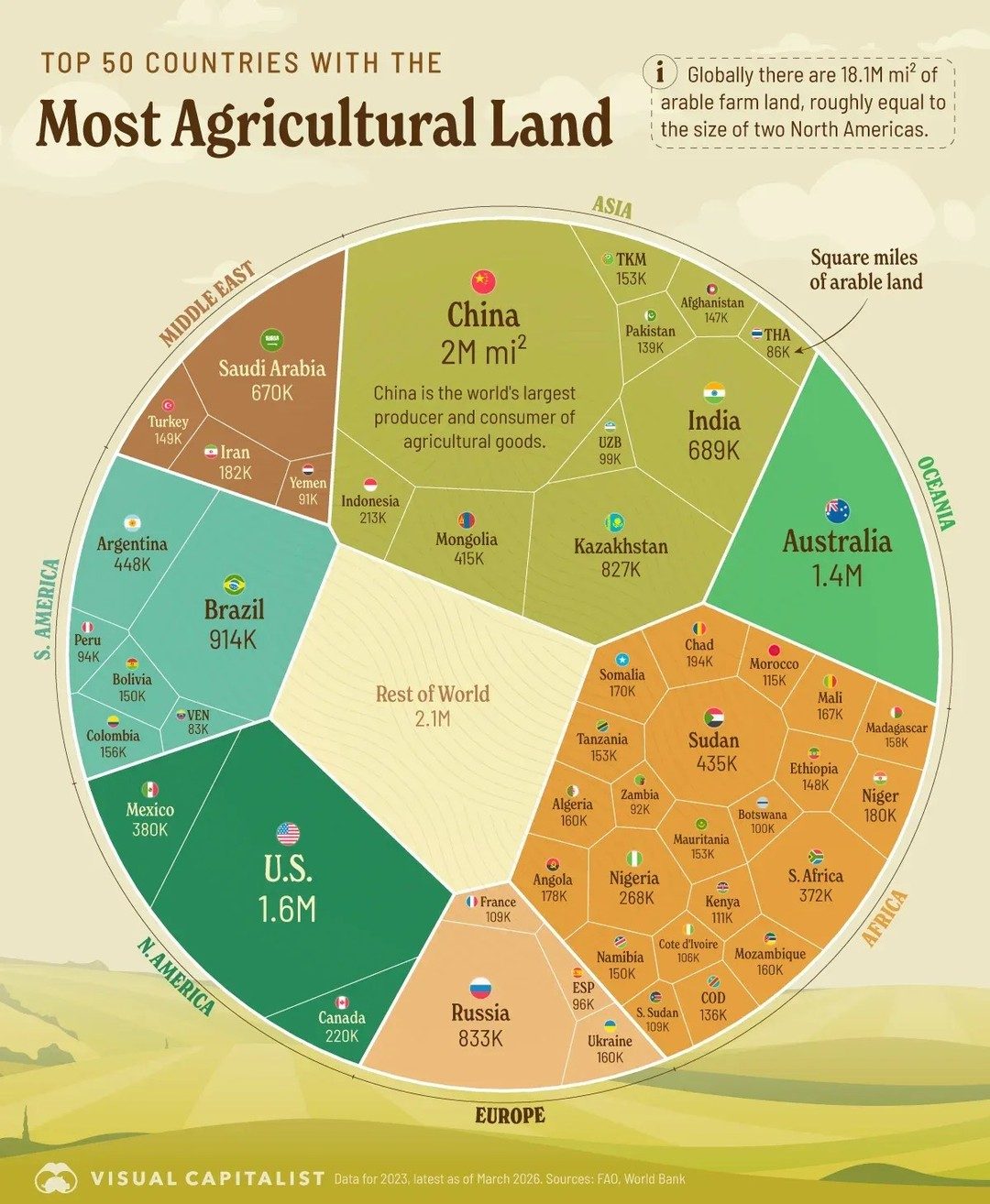
Agricultural land is fundamental to global food production, and its distribution varies significantly across countries. China leads the world with approximately 2.0 million square miles of agricultural land. The United States, Australia, Brazil, and Russia follow as the next largest holders. Countries in Asia and Africa collectively hold a substantial portion of the global top 50. Altogether, agricultural land spans more than 18 million square miles worldwide.
Context / Why This Matters
Understanding the distribution of agricultural land is crucial for several reasons. It impacts food security, economic stability, and environmental sustainability. Countries with abundant arable land often play pivotal roles in global food markets, influencing prices and trade policies. Additionally, the distribution of farmland can highlight regional disparities and the need for sustainable land use practices.
Main Discussion
Global Agricultural Land Overview
Globally, there are approximately 18.1 million square miles of arable farmland, an area roughly equivalent to the size of two North Americas. This vast expanse supports the cultivation of diverse crops and the rearing of livestock, forming the backbone of the global food system.
Top Agricultural Land Holders
Several countries stand out for their extensive agricultural lands:
-
China: With 2 million square miles of agricultural land, China is not only the largest producer but also the largest consumer of agricultural goods. This vast land area supports a wide range of crops, including rice, wheat, and maize, which are essential for feeding China's large population.
-
United States: The U.S. holds approximately 1.6 million square miles of agricultural land. The country is a major exporter of grains, soybeans, and meat, playing a significant role in global food trade.
-
Australia: Australia's agricultural land extends over 1.4 million square miles. The country is known for its vast grazing lands and is a key player in the global wheat and beef markets.
-
Brazil: Brazil's agricultural land covers 914,000 square miles, making it one of the world's leading producers of soybeans, coffee, and sugarcane. The country’s agricultural sector is a significant contributor to its economy.
-
Russia: With 833,000 square miles of agricultural land, Russia is a major producer of wheat and other grains. The country’s vast expanse of arable land supports both domestic consumption and export markets.
Regional Highlights
-
Asia: Asian countries, including India, Indonesia, and Pakistan, hold significant portions of global agricultural land. India, for instance, has 689,000 square miles of arable land, supporting a diverse range of crops essential for its vast population.
-
Africa: African countries like Nigeria, Ethiopia, and Sudan also have substantial agricultural land. These countries are crucial for regional food security and contribute to the global food market with crops like maize, rice, and sorghum.
-
Europe: European countries such as Ukraine, France, and Germany have extensive agricultural lands. These countries are known for their high-yield crops and advanced farming technologies.
Agricultural Land in Oceania
Oceania, led by Australia, holds a considerable portion of global agricultural land. Australia's extensive grazing and cropping lands support its significant role in global agriculture, producing commodities like wheat, beef, and wool. New Zealand, though smaller in land area, also contributes significantly to the region's agricultural output with its dairy and meat exports.
South America
Brazil and Argentina are the leading countries in South America in terms of agricultural land. Brazil, as mentioned, is a major player in global agriculture, while Argentina, with 150K square miles of agricultural land, is known for its beef and soybeans.
Practical Tips
For countries aiming to optimize their agricultural land use, several practical tips can be considered:
-
Sustainable Farming Practices: Implementing sustainable farming methods can help preserve soil health and increase crop yields. Techniques such as crop rotation, organic farming, and precision agriculture can contribute to long-term productivity.
-
Investment in Technology: Adopting modern agricultural technologies, such as drones, GPS systems, and sensors, can enhance farming efficiency. These technologies can help monitor soil conditions, pest control, and irrigation, leading to better land utilization.
-
Government Policies: Governments can play a crucial role by implementing policies that support agriculture. Subsidies, research and development funding, and infrastructure development can boost agricultural productivity.
Important Takeaways
-
China leads the world in agricultural land, followed by the United States, Australia, Brazil, and Russia.
-
The distribution of agricultural land varies significantly across regions, with Asia and Africa holding a substantial portion of global arable land.
-
Optimizing agricultural land use through sustainable practices, technology adoption, and supportive policies is essential for ensuring food security and economic stability.
Conclusion
The distribution of agricultural land is a critical facet of global food production. Understanding which countries hold the most arable land and how they utilize it can provide insights into broader trends in food security, economics, and sustainability. As the world population continues to grow, the efficient and sustainable use of agricultural land will become increasingly important.
Watch the Reel
Questions readers ask
Which country has the largest agricultural land area in the world?
China tops the list with approximately 2.0 million square miles of agricultural land. This extensive area underscores China's significant role in global food production and agricultural markets.
What are the top five countries by agricultural land area?
Following China, the top five countries by agricultural land area are the United States, Australia, Brazil, and Russia. These nations collectively hold a vast portion of the world's agricultural land, each playing a crucial role in global food security.
How much agricultural land is there in total worldwide?
Worldwide, agricultural land spans more than 18 million square miles. This vast expanse supports global food production and is vital for understanding the dynamics of international food markets and sustainability efforts.
Which continents hold the most agricultural land?
Asia and Africa collectively hold a substantial portion of the global top 50 countries by agricultural land area. This distribution highlights the importance of these continents in global agriculture and food security.
Why is it important to track global agricultural land data?
Tracking global agricultural land data is essential for assessing food security, economic stability, and environmental sustainability. It helps in understanding the capacity of countries to produce food and their influence on global markets.
What makes China's agricultural land area significant?
China's agricultural land area is significant due to its sheer size and the country's role as a major player in global food production. This vast area supports a large population and has implications for international food markets and sustainability.
How do agricultural land areas in Brazil and Australia compare?
Brazil and Australia are among the top countries by agricultural land area, with Brazil holding approximately 1.8 million square miles and Australia holding about 1.6 million square miles. Both countries are key players in global agriculture, contributing significantly to world food production.
Related deep dives
Similar reads based on topic and creator.

Recent articles
Fresh deep dives from the latest Reels we unpacked.




Comments
Be the first to comment.