The Top 10 Most Educated Countries in the World
Understanding which countries have the highest levels of education can provide valuable insights into various socio-economic factors, including economic growth, innovation, and overall quality of life. The ranking is typically based on the percentage of the population that holds a tertiary education degree, such as a Bachelor's degree or higher. Let’s dive into the top 10 most educated countries globally, exploring what sets them apart and why their educational achievements matter.
Context / Why This Matters
A well-educated population is a cornerstone of a thriving society. Countries with high levels of tertiary education often see benefits in areas such as healthcare, technological advancement, and social cohesion. These nations are better equipped to tackle complex challenges like climate change, economic instability, and public health crises. Moreover, the educational achievements of a country can attract global talent and investment, fostering growth and innovation.
Main Discussion
Canada: Leading the Way
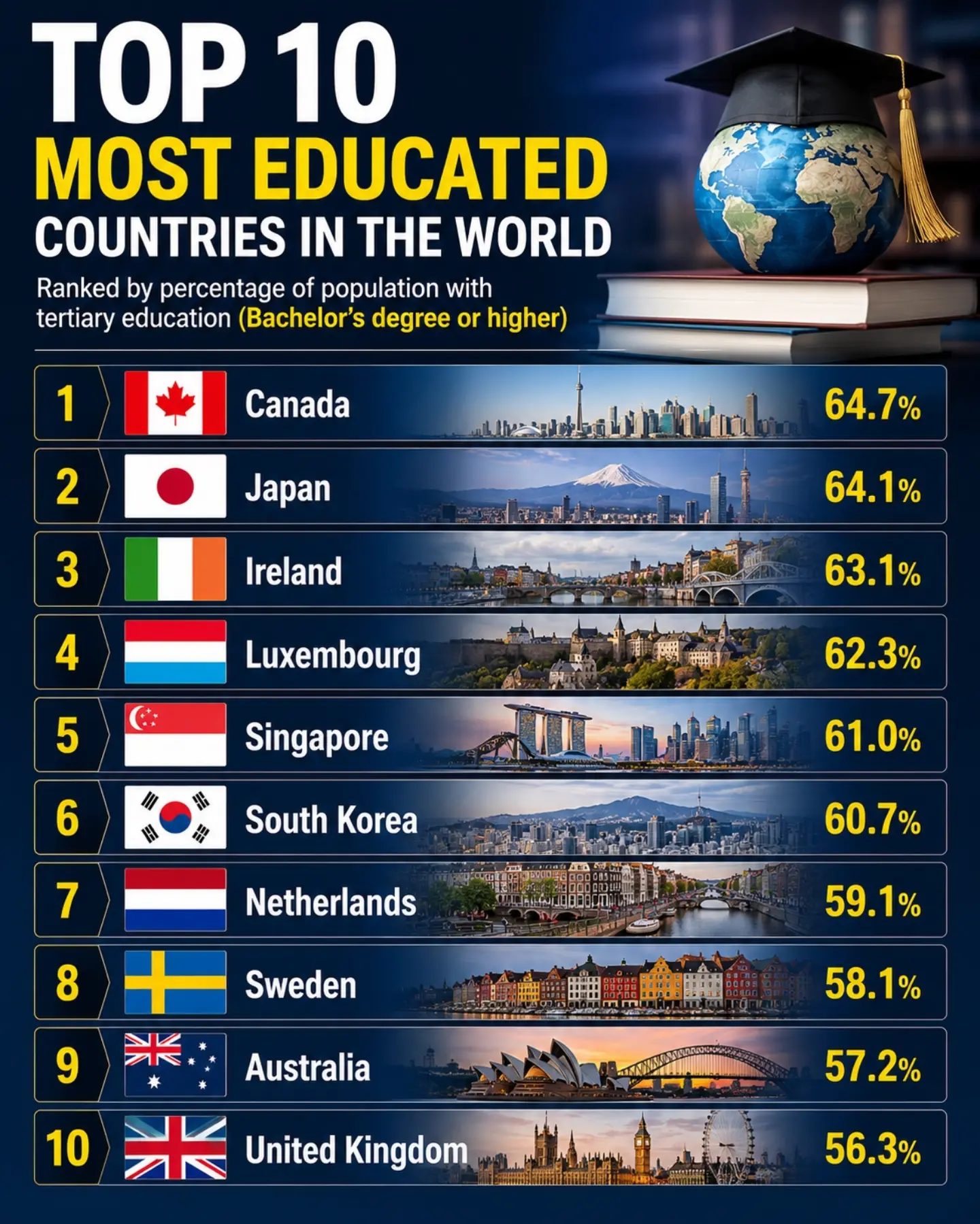
Ranked as the most educated country in the world, Canada boasts an impressive 64.7% of its population holding a tertiary education degree. This high level of education is a testament to the country’s robust education system, which emphasizes accessibility and inclusivity. Canada’s commitment to investing in education, combined with its multicultural environment, makes it a hub for international students and researchers.
Japan and Ireland: Close Contenders
Japan and Ireland tie for second place with 64.1% and 63.1% of their populations holding tertiary degrees, respectively. Both countries have made significant strides in their education systems, focusing on STEM fields and vocational training. Japan’s emphasis on technological innovation and Ireland’s thriving tech industry are clear reflections of their educational investments.
Luxembourg and Singapore: Small but Mighty
Luxembourg and Singapore round out the top five with impressive percentages of 62.3% and 61.0%, respectively. These small nations have leveraged their educational systems to become global leaders in finance and technology. Luxembourg’s commitment to multilingual education and Singapore’s focus on a holistic educational approach have contributed to their success.
South Korea and the Netherlands
South Korea and the Netherlands rank sixth and seventh with 60.7% and 59.1% of their populations holding tertiary degrees. South Korea’s rigorous education system, known for its emphasis on discipline and hard work, has produced a highly skilled workforce. The Netherlands, on the other hand, is renowned for its innovative approach to education, blending traditional learning with modern techniques.
Sweden and Australia: Nordic and Oceanic Excellence
Sweden and Australia come in at eighth and ninth place with 58.1% and 57.2% of their populations holding tertiary degrees. Sweden’s educational system is characterized by its egalitarian principles, ensuring that education is accessible to all. Australia’s focus on research and development has positioned it as a global leader in higher education, attracting students from around the world.
United Kingdom: A Tradition of Excellence
Rounding out the top 10 is the United Kingdom with 56.3% of its population holding a tertiary education degree. The UK is home to some of the world’s most prestigious universities and has a long-standing tradition of academic excellence. The country’s rich cultural diversity and commitment to research and innovation continue to drive its educational achievements.
Practical Tips
For countries looking to improve their educational rankings, there are several practical steps to consider:
- Invest in Early Education: Early childhood education lays the foundation for lifelong learning. Investing in quality early education programs can have a lasting impact on a population’s educational outcomes.
- Promote Accessibility: Ensure that higher education is accessible to all, regardless of socio-economic background. Scholarships, grants, and affordable tuition can play a crucial role in this.
- Focus on STEM: Emphasize education in Science, Technology, Engineering, and Mathematics (STEM) fields to prepare the workforce for the demands of the 21st century.
- Encourage Multilingualism: In a globalized world, being multilingual can open up numerous opportunities. Promoting multilingual education can enhance a country’s competitiveness.
- Support Research and Development: Investing in research and development fosters innovation and attracts global talent. Countries that prioritize R&D tend to see higher levels of educational achievement.
Important Takeaways
- Canada, Japan, and Ireland are leading the way in terms of educational attainment, with over 63% of their populations holding tertiary degrees.
- Smaller nations like Luxembourg and Singapore have leveraged their educational systems to become global leaders in specific fields.
- Educational achievement is closely tied to economic growth and technological advancement.
- Investing in education at all levels, from early childhood to higher education, is key to improving a country’s educational rankings.
- Promoting STEM education and research and development can drive innovation and competitiveness.
Conclusion
The top 10 most educated countries in the world provide a roadmap for what educational success can look like. By examining their strategies and investments, other nations can learn valuable lessons and implement practices that foster educational excellence. Whether through investing in early education, promoting accessibility, or focusing on STEM fields, these countries offer a blueprint for building a well-educated population that can drive progress and innovation.
Watch the Reel
Questions readers ask
Which country has the highest percentage of degree holders among its population?
Canada currently has the highest percentage of degree holders among its population, with over 64% of its residents holding a tertiary education degree. This high level of education contributes significantly to the country's advancements in healthcare, technology, and economic stability.
How does Japan rank among the most educated countries, and what are its notable achievements in this area?
Japan ranks second among the most educated countries, following Canada. It has a high percentage of its population holding tertiary degrees, which has contributed to its advancements in technology and innovation. Japan's focus on STEM fields has been particularly impactful, leading to significant progress in areas like robotics and electronics.
What are the benefits of having a high percentage of degree holders in a country?
Countries with a high percentage of degree holders often experience benefits such as improved healthcare systems, technological advancements, and economic stability. These nations typically see higher innovation rates, better social cohesion, and increased job opportunities, making them more competitive on the global stage.
Which countries are known for their high levels of tertiary education, and what makes them stand out?
The top 10 most educated countries include Canada, Japan, and Ireland, among others. These countries stand out due to their high percentages of degree holders, strong focus on tertiary education, and significant advancements in various fields. Their success is often attributed to robust educational systems, investment in research, and a societal emphasis on lifelong learning.
How does tertiary education impact economic stability in leading countries?
Tertiary education plays a crucial role in achieving economic stability. Countries with high levels of tertiary education tend to have a skilled workforce, which drives innovation and productivity. This, in turn, leads to economic growth, higher employment rates, and improved living standards, making these nations more resilient to economic fluctuations.
In what ways does a well-educated population contribute to healthcare advancements?
A well-educated population, particularly those with tertiary degrees, is crucial for healthcare advancements. These individuals often contribute to medical research, innovation in healthcare technologies, and the development of new treatments. As a result, countries with high levels of tertiary education tend to have more advanced and effective healthcare systems, leading to better health outcomes for their citizens.
What role does tertiary education play in technological progress?
Tertiary education is a key driver of technological progress. Nations with high levels of tertiary education often have a larger pool of skilled professionals who can innovate and develop new technologies. This focus on tertiary education fosters a culture of research and development, leading to significant advancements in areas like artificial intelligence, biotechnology, and renewable energy.
Related deep dives
Similar reads based on topic and creator.




Recent articles
Fresh deep dives from the latest Reels we unpacked.




Comments
Be the first to comment.