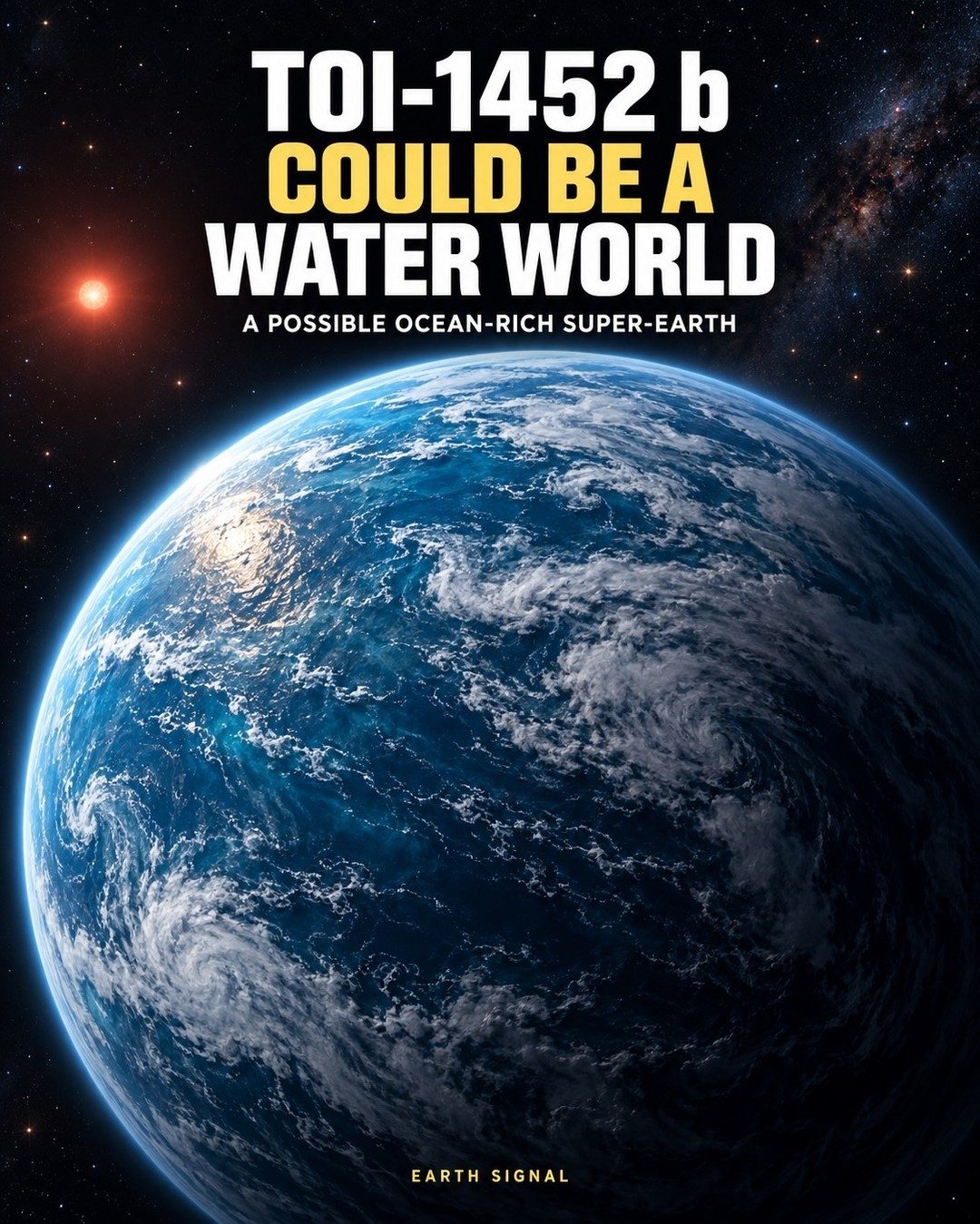
A Looming Signal of Water In Space
The likeness of TOI-1452 b is not yet another generic exoplanet, but rather an enticing cosmic near-Earth. The planet may very well be a teeming world of water, a so-called "water world". If true, then the implications are immense. A world that could theoretically host expansive oceans and cloud formations with Earth-like characteristics is not only a future goal for astrobiology and exoplanet exploration, but also a way to understand Earth's origin and future. TOI-1452 b is a super-Earth — an exoplanet with a mass higher than Earth's, but substantially lower than ice giants like Uranus and Neptune. This "signal" is intriguing. In 2022, scientists detected a possible water-rich planet TOI-1452 b using NASA's TESS satellite. TOI-1452 b is approximately 100 light-years away from Earth. The planet's star is cooler than our Sun, and the planet orbits in the star's habitable zone — the Goldilocks region where liquid water could potentially exist on the planet's surface. However, while TOI-1452 b could be a water world it is more likely a rocky planet with a deep atmosphere that contains water. Water can exist as a gas, liquid, or solid, depending on its temperature and pressure. The search for water-bearing worlds is exciting, but not simple.
The Potential of a Super-Earth
This super-Earth’s potential is a landmark not only for its unique qualities, but also for what it teaches us about our own planet. We are only beginning to learn about the geography of worlds away from the solar system. TOI-1452 b moves across the sky like the sun, but with a cycle of 11 days. Our solar system only has eight planets, none of them Super-Earths. If asked to imagine an ocean planet, most people would immediately picture something similar to Earth. But we have hardly begun to explore what an ocean planet can truly look like, or feel like. TOI-1452 b's true nature is still to be determined, but it is a prime candidate to explore as a potential home for liquid water. TOI-1452 b orbits a red dwarf, a type of star that is smaller and cooler than the Sun. The planet is considered to be in the habitable zone, which is the region around a star where the temperature is just right for liquid water. However, the exact conditions on TOI-1452 b are still unknown. The planet is classified as a super-Earth, which means that it is larger than Earth but smaller than ice giants. It may have a thick atmosphere that contains water, but it is more likely that the planet has a rocky surface with a deep atmosphere that contains water vapor.
Is it Oceanic Physically?
The potential for life on TOI-1452 b must be viewed with caution. Certain features on the planet could impact the prospects for life as we know it. TOI-1452 b does not have any moons, and it orbits a red dwarf star, which is known for its intense stellar flares. These flares could potentially strip away the planet’s atmosphere and make the surface inhospitable for life. If TOI-1452 b is indeed a water world like Earth, the temperature variation and radiation from the star might make the surface water uninhabitable. It is also possible that a super-Earth could have a thicker atmosphere than Earth, which would provide more protection from stellar radiation and could make the planet more habitable.
Alternate Oceanic Solutions
The exploration of TOI-1452 b will continue with the James Webb Space Telescope. The telescope will be able to analyze the planet’s atmosphere and determine if it contains water vapor. If confirmed, the discovery of liquid water on TOI-1452 b could greatly increase the potential for finding extraterrestrial life in the universe. However, there’s still a lot to learn about the planet’s location, radiation, and conditions. It could be a planet like Earth, or like others in the solar system. Only time and technology will tell.
Watch the Reel
Related deep dives
Similar reads based on topic and creator.

Recent articles
Fresh deep dives from the latest Reels we unpacked.


Comments
Be the first to comment.