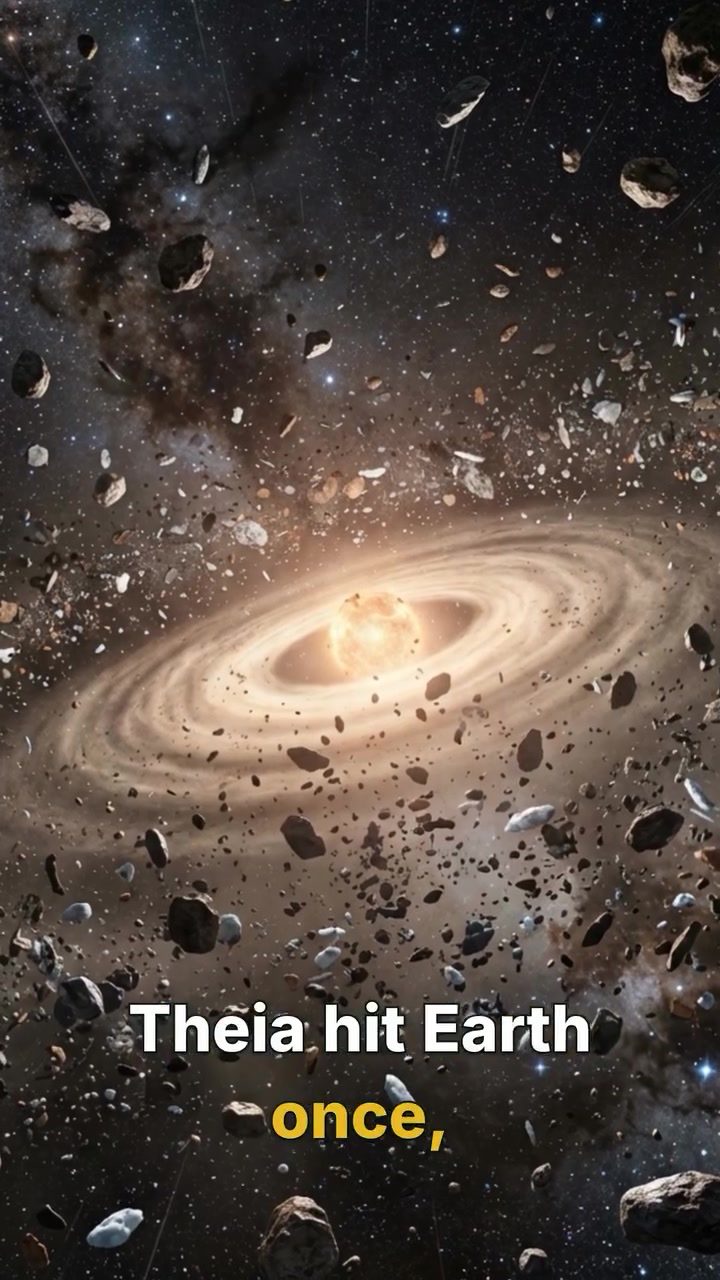
Our changing understanding of the Moon's origins
For decades, the prevailing theory of the Moon's creation involved a slow accretion of debris. But recent simulations by the Southwest Research Institute challenge this traditional narrative. According to these new models, under the right pre-impact conditions, the Moon may have started as nearly a whole entity, forming rapidly — not drifting into existence over millennia. Drew one observer with an interest in planetary geology, "If the simulations are accurate, it suggests that our understanding of the process is incomplete, and planetary formation is more dynamic than previously thought." Once thought to have occurred gradually, the Moon's formation “didn't slowly form from drifting debris” anymore. Still, the scientific community remains divided.
Theia's catastrophic impact on early Earth
The hypothesis of a catastrophic impact between Earth and its neighbor, the hypothesized Mars-sized asteroid Theia, has been around for a while. However, it is only recently that technological advancements have allowed for deeper insights into this event. The simulations point to a dramatic and swift collision, which would have melted and vaporized both the Earth and Theia, "It may have emerged nearly whole" in about five hours. Nevertheless, this model is one potential scenario, not the final answer. According to computer simulations, the collision may have occurred about 4.5 billion years ago, generating a debris cloud that also condensed into the Moon. The dust and vapor from Earth and Theia would have orbited Earth's debris and condensed into a single celestial object that is what we now call the Moon.
What the Moon's formation tells us
The Moon’s formation has always been inextricably linked to the Earth’s development. With the Moon and Earth sharing similar chemistry, these similarities are still an unresolved question. This could be due to the Moon's origin being tied to Earth's deep mantle, composed of similar materials. It would follow that the composition of the Moon’s makeup originates from the Earth. Additionally, this reveals more about Earth’s orbit, which may have been altered by the impact. All these factors make for a complex and evolving mystery of the Moon's origins.
Watch the Reel
Related deep dives
Similar reads based on topic and creator.
Recent articles
Fresh deep dives from the latest Reels we unpacked.


Comments
Be the first to comment.