Tesla's Global Sales Breakdown
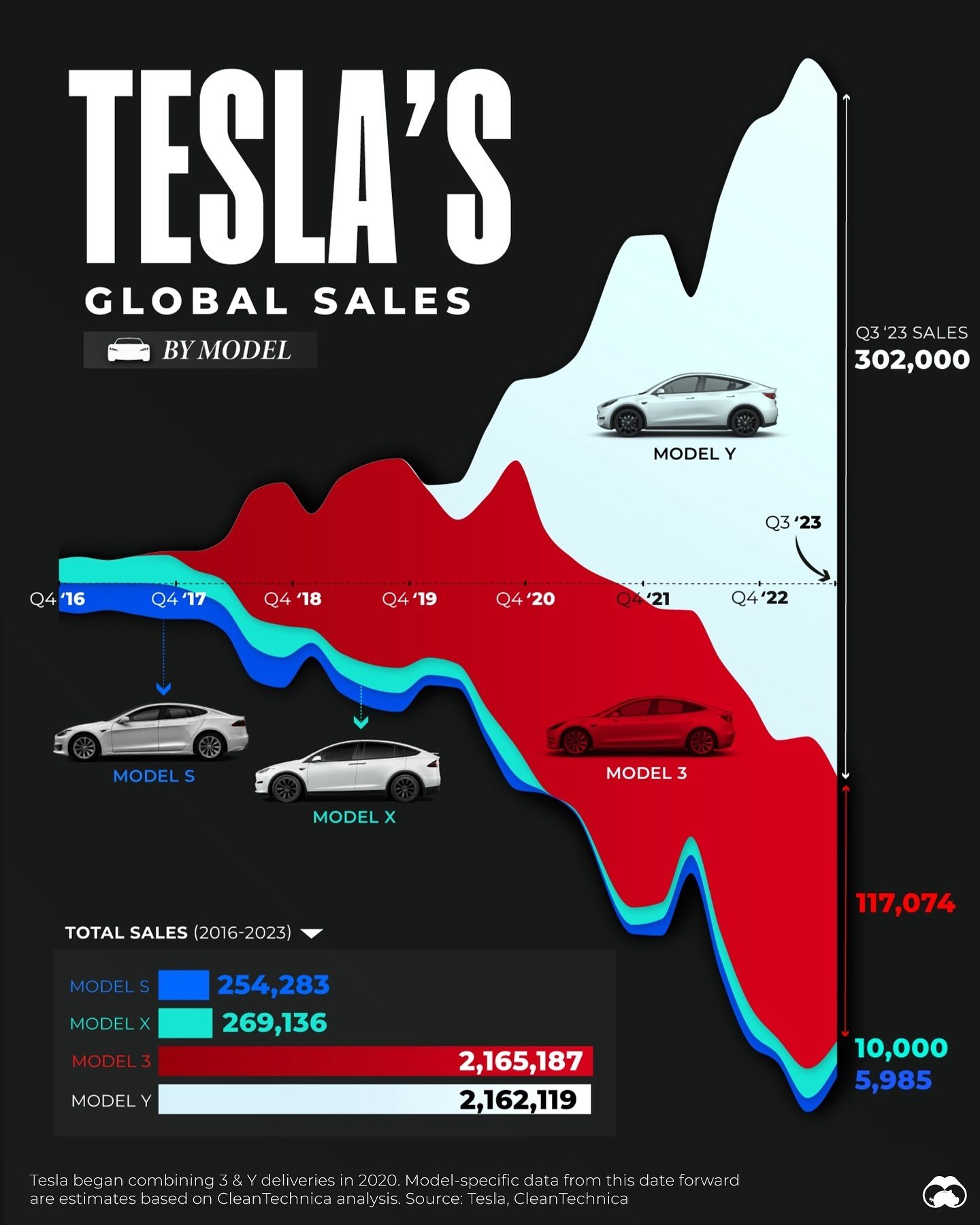
Tesla's global sales have seen a remarkable surge over the past seven years, with a staggering 30x increase in sales from Q2 2016 to Q3 2023. This period also saw Tesla's stock rise by more than 800%, highlighting the company's significant market impact. Understanding the model-specific sales trends provides valuable insights into Tesla's strategic growth and market performance.
The Model Breakdown
Tesla's sales can be segmented into four primary models: the Model 3, Model Y, Model S, and Model X. Let's delve into the sales trends for each model.
Model 3 and Model Y
The Model 3 and Model Y have been pivotal in Tesla's rapid expansion. Introduced in 2017 and 2020, respectively, these models quickly became the backbone of Tesla's sales. In fact, Tesla began combining deliveries of these models from 2020 onwards, underscoring their combined market dominance. Estimates based on CleanTechnica analysis suggest that the Model 3 and Model Y have collectively driven the majority of Tesla's sales growth.
Model S and Model X
The Model S and Model X, Tesla's initial foray into the luxury electric vehicle market, continue to hold a significant share of the company's sales. While their sales figures are lower compared to the Model 3 and Model Y, these models remain crucial for Tesla's brand positioning in the luxury segment. The Model S and Model X have seen steady demand, contributing to Tesla's overall market presence and innovation leadership.
Why This Matters
Tesla's sales growth is not just a testament to the company's success but also a reflection of the broader shift towards electric vehicles (EVs). The surge in Tesla's sales over the past seven years highlights several key trends and factors:
Market Adoption and Consumer Preferences
The exponential increase in Tesla's sales indicates a growing consumer preference for electric vehicles. Factors such as environmental awareness, government incentives, and advancements in battery technology have driven this shift. Tesla's success serves as a case study for the EV market's potential and the public's willingness to adopt sustainable transportation solutions.
Technological Innovation and Supply Chain Efficiency
Tesla's ability to scale production and maintain quality has been integral to its sales growth. The company's vertical integration, where Tesla controls much of its supply chain, has allowed it to innovate rapidly and introduce new models more efficiently. This strategy has been crucial in meeting the high demand for Tesla's vehicles and maintaining its competitive edge.
Strategic Market Positioning
Tesla's strategy of introducing models at different price points has allowed it to capture a broader market. The Model 3 and Model Y, priced more affordably, have attracted a larger consumer base, while the Model S and Model X cater to the luxury segment. This diversified approach ensures that Tesla remains competitive across multiple market segments.
Practical Tips for Understanding Tesla's Sales Data
For those looking to analyze Tesla's sales data, here are some practical tips:
Focus on Quarterly Trends
Analyzing Tesla's sales data on a quarterly basis provides a clearer picture of seasonal variations and the impact of new model releases. This granular data can highlight trends that monthly or annual figures might obscure.
Compare Model-Specific Data
Comparing the sales figures of different models can reveal how Tesla's market strategy evolves. For instance, the combined delivery data for the Model 3 and Model Y from 2020 onwards can provide insights into how these models' shared success has influenced Tesla's overall sales performance.
Consider External Factors
External factors such as government policies, economic conditions, and technological advancements can significantly impact Tesla's sales. Keeping an eye on these factors can help contextualize the sales data and provide a more comprehensive understanding of Tesla's market performance.
Important Takeaways
Here are the key takeaways from Tesla's global sales data:
- Model 3 and Model Y Dominance: These models have been the driving force behind Tesla's sales growth, with combined deliveries significantly impacting overall sales.
- Luxury Segment: The Model S and Model X maintain a strong presence, contributing to Tesla's brand image and market positioning.
- Market Trends: Tesla's success reflects broader trends in EV adoption, consumer preferences, and technological advancements.
- Strategic Diversification: Tesla's strategy of offering models at various price points has allowed it to capture a broader market and remain competitive.
Conclusion
Tesla's global sales data from 2016 to 2023 provides a detailed look into the company's remarkable growth and strategic successes. By analyzing the sales trends of the Model 3, Model Y, Model S, and Model X, one can gain valuable insights into Tesla's market positioning, consumer preferences, and overall market impact. Understanding these trends is crucial for anyone looking to grasp the dynamics of the electric vehicle market and Tesla's pivotal role within it.
Watch the Reel
Questions readers ask
Which Tesla models have contributed the most to the company's sales surge?
The Tesla Model 3 and Model Y have been the primary drivers of Tesla's sales growth. Introduced in 2017 and 2020 respectively, these models have become the most popular in Tesla's lineup. Their affordability and practicality have made them favorites among consumers, contributing significantly to the global electric vehicle market trend.
How have Tesla's global sales changed from 2016 to 2023?
Tesla's global sales have increased by 30x from Q2 2016 to Q3 2023. This dramatic increase reflects the company's growing market influence and consumer preference. The surge in sales is also mirrored by a more than 800% rise in Tesla's stock during the same period.
What are the primary models that make up Tesla's sales?
Tesla's sales are primarily made up of four models: the Model 3, Model Y, Model S, and Model X. The Model 3 and Model Y, in particular, have been pivotal in Tesla's rapid expansion, with the Model 3 being the best-selling model.
What factors have influenced Tesla's market performance?
Tesla's market performance has been influenced by several factors, including the success of the Model 3 and Model Y, a growing consumer preference for electric vehicles, and strategic growth initiatives. The company's stock performance and sales data highlight its significant impact on the global electric vehicle market.
What are the most significant trends in Tesla's sales data over the past seven years?
The most significant trends in Tesla's sales data over the past seven years include a 30x increase in sales from Q2 2016 to Q3 2023, with the Model 3 and Model Y leading the way. Additionally, Tesla's deliveries in 2020 and the subsequent years have shown a consistent upward trend, reflecting the rising consumer demand for electric vehicles.
Related deep dives
Similar reads based on topic and creator.


Recent articles
Fresh deep dives from the latest Reels we unpacked.




Comments
Be the first to comment.