The Hidden World Within
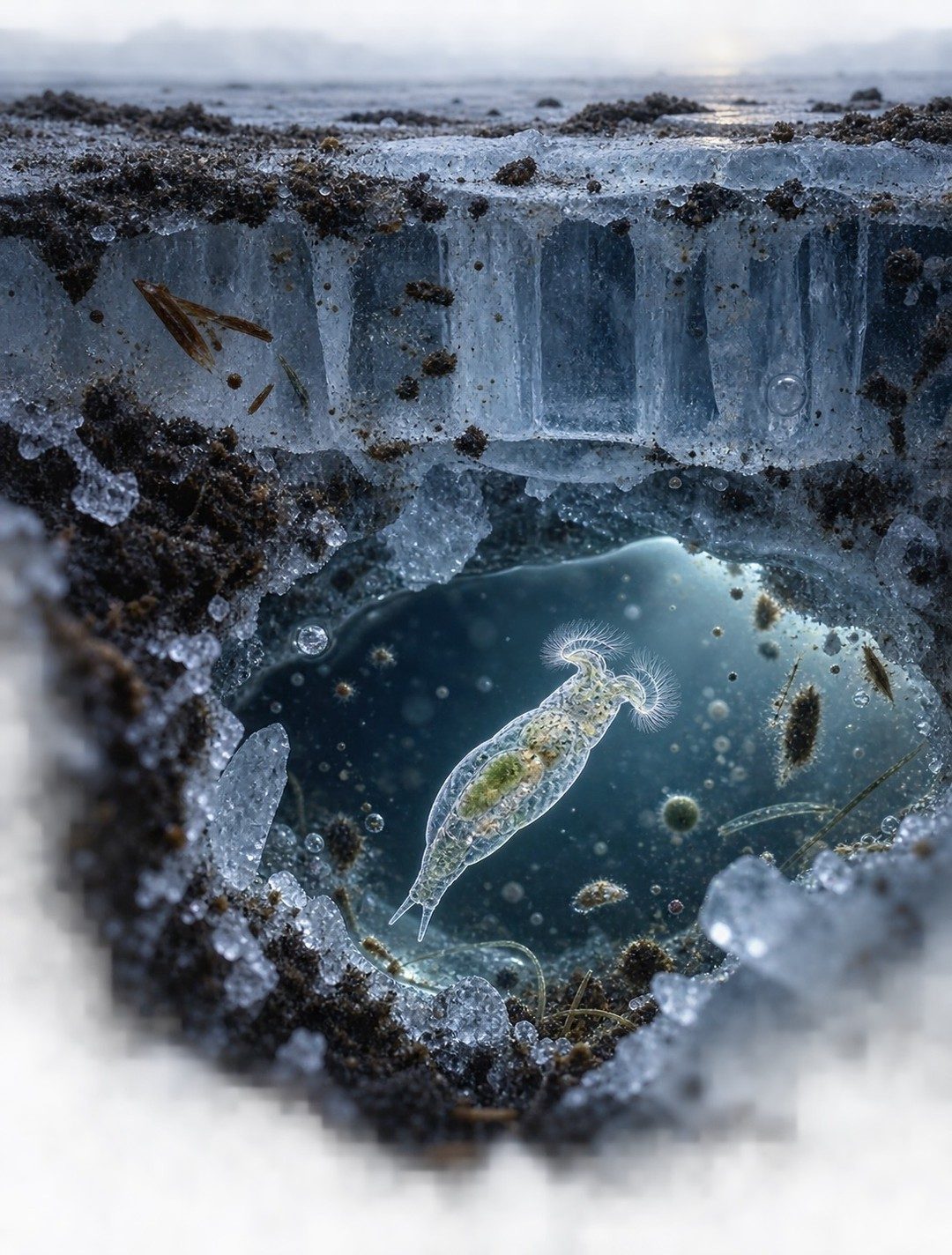
Hidden beneath the icy surface lies a world teeming with more life than the untrained eye would guess. The frozen ecosystems of our planet are not as desolate as they might seem. It is not solely polar bears and seals that thrive here. A tiny, nearly invisible figure stands out among the ice crystals. The translucent figure is a tardigrade. These organisms, also known as water bears, have an incredible ability to withstand extreme conditions. This resilience allows the tardigrade to live in environments where most other life forms would perish. Such camoflauged resilience may explain their presence in an environment that seems devoid of life. The tardigrade's usual habitats include moss, soil, and even the surface of the ocean. The sighting of one in frozen water highlights a fascinating case of adaptability.
Life in the Deep Freeze
Tardigrades are remarkable for their ability to survive in the harshest conditions. They can withstand temperatures as low as -300°F and as high as 300°F. Such conditions, though widespread in nature, can be hostile to most organisms. The tardigrade is an example of how life can adapt to thrive in marginal places. This adaptability is often overlooked by the general public, who might think of frozen environments as sterile wastelands. The ability to survive in frozen water is not the only astonishing feat of the tardigrade. They can also enter a state called cryptobiosis, where their metabolic processes halt, and they become completely dormant. This is not unlike turning into a kind of living fossil. This ability to enter cryptobiosis allows them to survive in environments where water and food are scarce and temperatures too unstable for survival. Tardigrades have been known to survive being exposed to the vacuum of space. This resilience is a testament to the power of biological adaptation.
The Unseen Universe
Researchers are actively exploring the idea that life might exist in the outer solar system in such habitats for this reason. Jupiter's icy moon, Europa, and Saturn's Enceladus offer environments that are both cold and rich in water. The tardigrade's abilities suggest that if life does exist in such remote places, it could be in a state similar to the tardigrade's cryptobiosis, awaiting the right conditions to resume its life processes. More is being learned about the hardiness of tardigrades as they continue to unlock the mysteries of frozen ecosystems. Deep beneath the icy surface, beneath the ice formations and bubbles, a unique and captivating ecosystem thrives, revealing that even in the harshest conditions, life finds a way. The tardigrade's presence in frozen water underscores the power of adaptation and the resilience of life.
Watch the Reel
Related deep dives
Similar reads based on topic and creator.
Recent articles
Fresh deep dives from the latest Reels we unpacked.

Comments
Be the first to comment.