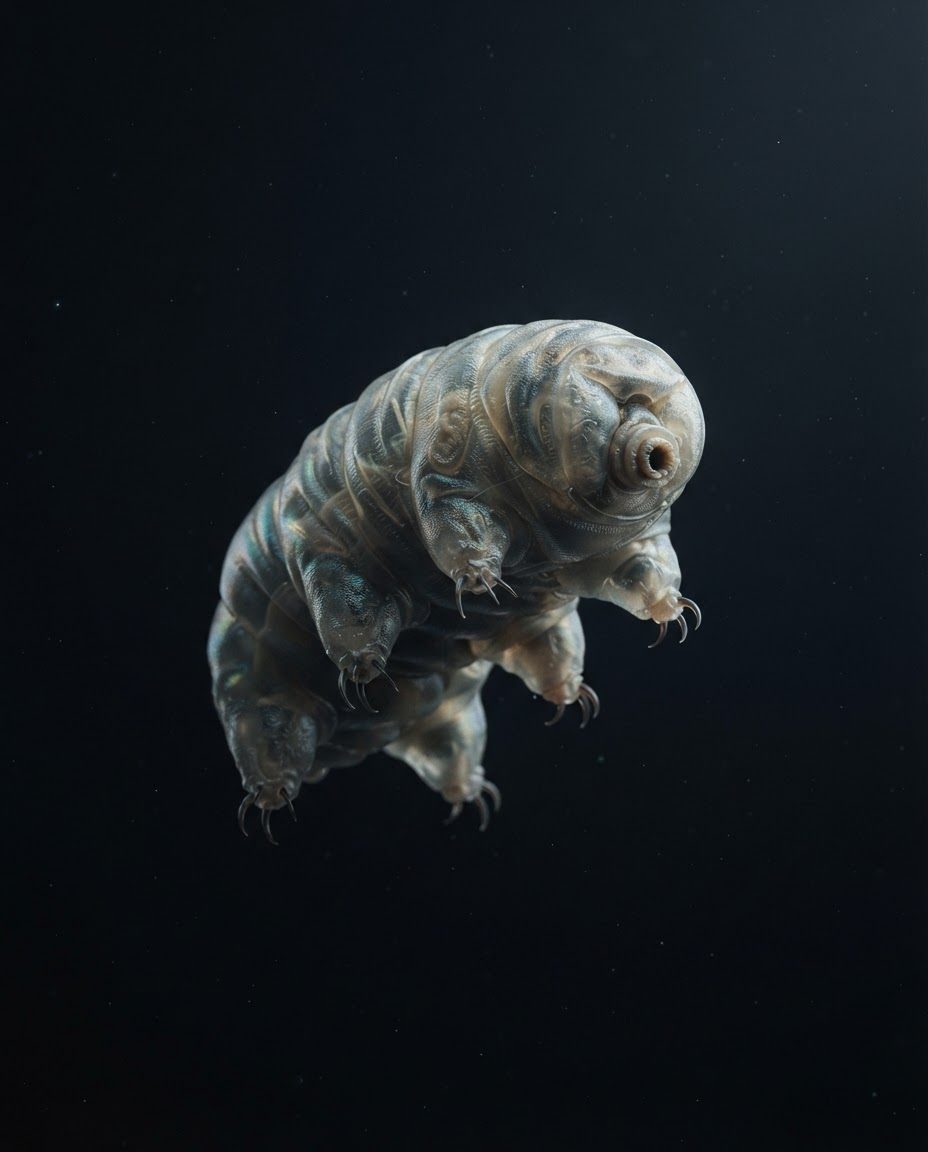
Tardigrades: Masters of Extreme Survival
Tardigrades—no bigger than the width of a human hair—are the ultimate survivors in the animal kingdom. They are often referred to as water bears or moss piglets. Researchers have discovered that tardigrades can endure extreme conditions that would kill almost any other creature. From radiation to dehydration, and even the vacuum of space. Tardigrades have a unique biological mechanism called cryptobiosis, which allows them to enter a state of metabolic inactivity. This process slows their metabolism to less than 0.01% of their normal rate. They can survive these extreme conditions due to a biological response called cryptobiosis. In this state, the tardigrade's metabolism slows to less than 0.01% of the normal rate, allowing it to withstand conditions that would kill most other creatures. These microscopic animals live in diverse environments, including moss, soil, and freshwater. The key to their survival may lie in their ability to produce a unique type of protein called a tardigrade-specific intrinsically disordered protein, known as TDP-1.
The Art of Longevity
Tardigrades could potentially live up to 60 years. Tardigrade's remarkable resilience opens up new avenues for understanding human aging and longevity. They are capable of surviving in extreme environments because they can halt their life processes for extended periods. One of the most fascinating aspects of tardigrades is their ability to go dormant. This process is called cryptobiosis. Scientists are particularly interested in the proteins that tardigrades produce: these help unlock the secrets of longevity and can be used to develop medications that combat aging and diseases like Parkinson's and cancer.
Future Exploration and Medical Advancements
Researchers hope that tardigrade proteins could one day be used to protect humans from the effects of radiation and space travel. This discovery could be crucial for future space missions. Tardigrade studies, which may hold the keys to protecting people from space travel's harsh conditions. The proteins tardigrades produce might protect astronauts' DNA and cells from radiation during deep-space missions. These tiny creatures could pave the way for future medical advancements.
Watch the Reel
Related deep dives
Similar reads based on topic and creator.




Recent articles
Fresh deep dives from the latest Reels we unpacked.



Comments
Be the first to comment.