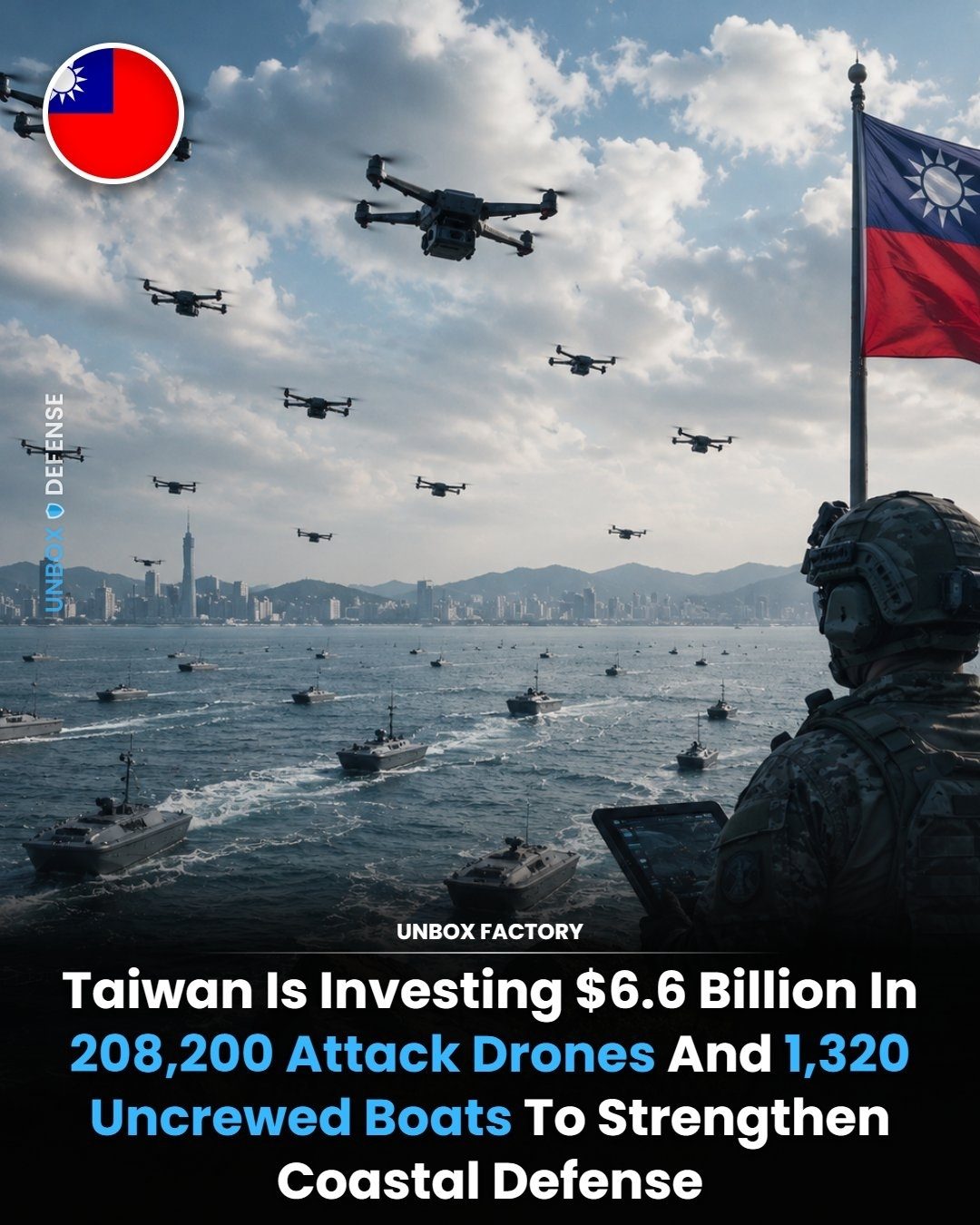
Taiwan's $6.6 Billion Investment in Military Drones and Boats
Taiwan's recent announcement of a $6.6 billion defense investment signals a significant shift in its military strategy. This investment is focused on building an asymmetric force centered around 208,200 attack drones and 1,320 unmanned surface vessels (USVs) to bolster coastal defense and deter amphibious assaults. This move reflects a broader global trend toward AI-enabled, autonomous warfare, particularly in the Indo-Pacific region.
Context: Why This Matters
The Indo-Pacific region is a hotspot for geopolitical tensions, with Taiwan often at the center of these dynamics. Traditional defense strategies often rely on large, expensive warships and aircraft. Taiwan's new strategy, however, emphasizes the use of inexpensive, autonomous drones and uncrewed boats. These force multipliers can saturate defenses, overwhelming much larger naval forces at a fraction of the cost. This approach not only augments Taiwan's defensive capabilities but also aligns with a broader global shift toward AI and autonomous warfare.
Main Discussion
The Role of Autonomous Drones
Autonomous drones are transforming military strategy worldwide. Their affordability and versatility make them powerful tools for surveillance, reconnaissance, and even offensive operations. Taiwan's plan to acquire 208,200 attack drones represents a massive scaling up of this technology.
Versatility in Operations
One of the key advantages of autonomous drones is their versatility. They can be used for a wide range of missions, including:
- Surveillance and Reconnaissance: Drones equipped with high-resolution cameras and sensors can provide real-time intelligence, helping military planners make informed decisions.
- Offensive Operations: Armed drones can strike targets with precision, minimizing collateral damage and reducing the risk to human personnel.
- Force Multiplication: Due to their relatively low cost, drones can be deployed in large numbers, creating a formidable defense line that is difficult for adversaries to penetrate.
Cost-Effectiveness
The cost-effectiveness of autonomous drones is a significant factor in Taiwan's decision. Traditional military assets, such as warships and aircraft, are extremely expensive to acquire, operate, and maintain. In contrast, drones offer a cost-effective alternative that can achieve similar or even superior outcomes in certain scenarios.
The Importance of Unmanned Surface Vessels (USVs)
In addition to drones, Taiwan is investing in 1,320 unmanned surface vessels (USVs). These vessels are designed to enhance coastal defense by patrolling waters and conducting various maritime operations without putting human lives at risk.
Enhancing Coastal Defense
USVs play a crucial role in coastal defense by providing continuous surveillance and deterrence. They can operate autonomously, patrolling the coast and responding to potential threats. This capability is particularly important for Taiwan, given its extensive coastline and the risk of amphibious assaults.
Operational Capabilities
USVs can be equipped with various sensors and weapons, making them versatile in their operational capabilities:
- Mining Operations: USVs can lay mines to defend against enemy ship incursions, creating a barrier that is difficult to breach.
- Anti-Submarine Warfare (ASW): Equipped with sonar and other sensing technologies, USVs can detect and engage submarines, enhancing overall maritime security.
- Reconnaissance and Surveillance: USVs can gather intelligence and monitor maritime activities, providing valuable data for strategic planning.
The Global Shift Toward Autonomous Warfare
Taiwan's investment is part of a broader global trend toward AI-enabled, autonomous warfare. Nations around the world are increasingly recognizing the advantages of autonomous systems in military operations. This shift is driven by several factors:
- Technological Advancements: Rapid advancements in AI, robotics, and sensor technology have made autonomous systems more capable and reliable.
- Cost Efficiency: Autonomous systems offer a cost-effective way to enhance military capabilities without the high costs associated with manned systems.
- Risk Reduction: Autonomous systems reduce the risk to human personnel, making them an attractive option for dangerous missions.
- Force Multiplication: The ability to deploy large numbers of autonomous systems allows for force multiplication, making it possible to overwhelm adversaries with sheer numbers.
Practical Tips
For military planners and strategists, there are several practical considerations to keep in mind when integrating autonomous systems into defense strategies:
- Training and Adaptation: While autonomous systems reduce the need for human personnel in certain roles, they still require skilled operators and maintainers. Ensuring that personnel are adequately trained and adapted to these new technologies is crucial.
- Cybersecurity: Autonomous systems rely on advanced software and communication networks, making them vulnerable to cyber-attacks. Robust cybersecurity measures are essential to protect these systems from potential threats.
- Interoperability: Autonomous systems must be integrated with existing military infrastructure and communication networks. Ensuring interoperability is key to maximizing their effectiveness.
- Ethical and Legal Considerations: The use of autonomous weapons raises important ethical and legal questions. Military planners must consider the implications of using such systems and ensure compliance with international laws and regulations.
Important Takeaways
- Taiwan's $6.6 billion investment in military drones and boats represents a significant shift in its defense strategy, emphasizing the use of autonomous systems to bolster coastal defense.
- Autonomous drones and unmanned surface vessels offer cost-effective, versatile solutions for a range of military operations, from surveillance to offensive strikes.
- The global trend toward AI-enabled, autonomous warfare is driven by technological advancements, cost efficiency, and the need to reduce risks to human personnel.
- Integrating autonomous systems into defense strategies requires careful consideration of training, cybersecurity, interoperability, and ethical/legal implications.
Conclusion
Taiwan's investment in military drones and boats underscores a broader global shift toward AI-enabled, autonomous warfare. By leveraging the advantages of these technologies, Taiwan aims to enhance its coastal defense capabilities and deter potential threats. The successful integration of autonomous systems will require careful planning, training, and adherence to ethical and legal standards. As other nations follow suit, the future of warfare is likely to see an increasing reliance on autonomous technologies, reshaping military strategies and capabilities worldwide.
Watch the Reel
Questions readers ask
What is the primary goal of Taiwan's $6.6 billion military investment?
The primary goal is to enhance coastal defense and deter potential amphibious assaults by investing in a large fleet of drones and unmanned surface vessels (USVs) along the coast to bolster defense capabilities.
Why is Taiwan focusing on drones and unmanned boats for its defense strategy?
Taiwan is focusing on these technologies due to their affordability and versatility. Drones and unmanned boats can be deployed in large numbers and are adaptable to various defense scenarios, making them an effective choice for bolstering regional security.
How many drones and unmanned boats does Taiwan plan to acquire with this investment?
Taiwan intends to acquire 208,200 attack drones and 1,320 unmanned surface vessels (USVs) as part of this military strategy.
What role does AI and automation play in Taiwan's new defense strategy?
AI and automation are integral to Taiwan's new defense strategy, enabling the operation of a large number of drones and unmanned boats. This allows for enhanced situational awareness and quicker response times, significantly improving overall defense capabilities.
How does Taiwan's new strategy differ from traditional defense approaches?
Taiwan's new strategy diverges from traditional approaches by prioritizing the use of large numbers of cost-effective, autonomous systems (drones and unmanned boats) over a few, expensive warships and aircraft, making defense more efficient and sustainable.
What is the significance of the Indo-Pacific region in Taiwan's defense strategy?
The Indo-Pacific region is a crucial area for Taiwan's defense due to its geopolitical tensions. This region is a focal point for many global security concerns, and Taiwan's investment in drones and unmanned boats is a strategic response to the need for robust coastal defense in this dynamic environment.
What is the timeline for this military investment by Taiwan?
The exact timeline for the implementation of this $6.6 billion investment is not explicitly mentioned, but it is part of the 2023 defense budget, indicating that the initiative is underway and planned for near-future execution.
Related deep dives
Similar reads based on topic and creator.


Recent articles
Fresh deep dives from the latest Reels we unpacked.




Comments
Be the first to comment.