Nature's ephemeral art
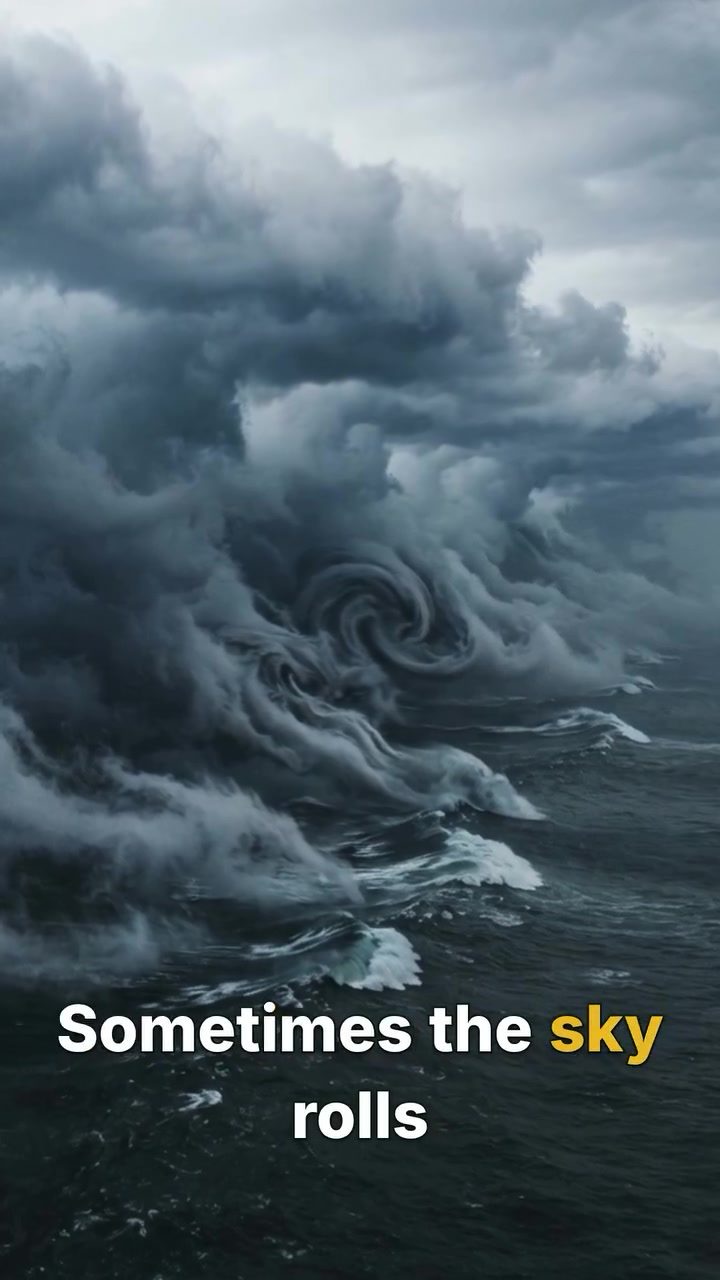
The sky is a canvas. The Earth is a painter. The wind is a brush. Vortices on the sea mirror vortices in the sky. Some clouds cascade in waves. They have a name. Kelvin-Helmholtz Instability. This means clouds churn like stormy waters. This instability occurs 6,000 miles above the Earth, rarely lasts more than a few minutes, and can "serve as an example of the complexity of fluid dynamics." The border of a sliding layer of faster air and a slower layer of air curls in on itself, forming "breaking waves of cloud. This is usually during a temperature inversion."
The birth of understanding
Physicists Lord Kelvin and Hermann von Helmholtz studied this phenomenon in the 1800s. Kelvin was born into privilege and meant for a career in law. However, his curiosity was piqued. He wanted to understand the natural world. He wanted to understand electricity, which a few centuries earlier was "a puzzling and sometimes dangerous phenomenon." This barely visible force. Kelvin's work on electricity put him at the forefront of the scientific frontier. He also contributed to thermodynamics and the atom. Their names are stitched together. It is a permanent thread in the fabric of science. One of the great pairs. The duo studied the instability behind cloud waves. The instability is behind cloud formations. And as well, the instability is behind the breaking waves of cloud formations that unfold in the sky. The work of Kelvin and Helmholtz helps us comprehend the flow of clouds and uncertainty. In weather, fog appears like the paint on a canvas. In art, paint appears like fog. Out of this flow, form emerges.
The backstory of an object
The sea stretches beneath the sky. Patched with clouds. The sky rolls like the ocean. Kelvin and Helmholtz studied the instability behind it. Air layers move over one another, creating cloud waves. A few minutes later, those clouds have changed. Air currents and humidity shift. Clouds disappear. The fluid dynamics equation written briefly across the sky is no longer visible. However, it remains. The backstory of an object is the deep understanding of its creation. The sky is a canvas. The Earth is a painter. The wind is a brush. But the temperamental canvas is always changing. The backstory of the clouds is the deep understanding of thermodynamic phenomena.
Watch the Reel
Related deep dives
Similar reads based on topic and creator.

Recent articles
Fresh deep dives from the latest Reels we unpacked.


Comments
Be the first to comment.