AI Model Optimization: Splitting Models for Speed
AI models have been revolutionizing various fields, but their optimization remains a critical area of research. One recent breakthrough involves splitting a 30B AI model in half, significantly enhancing its speed while maintaining most of its original quality. This approach, called Nemotron-Labs-TwoTower, illustrates a new frontier in AI model optimization.
Why This Matters
As AI models grow larger and more complex, their computational demands also increase. This can lead to slower processing times, higher costs, and reduced efficiency. Optimization techniques that can enhance speed without compromising quality are crucial for advancing AI applications. The Nemotron-Labs-TwoTower method demonstrates a practical solution to this challenge, offering a glimpse into the future of AI model design.
Main Discussion
The Split Model Approach
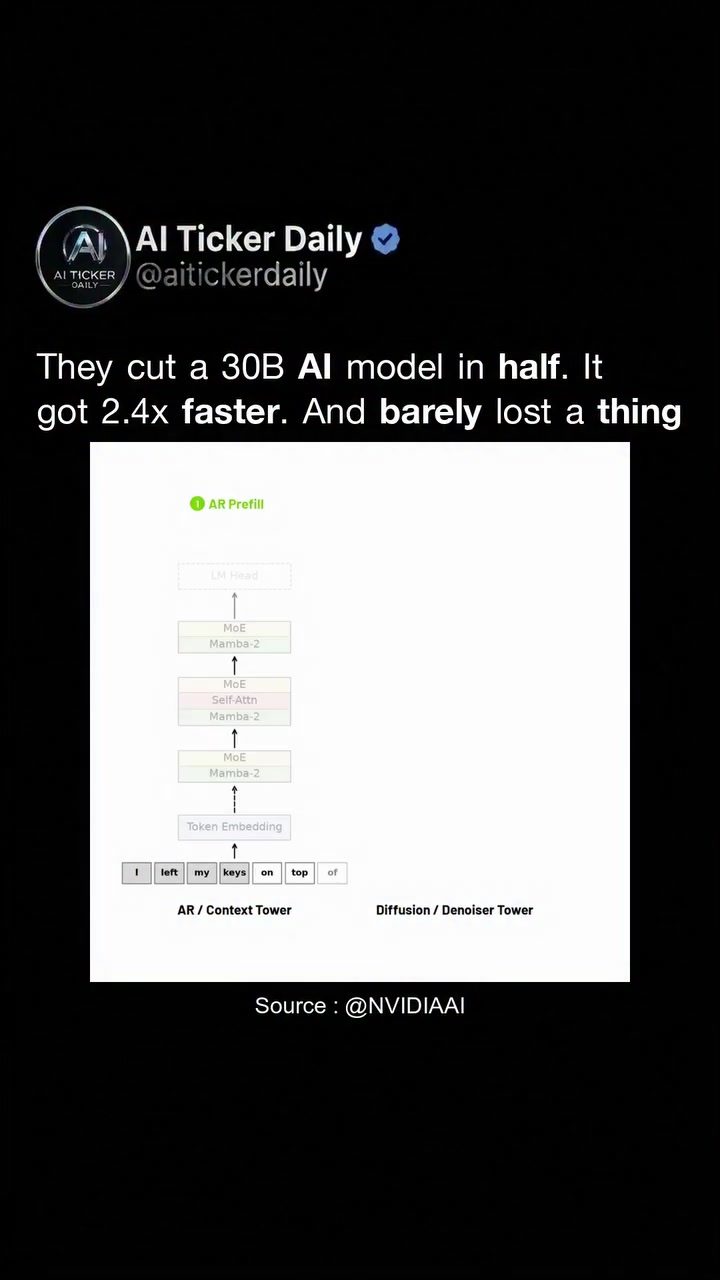
The Nemotron-Labs-TwoTower method involves splitting a 30B AI model into two halves. One half is responsible for holding the context, while the other handles token generation. This division allows both halves to run in parallel, rather than sequentially, leading to a 2.4x speed increase. Essentially, the model processes multiple tasks simultaneously, reducing the overall time required for generation.
Parallel Processing
In traditional AI models, tasks are often processed one after the other. By splitting the model and running the two halves in parallel, the Nemotron-Labs-TwoTower method achieves significant speed improvements. This parallel processing is akin to having two workers complete different parts of a task simultaneously, resulting in faster completion times.
Preserving Model Quality
One of the most impressive aspects of this optimization technique is its ability to maintain 98.7% of the original model's quality. The split does not require retraining from scratch; instead, it adapts existing components. This adaptation ensures that the model retains its accuracy and performance, despite the structural changes.
Key Components
Several key components are involved in the Nemotron-Labs-TwoTower model. These include:
- Mamba-2: This component is integral to the model's architecture, playing a crucial role in both halves.
- Token Embedding: This process converts tokens into a format that the model can understand and process.
- AR Context Update: This component ensures that the context is updated in real-time, maintaining the model's accuracy.
- MoE (Mixture of Experts): This technique allows the model to combine the strengths of different sub-models, enhancing its overall performance.
Diagrams and Visualization
Visual aids, such as diagrams showing the model's architecture and optimization process, are essential for understanding this method. These diagrams illustrate how the model is split and how each component interacts with the others. They highlight key elements like the AR Context Update, Token Embedding, and Mamba-2, providing a clear visual representation of the optimization process.
Practical Tips
Implementing a similar optimization in your own AI models can be highly beneficial. Here are some practical tips to get you started:
1. Identify Key Components
Analyze your model's architecture to identify key components that can be split and run in parallel. Look for processes that can be handled independently, such as context holding and token generation.
2. Test Parallel Processing
Experiment with parallel processing to see how it affects your model's speed and quality. Start with small-scale tests and gradually scale up as you become more comfortable with the process.
3. Adapt Existing Components
Rather than retraining from scratch, adapt existing components to fit the new parallel structure. This approach can save time and resources while maintaining the model's original quality.
4. Monitor Performance
Regularly monitor your model's performance to ensure that the optimization does not compromise its quality. Use metrics like speed and accuracy to track improvements and make necessary adjustments.
Important Takeaways
Speed and Efficiency
Splitting an AI model and running its halves in parallel can significantly enhance speed and efficiency. This method allows for faster processing times, reducing the overall computational demands and costs.
Quality Preservation
Optimization techniques that adapt existing components can maintain high-quality performance. This approach ensures that the model retains its accuracy and reliability, even after structural changes.
Future of AI Model Design
The Nemotron-Labs-TwoTower method offers a glimpse into the future of AI model design. As researchers continue to explore new optimization techniques, we can expect even more innovative solutions that enhance speed and efficiency without sacrificing quality.
Conclusion
The optimization of AI models is a critical area of research, and the Nemotron-Labs-TwoTower method represents a significant breakthrough. By splitting a 30B AI model into two halves and running them in parallel, this approach achieves a 2.4x speed increase while maintaining 98.7% of the original quality. This method demonstrates the potential of parallel processing and adaptation in enhancing AI model performance, paving the way for future innovations in the field.
Watch the Reel
Questions readers ask
What is the Nemotron-Labs-TwoTower method and how does it improve AI model speed?
The Nemotron-Labs-TwoTower method involves splitting a 30B AI model in half and running these two halves in parallel. By doing so, this technique can boost the processing speed by 2.42 times without the need for extensive retraining, making it a effective way to enhance AI model performance.
Can splitting an AI model affect its quality?
Splitting an AI model using the Nemotron-Labs-TwoTower method maintains most of the original model's quality. This ensures that the speed boost does not come at the cost of reduced accuracy or performance.
How does parallel processing contribute to AI model acceleration?
Parallel processing allows different parts of the AI model to run simultaneously, rather than sequentially. This significantly reduces the overall processing time, making the model faster and more efficient.
Do I need to retrain the model after using the Nemotron-Labs-TwoTower method?
One of the key benefits of the Nemotron-Labs-TwoTower method is that it does not require extensive retraining. This saves significant time and computational resources, making it a practical solution for speeding up AI models.
What are the benefits of optimizing a 30B AI model?
Optimizing a 30B AI model through techniques like the Nemotron-Labs-TwoTower method can lead to faster processing times, reduced costs, and improved efficiency. This is crucial for advancing AI applications in various fields, where speed and performance are critical.
Can the Nemotron-Labs-TwoTower method be applied to smaller AI models?
While the Nemotron-Labs-TwoTower method was specifically tested on a 30B AI model, the principles of model splitting and parallel processing can potentially be applied to smaller models as well. However, the specific benefits and impact may vary depending on the model's size and complexity.
What are the computational demands of large AI models?
Large AI models, like the 30B model, have high computational demands due to their complexity and size. This can result in slower processing times and higher costs, making optimization techniques like the Nemotron-Labs-TwoTower method essential for efficient AI processing.
Recent articles
Fresh deep dives from the latest Reels we unpacked.




Comments
Be the first to comment.