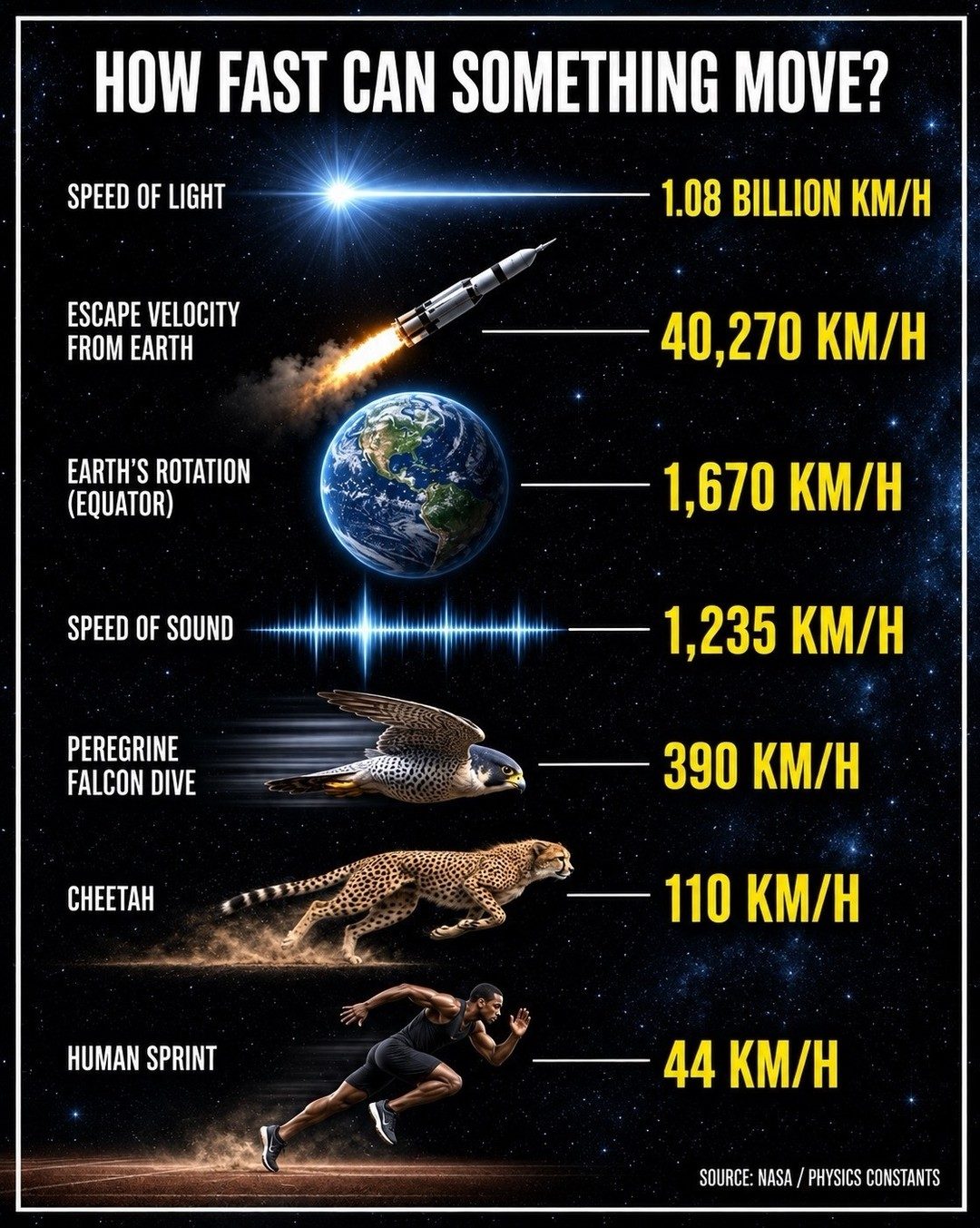
The vast scale of speeds we encounter every day
Our world is in constant motion, from the slow creep of tectonic plates to the supersonic dive of a peregrine falcon. An illustrative infographic begins with the most familiar, the Earth's rotation at the equator, and runs through the Earth system from Earth's escape velocity to the speed of light. The Earth's equatorial rotation is 1,670 kilometers per hour. We frequently use escape velocity as a reference point for space rockets, "escape velocity from Earth" is 40,270 kilometers per hour.
Speed phenomena on Earth
Relative to Earth, the peregrine falcon dive is a startling 390 km/h. For the fastest land animal, "cheetah sprints" are just 110 km/h. The sound barrier is 1,235 km/h, cracking it is critical for fighter jets approaching aircraft carriers.
Building frames of reference
How do we make sense of these vast differences? We categorize, compare, and contextualize. We've easily internalized the speed of our world, from the briskness of a cheetah to the relentlessness of a falcon’s dive. We know the sounds of our world, from the wind rushing past a sprinting human moving at a stately 44 kilometers per hour.
The infographic frames these speeds as a continuum. NASA and other physics data sources provide the speed of light, 1.08 billion kilometers per hour.
At the other extreme is the familiar human sprint. While a human sprint is a peak of physical achievement, juxtaposed with the speed of sound, it might as well be standing still. Mountaineers use familiar landmarks to navigate; we use familiar speeds to comprehend the unimaginably vast scale of our world.
Watch the Reel
Related deep dives
Similar reads based on topic and creator.

Recent articles
Fresh deep dives from the latest Reels we unpacked.



Comments
Be the first to comment.