The Global Space Economy
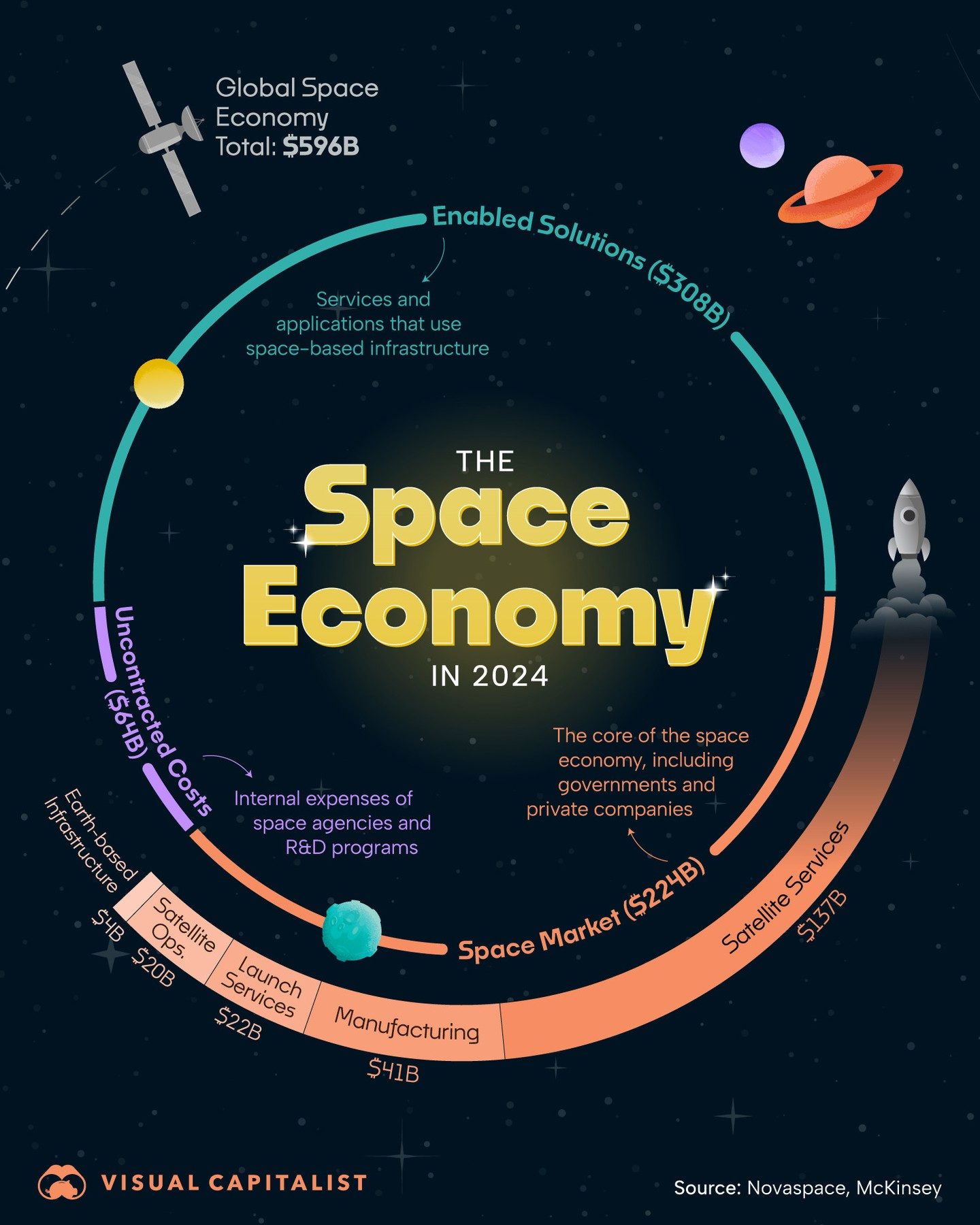
The global space economy hit a staggering $596 billion in 2024, with a projected growth to $944 billion by 2033. This expansive economic segment is dominated by space-based services, including critical functions like weather forecasting, satellite television, and GPS, which collectively account for $308 billion.
Why This Matters
The space economy's exponential growth underscores its pivotal role in modern society. From communication and navigation to scientific research and defense, the applications of space-based technologies are vast and varied. Understanding the space economy's structure and its key sectors—such as launch services, satellite operations, and manufacturing—provides insights into how these technologies are developed, deployed, and maintained. The infographic breaks down the global space economy, illustrating how various sectors contribute to the industry's overall value.
The Core of the Space Economy
Enabled Solutions
Enabled Solutions, valued at $308 billion, form the largest component of the space economy. These solutions include a wide range of services and applications that rely on space-based infrastructure. Key examples include:
- Communication Services: Satellite TV, internet, and telecommunication services that enable global connectivity.
- Navigation Systems: GPS and other navigation systems that guide everything from aircraft to smartphones.
- Weather Forecasting: Satellite data and imagery used for weather prediction and climate monitoring.
- Earth Observation: Remote sensing and satellite imagery for environmental monitoring, agriculture, and disaster management.
These solutions are indispensable for both private and public sectors, driving innovation and economic growth.
Uncontracted Costs
Uncontracted Costs, totaling $41 billion, represent the expenses related to Earth-based infrastructure. This includes ground stations, data centers, and the extensive network required to support space-based operations. These costs are essential for maintaining the operational effectiveness of space-based systems, ensuring reliable data transmission and processing.
Launch Services
Launch Services, valued at $22 billion, encompass the critical activities of launching payloads into orbit. This sector includes launch vehicles, launch pads, and the associated services required to transport satellites and spacecraft into space. Key players in this sector include NASA and private companies like SpaceX and Blue Origin, each contributing to the advancement of launch technology and reducing costs.
Satellite Operations
Satellite Operations, worth $20 billion, focus on the maintenance and management of satellites in orbit. This includes tasks such as tracking satellite positions, performing orbital maneuvers, and ensuring the proper functioning of satellite systems. These operations are crucial for the longevity and reliability of space-based services.
Space Market
The Space Market, valued at $224 billion, includes the internal expenses of space agencies and research and development (R&D) programs. This sector supports the development of new technologies, the expansion of space exploration, and the commercialization of space activities. The Space Market is the core of the space economy, driving innovation and funding the industry's future growth.
Satellite Services
Satellite Services, totaling $137 billion, encompass a wide range of applications that leverage satellite technology. This includes direct-to-home broadcasting, satellite internet, and various Earth observation services. These services are essential for global communication, entertainment, and scientific research.
Manufacturing
Manufacturing, valued at $41 billion, is the backbone of the space economy, involving both governments and private companies. This sector covers the production of satellites, launch vehicles, and other space-related hardware. It includes aerospace companies, defense contractors, and specialized manufacturers that produce critical components for space missions.
The Future of the Space Economy
The space economy is expected to grow significantly over the next decade, driven by advancements in technology, increased investment, and the growing demand for space-based services. Innovations in areas such as satellite constellations, reusable rockets, and space tourism are poised to further expand the industry's reach and impact.
Practical Tips
For those interested in the space economy, staying informed about the latest developments and trends is crucial. Here are some practical tips:
- Follow Industry Leaders: Keep an eye on key players such as SpaceX, Blue Origin, and NASA. These organizations are at the forefront of space innovation and often release updates on their latest projects and advancements.
- Stay Updated on Research: Research institutions and university programs focused on aerospace engineering and space science offer valuable insights into emerging technologies and applications.
- Engage with Space Forums: Participate in online communities and forums dedicated to space exploration and technology. These platforms provide opportunities to discuss and learn from industry experts and enthusiasts.
Important Takeaways
- Space-Based Services: The dominant sector in the space economy, valued at $308 billion, includes essential services like weather forecasting, satellite TV, and GPS.
- Enabled Solutions: These applications, such as communication and navigation systems, rely on space-based infrastructure and account for a significant portion of the space economy.
- Uncontracted Costs: Ground-based infrastructure and operations are crucial for maintaining space-based systems, totaling $41 billion.
- Launch Services: Essential for deploying satellites and spacecraft into orbit, valued at $22 billion.
- Space Market: The core of the space economy, including internal expenses of space agencies and R&D programs, valued at $224 billion.
- Satellite Services: Encompass a wide range of applications, valued at $137 billion, leveraging satellite technology.
Conclusion
The global space economy is a dynamic and rapidly evolving sector with far-reaching implications. From communication and navigation to scientific research and defense, the applications are vast and critical to modern society. Understanding the various sectors, their contributions, and future prospects provides a comprehensive view of this expanding industry. As the space economy continues to grow, it will undoubtedly shape the future of technology and global development.
Watch the Reel
Questions readers ask
What were the primary drivers of the $596 billion global space economy in 2024?
The global space economy in 2024 was primarily driven by space-based services, including weather forecasting, satellite television, and GPS, which together accounted for over half of the total revenue. The demand for these services underscores their importance in various aspects of daily life and industry operations.
How much is the global space economy expected to grow by 2033?
The global space economy is anticipated to grow by 53% from 2024 to 2033, reaching approximately $944 billion. This growth is expected to be fueled by advancements in satellite technology and increasing demand for space-based solutions across various sectors.
What are the key sectors of the space economy?
The key sectors of the space economy include launch services, satellite operations, and manufacturing. Each of these sectors plays a critical role in developing, deploying, and maintaining space-based technologies, which are essential for a wide range of applications, from communication and navigation to scientific research.
What is the significance of the $596 billion figure for the global space economy in 2024?
The $596 billion figure highlights the substantial economic impact of the space industry. It reflects the increasing reliance on space-based technologies for everyday services, as well as the growing investment and innovation in the space sector.
What is NovaSpace economy?
NovaSpace refers to the emerging and rapidly growing segment of the space economy. It encompasses innovative startups, new technologies, and entrepreneurial ventures that are driving the future of space exploration and commercialization.
How do weather forecasting satellites contribute to the global space economy?
Weather forecasting satellites play a vital role in the global space economy by providing critical data for weather prediction, climate monitoring, and disaster management. These satellites support industries ranging from agriculture to aviation, contributing significantly to the overall revenue of the space sector.
What impact does the space economy have on modern communication and scientific research?
The space economy has a profound impact on modern communication and scientific research. Space-based technologies enable global communication networks, facilitate scientific research through satellite observations, and support a wide range of applications, from environmental monitoring to astronomy, enhancing our understanding of the Earth and the universe.
Related deep dives
Similar reads based on topic and creator.




Recent articles
Fresh deep dives from the latest Reels we unpacked.




Comments
Be the first to comment.