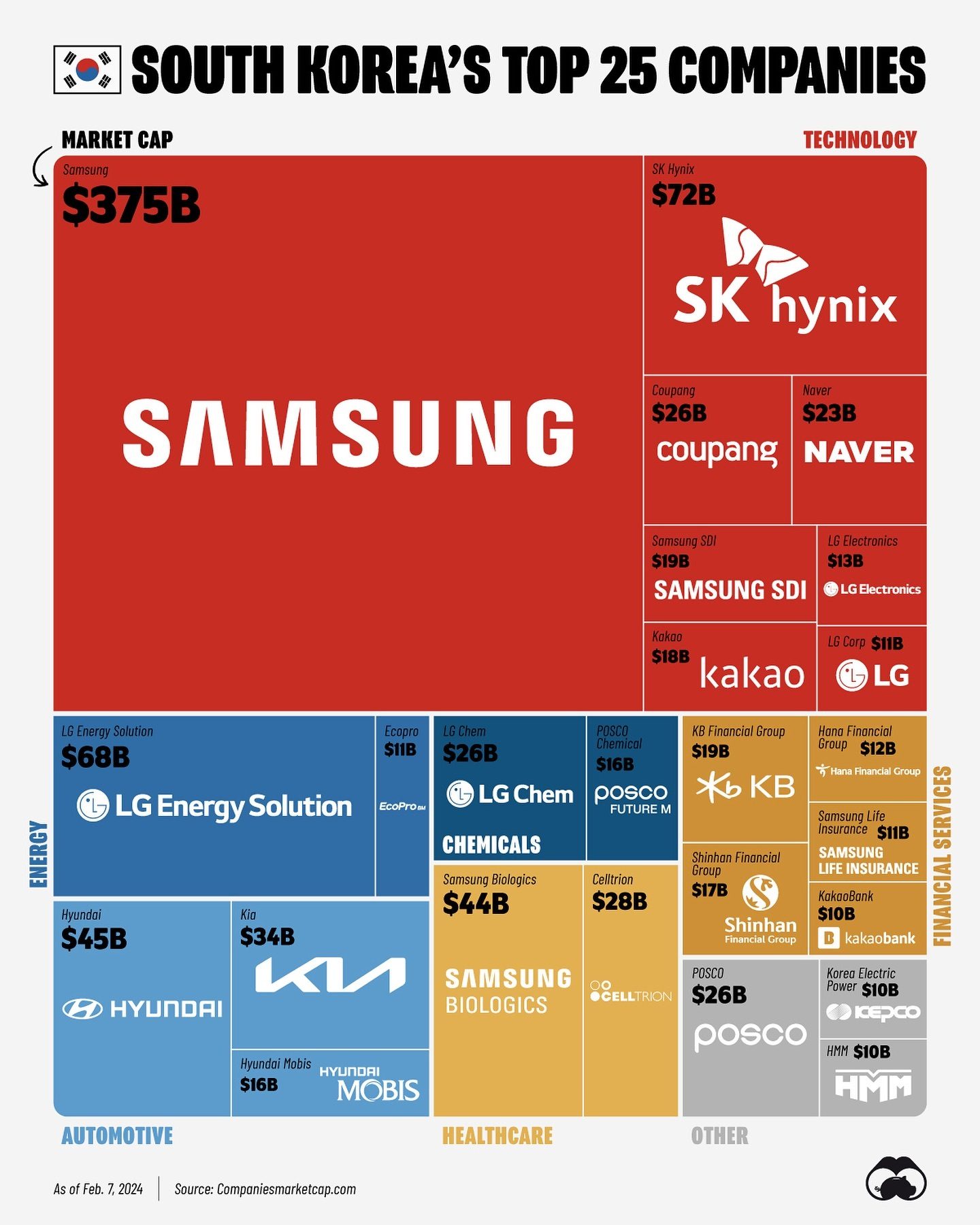
South Korea's Top 25 Companies
South Korea is home to some of the world's most valuable companies, many of which were founded in the decades following the Korean War. These companies, often referred to as chaebols, have grown to become global powerhouses in various industries. Samsung, with a market capitalization exceeding $375 billion, is the most valuable company in South Korea and one of the largest in the world. Among the top 25 companies, a diverse range of sectors are represented, including technology, energy, automotive, healthcare, and financial services.
Why This Matters
Understanding the landscape of South Korea's top companies provides insight into the country's economic strength and global influence. These companies not only drive South Korea's economy but also significantly impact global markets. Their success stories offer valuable lessons in innovation, resilience, and strategic growth.
Samsung: The Undisputed Leader
Samsung, the South Korean electronics and technology giant, dominates the list with a market capitalization of over $375 billion. Samsung's success spans multiple sectors, including consumer electronics, semiconductors, and telecommunications. The company's relentless focus on innovation and quality has positioned it as a global leader in technology.
The Technology Sector
After Samsung, SK Hynix, a leading semiconductor manufacturer, holds the second spot with a market cap of approximately $72 billion. SK Hynix is a key player in the global memory chip market, supplying essential components for a wide range of electronic devices. In the technology sector, other notable companies include:
- LG Corporation: Focused on electronics, chemicals, and telecommunications, LG Corporation has a market cap of $19 billion.
- LG Chem: Specializing in chemicals, LG Chem has a market capitalization of $1 billion.
- Celltrion: A biopharmaceutical company with a market cap of $17 billion, Celltrion is known for its innovative biotech solutions.
The Automotive Industry
The automotive sector is another pillar of South Korea's economy, with Hyundai and its subsidiaries leading the charge. Hyundai, with a market cap of $45 billion, is one of the world's largest automobile manufacturers. Its subsidiaries, Hyundai Mobis and Kia, also feature prominently on the list. Hyundai Mobis, known for its automotive components, has a market cap of $16 billion, while Kia, the automobile manufacturer, has a market cap of $44 billion.
Energy and Financial Services
POSCO, the world's fifth-largest steel producer, is a significant player in the energy and materials sector. With a market cap of $26 billion, POSCO's contributions to the steel industry are vital for South Korea's industrial sector. In the financial services sector, several major banks dominate the market:
- KB Financial Group: With a market cap of $19 billion, KB Financial Group is one of South Korea's largest financial institutions.
- Hana Financial: This financial services company has a market cap of $12 billion.
- Shinhan Financial: Another major player in the financial sector, Shinhan Financial has a market cap of $12 billion.
Healthcare Innovators
South Korea's healthcare sector is also home to innovative companies. Samsung Biologics, a biopharmaceutical manufacturing company, has a market cap of $44 billion. Celltrion, another leading biopharmaceutical company, has a market cap of $17 billion. Samsung Life Insurance, with a market cap of $11 billion, is one of the largest insurance companies in the region.
Diversified Conglomerates
Several diversified conglomerates round out the list of South Korea's top companies. These companies have interests in multiple sectors, contributing to the country's economic diversity. Notable mentions include:
- POSCO: With a market cap of $16 billion, POSCO is a key player in the steel and energy sectors.
- KT Corporation: A leading telecommunications company with a market cap of $19 billion.
- HMM: A shipping and logistics company with a market cap of $10 billion.
Practical Tips for Understanding Market Capitalization
When evaluating companies, it's essential to understand market capitalization. This metric represents the total market value of a company's outstanding shares. Market capitalization is calculated by multiplying the current stock price by the total number of outstanding shares. This figure provides a snapshot of a company's size and potential influence in the market. However, it's important to consider other financial metrics, such as earnings, revenue, and debt, for a comprehensive analysis.
Important Takeaways
South Korea's top companies showcase the country's economic prowess and global influence. Samsung's dominance highlights the company's innovative strength and market dominance. The diverse range of sectors represented in the top 25 companies illustrates South Korea's economic diversity and resilience. Understanding these companies provides valuable insights into the global market dynamics and the strategic advantages of South Korean businesses.
Conclusion
South Korea's top 25 companies represent a blend of technological innovation, industrial might, and financial acumen. From Samsung's dominance in technology to Hyundai's leadership in automotive and POSCO's strength in steel, these companies drive South Korea's economic growth and global influence. Exploring the market capitalizations and sectors of these top companies offers a window into the dynamics of South Korea's economy and its role in the global market.
Watch the Reel
Questions readers ask
What is a chaebol and why are they significant in South Korea's economy?
A chaebol is a large, powerful, and globally recognized company in South Korea. They are significant because they drive the country's economic growth and are major contributors to South Korea's global influence, particularly in sectors like technology, automotive, and healthcare.
What is the market capitalization of Samsung in 2024?
As of 2024, Samsung's market capitalization exceeds $375 billion, making it the most valuable company in South Korea and one of the largest globally. This underscores the company's significant impact on both the domestic and global markets.
Which industries are represented among the top 25 companies in South Korea?
South Korea's top 25 companies span a diverse range of industries, including technology, energy, automotive, healthcare, and financial services. This diversity highlights the country's robust and multifaceted economic landscape.
How did chaebols become such powerful entities in South Korea?
Many of South Korea's chaebols were founded in the decades following the Korean War. They grew rapidly during this period, often with significant government support, and expanded globally, becoming leaders in various industries.
What is the market value of Hyundai and where does it stand among Korean companies?
Hyundai's market value places it among the top companies in South Korea, although exact figures can vary. It is a prominent player in the automotive and construction sectors, contributing significantly to the country's economic landscape.
What insights can be gained from studying South Korea's top companies?
Studying South Korea's top companies provides valuable insights into the country's economic strength, global market influence, and the strategies that have led to their success. It also offers a clearer picture of the competitive dynamics and opportunities within various industries.
How does the market capitalization of South Korean companies compare globally?
South Korean companies, particularly the chaebols, have a substantial global market capitalization. With companies like Samsung leading the way, South Korea's presence in the global market is significant, making it a key player in the international economic landscape.
Related deep dives
Similar reads based on topic and creator.


Recent articles
Fresh deep dives from the latest Reels we unpacked.




Comments
Be the first to comment.