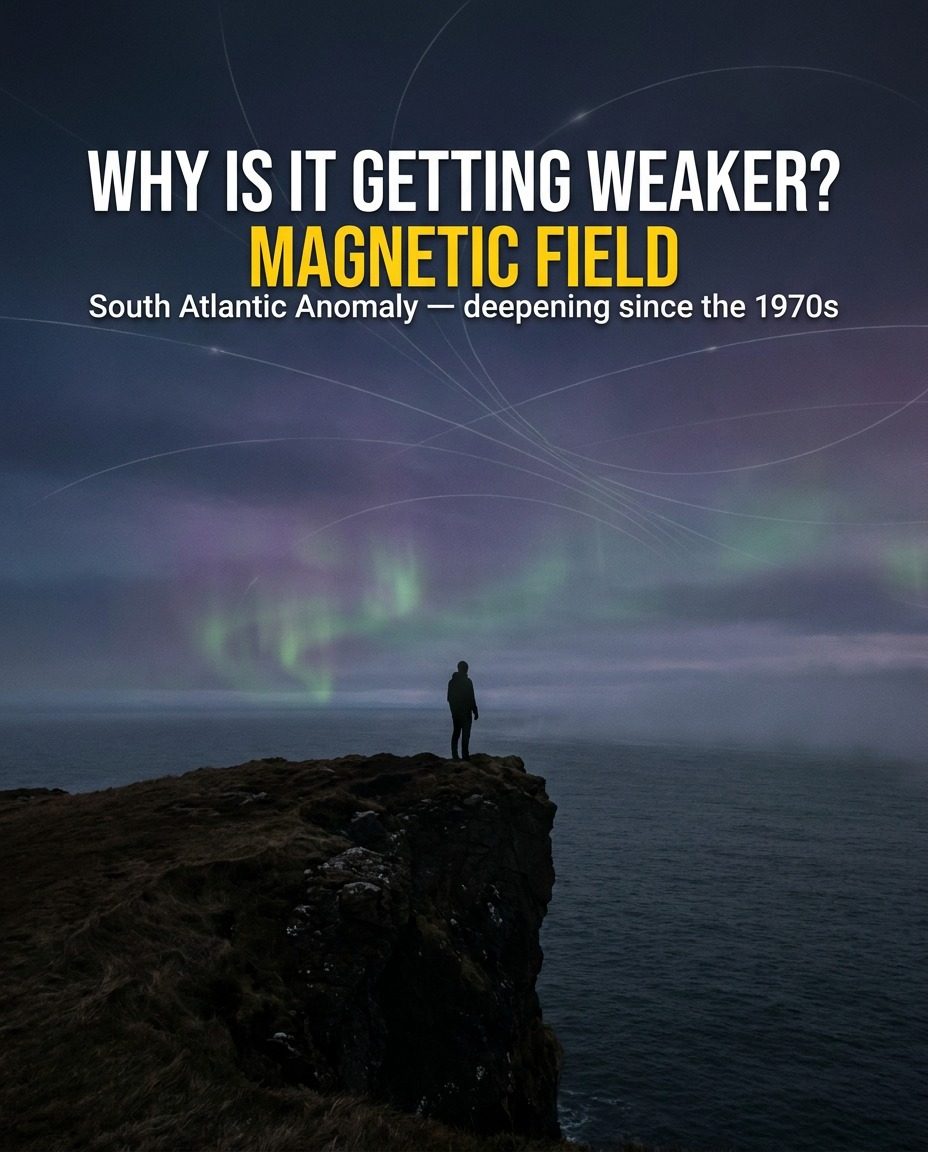
The Weakening South Atlantic Anomaly
Earth's magnetic field is in a state of flux, and the most dramatic evidence lies in a vast region known as the South Atlantic Anomaly. This area, where the Earth's magnetic field is significantly weaker than in other parts of the planet, has been gradually intensifying since the 1970s. The anomaly stretches from South Africa to Chile, creating a peculiar zone where the magnetic field dips closer to the Earth's surface. The weakening magnetic field in this region is likely caused by a combination of factors. One key factor is the sluggish flow of molten iron in the Earth's outer core. This slowdown disrupts the magnetic field lines, causing them to bunch up and form a distinctive oval shape. Imagine a loosely knotted ribbon being slowly tightened in one area. Consequently, the field in this region is about 30% weaker than in other parts of the planet.
Impact on Space Satellites
The anomaly is most noticeable in its impact on space satellites. As the field lines dip, charged particles from the sun become more likely to penetrate, leading to increased radiation and disruption. This radiation is especially detrimental to satellites and spacecraft, causing anomalies that can lead to data loss and equipment damage. The International Space Station has even been moved to avoid the heaviest radiation zones. International Space Station astronauts have been forced to take shelter within more heavily shielded compartments to avoid radiation exposure. Satellite operators must constantly adapt to these changes. For instance, they employ special shielding and software protections to safeguard instruments, astronauts, and communication equipment.
Geomagnetic shifts and Polar Wandering
The South Atlantic Anomaly is part of a broader phenomenon known as geomagnetic shifts, which have occurred sporadically throughout the Earth's history. These shifts often involve the Earth’s magnetic poles gradually moving and possibly even reversing. The last reversal was nearly 780,000 years ago. These shifts can be particularly dangerous for animals and humans that rely on the Earth's magnetic field for navigation and orientation. Marine animals, such as sea turtles, use the Earth’s magnetic field for long-distance migrations. They navigate by detecting the angle and intensity of the magnetic field. The South Atlantic Anomaly underscores the dynamic and evolving nature of the Earth's magnetic field. As the anomaly deepens, scientists remain vigilant, working to understand the underlying mechanisms and potential future impacts.
Watch the Reel
Related deep dives
Similar reads based on topic and creator.



Recent articles
Fresh deep dives from the latest Reels we unpacked.




Comments
Be the first to comment.