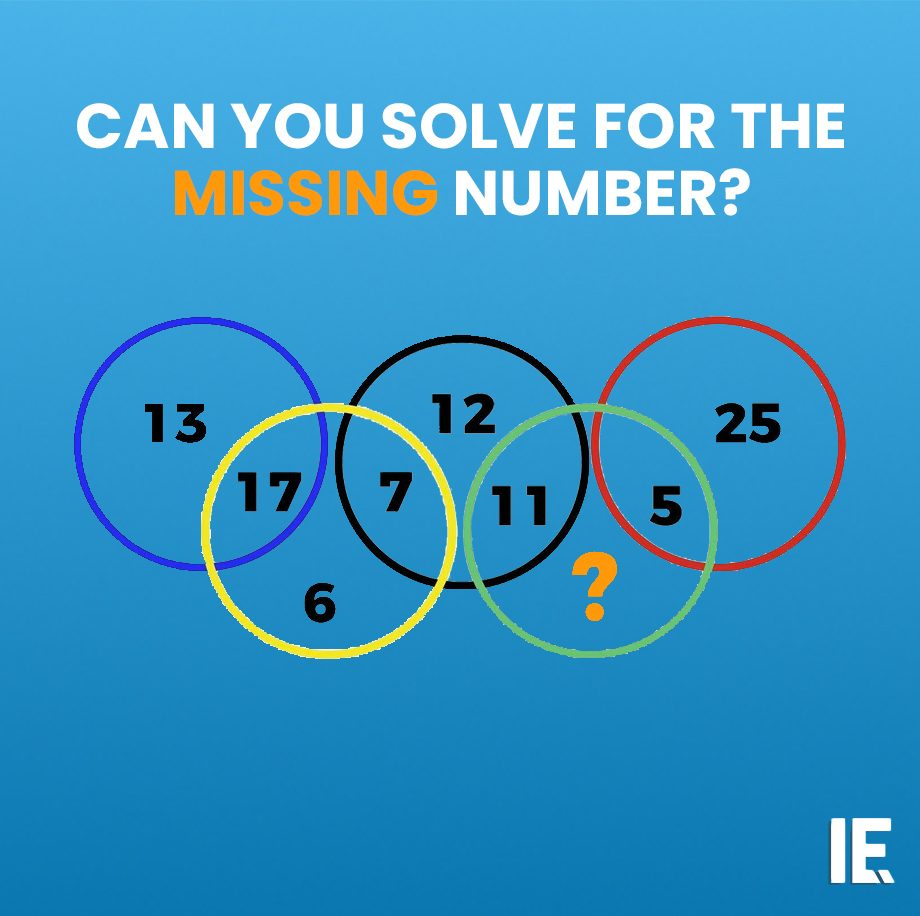
Unraveling the Math Puzzle: Solving the Missing Number in the Venn Diagram
Venn diagrams provide a visual way to represent the relationships between different sets, but when they are filled with numbers, they can become a challenging puzzle. In this case, the task is to figure out the missing number in a Venn diagram puzzle where each circle hides a distinctive pattern.
Understanding the Venn Diagram Puzzle
The puzzle involves a Venn diagram with several overlapping circles, each containing numbers. The challenge is to determine the missing number, specifically in the green circle. The visible numbers in the diagram are 13, 17, 7, 11, 6, 12, 25, and 5.
Context and Why This Matters
Numerical puzzles, particularly those involving Venn diagrams, combine logic and mathematics to create an engaging challenge. These types of puzzles can be found in various educational settings, brainteaser collections, and even in engineering challenges. Solving them helps sharpen analytical skills and pattern recognition. Understanding how to crack these codes can be useful in fields where logical reasoning and data interpretation are crucial.
Deciphering the Pattern
To determine the missing number, it's essential to identify the underlying pattern within each circle. Venn diagrams can show different relationships and combinations, and each section often has a unique rule that governs the numbers it contains.
Observing the Numbers
First, let's list the numbers visible in the diagram and their positions:
- Circle 1: 13
- Circle 2: 17, 11, 25
- Circle 3: 7, 11, 6, 12, 5
From these, we need to figure out the missing number in the green circle. The green circle likely represents the intersection of two or more circles which might be hiding a simple mathematical operation or a logical pattern.
Finding the Pattern
To solve the puzzle, consider the following steps:
-
Identify the intersection points: Determine where the circles overlap and which numbers are shared between them. This can often be the key to figuring out the pattern.
-
Analyze the operations: Check for common operations like addition, subtraction, multiplication, or a specific rule applied to the numbers in each section. For example, in one circle, numbers might be added or multiplied. In another, they could be subtracted or divided.
-
Apply the pattern to the missing number: Once you have identified a pattern, apply it to the numbers in the green circle to determine the missing value.
Practical Tips for Solving
- Break down the problem: Start by breaking down the Venn diagram into smaller parts. Focus on one circle at a time and identify the numbers within it.
- Look for common factors: Check for common factors or patterns that might link the numbers in each circle. Sometimes, a number in one circle might be a factor of the number in another.
- Simplify the problem: Try simplifying the problem by changing the numbers into more manageable ones. For example, if the numbers are large, try dividing all the numbers by the smallest common factor to see if the pattern becomes clear.
- Use trial and error: Sometimes, the best way to solve a puzzle is through trial and error. Try different operations and see which one fits all the numbers.
Important Takeaways
- Patterns are key: In puzzles like these, identifying a pattern is crucial. Look for relationships between the numbers, whether they are numerical, logical, or geometrical.
- Stay organized: Keep track of your findings and try to maintain a systematic approach. This will help you avoid confusion and ensure you don't miss any crucial details.
- Practice makes perfect: The more you solve such puzzles, the better you get at identifying patterns and solving them efficiently.
Conclusion
Solve the Venn diagram puzzle by analyzing the relationships between the numbers in each circle and identifying the underlying pattern. Whether it involves addition, subtraction, or a more complex operation, breaking down the problem, and using logical reasoning is the key to cracking the code.
Watch the Reel
Questions readers ask
How do I start solving a Venn diagram puzzle with numbers?
Begin by examining the numbers in each circle and their overlaps. Look for patterns or rules that apply to the numbers, such as arithmetic sequences, squares, multiples, or other mathematical relationships. Start with the most obvious patterns and work your way to more complex ones.
What should I do if I can't find an obvious pattern in the Venn diagram?
If the pattern isn't immediately clear, consider the relationships between the numbers in different sections of the diagram. Check for consistent differences or ratios between numbers in overlapping and non-overlapping sections. Also, consider the position of the numbers in the diagram and if they follow a sequential or positional pattern.
Why is the number in the green circle missing in a Venn diagram puzzle?
The missing number in the green circle is typically the target of the puzzle, as it requires you to apply the deduced patterns or rules to find the hidden value. This missing number is often the final step in verifying that you have correctly identified the underlying numerical pattern.
Can I use trial and error to solve a Venn diagram puzzle?
While trial and error can sometimes help, it's more efficient to use logical deduction. Look for consistent mathematical rules or patterns that apply to all given numbers. Once you identify a potential pattern, test it against all numbers in the diagram to confirm its validity.
Are there any specific types of number patterns I should look for in a Venn diagram puzzle?
Common patterns include arithmetic sequences (adding or subtracting the same number), geometric sequences (multiplying or dividing by the same number), squares or cubes, primes, multiples, and even more complex relationships. The key is to find a consistent rule that applies to all given numbers.
What if the Venn diagram has multiple missing numbers?
If there are multiple missing numbers, start by finding the patterns for the sections with the most information. Use these patterns to deduce the missing numbers in other sections. This approach helps to narrow down the possibilities and makes the puzzle more manageable.
How can I check if my solution to the Venn diagram puzzle is correct?
Once you've found a potential missing number, plug it back into the Venn diagram and verify that it follows the same numerical pattern as the other numbers. Ensure that the pattern holds true for all sections of the diagram, including the overlapping areas. This confirmation step is crucial to solving the puzzle accurately.
Related deep dives
Similar reads based on topic and creator.

Recent articles
Fresh deep dives from the latest Reels we unpacked.




Comments
Be the first to comment.