Number Patterns in Triangular Puzzles
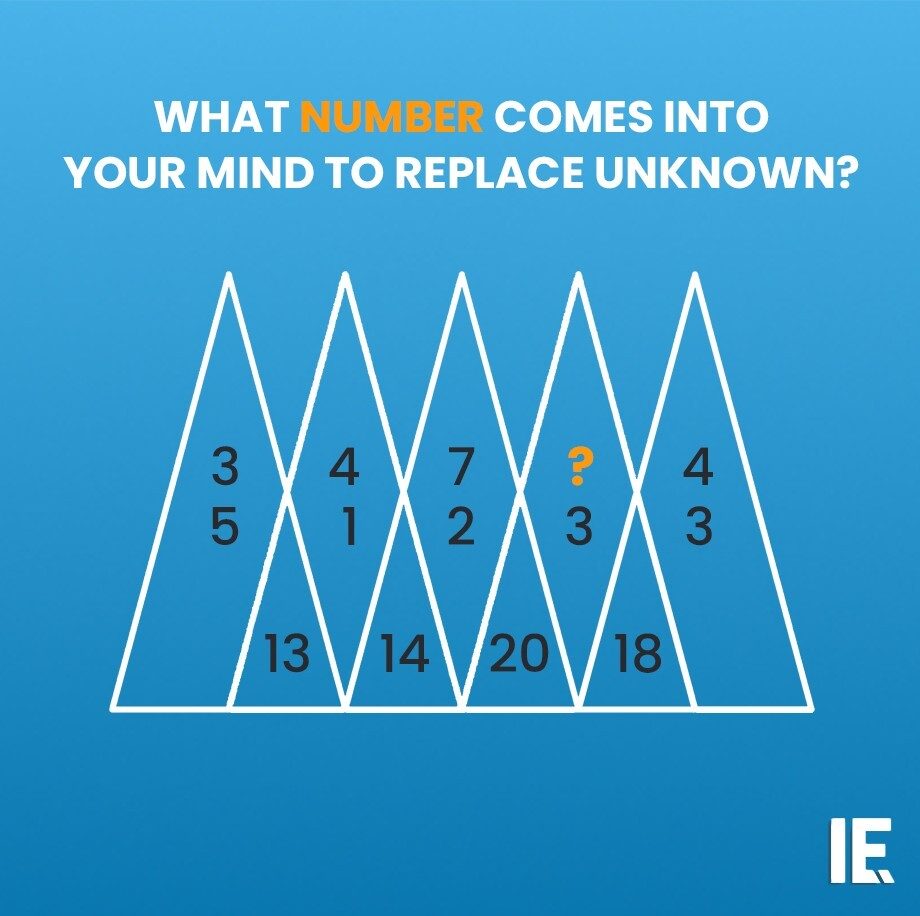
Number puzzles are a classic way to challenge the mind and sharpen analytical skills. Here, we explore a triangular number puzzle that involves identifying a pattern in a sequence of numbers. The goal is to determine a missing number based on the underlying rule connecting the triangles and their associated numbers.
Context / Why this matters
Puzzles like these are more than just a fun pastime. They help develop critical thinking, pattern recognition, and logical reasoning skills. Engaging with puzzles can also improve problem-solving abilities in various real-world scenarios, from engineering and mathematics to everyday decision-making. By understanding the patterns in these puzzles, you can enhance your cognitive abilities and approach complex problems with a more structured mindset.
Main discussion
Understanding the Triangular Number Puzzle
The puzzle features a series of numbers arranged in a triangular pattern. Each triangle contains a number, and there's a hidden rule that connects all these numbers. The challenge is to identify this rule and determine the missing number indicated by a question mark.
The Given Sequence
The sequence of numbers provided in the puzzle is: 3, 4, 7, 13, 14, 20, 18, 5, 1, 2, 3, 4. These numbers are arranged in a triangular pattern, with each number potentially representing a step or a rule in the sequence.
Identifying the Pattern
To solve the puzzle, you need to look for a rule or formula that relates the numbers in the sequence. Here are a few steps to help you identify the pattern:
-
Observe the Numbers: Start by looking at the numbers closely. Notice any obvious patterns, such as increments, decrements, or any arithmetic progression.
-
Check for Arithmetic or Geometric Sequences: Determine if the numbers follow an arithmetic sequence (where each term increases or decreases by a constant difference) or a geometric sequence (where each term is a constant multiple of the previous term).
-
Look for Combinations: Consider if the numbers could be derived from a combination of simpler sequences or mathematical operations.
Hypothesis and Verification
Once you have a hypothesis about the pattern, verify it by applying the rule to the entire sequence. Ensure that the rule holds for all the given numbers and that it can accurately predict the missing number.
Example Approach
One possible approach to solve the puzzle is to look for a pattern in the arrangement of the numbers. Here’s a step-by-step breakdown:
-
Identify the Pattern: Notice that the sequence might involve both addition and subtraction of certain values. For example, you might observe that the sequence alternates between adding and subtracting a specific number.
-
Apply the Pattern: Apply this pattern to the entire sequence to see if it holds true for all the numbers. If it does, you can use the same pattern to find the missing number.
-
Verify the Missing Number: Once you have a rule, use it to find the missing number. Ensure that it fits logically within the sequence.
Practical tips
Take Your Time: Don’t rush through the puzzle. Spend time observing the numbers and thinking through possible patterns.
Break It Down: If the sequence seems complex, break it down into smaller sections. Look for patterns within these smaller sections.
Experiment with Rules: Try different mathematical operations and see if any of them consistently apply to the sequence. This trial-and-error approach can help you identify the correct pattern.
Use a Systematic Approach: Start with simple arithmetic or geometric sequences and gradually move to more complex rules if needed.
Important takeaways
-
Patterns Exist: Numbers often hide patterns that can be cracked with careful observation and logical thinking.
-
Critical Thinking: Engaging with puzzles enhances critical thinking and problem-solving skills.
-
Process of Elimination: Use a systematic approach to eliminate incorrect hypotheses and narrow down the correct pattern.
-
Practice Makes Perfect: The more you practice solving puzzles, the better you become at identifying patterns and applying logical rules.
Conclusion
Puzzles like the triangular number puzzle are not just fun challenges but also excellent tools for mental exercise. By understanding the patterns in these puzzles, you can improve your analytical skills and approach complex problems with confidence. The key is to observe carefully, apply logical rules, and verify your findings. So, give it a try, and see if you can crack the missing number in the sequence.
Watch the Reel
Questions readers ask
What is a triangular number puzzle and how does it work?
A triangular number puzzle is a numerical challenge where numbers are arranged in a triangle. The goal is to identify the pattern that connects these numbers and use it to find a missing number in the sequence. By doing so, you can improve your analytical and logical reasoning skills.
What are the benefits of solving triangular number puzzles?
Solving triangular number puzzles can enhance your problem-solving abilities, critical thinking, and pattern recognition. These skills are valuable in various fields, including engineering and mathematics, and can improve your decision-making in everyday situations.
How do I identify the pattern in a triangular number puzzle?
To identify the pattern, look for relationships between the numbers in the triangles, such as differences, ratios, or sums that remain constant. Analyze the arrangement of numbers and check for incremental changes or consistent mathematical operations that could guide you to the missing number.
What strategies can help me find the missing number in a triangular number sequence?
Start by examining the given numbers and their positions. Check for arithmetic or geometric progressions, or look for patterns that involve adding, subtracting, multiplying, or dividing. Use logic to deduce the rule and apply it to find the missing number. Practice with simpler puzzles to improve your skills.
Can solving triangular number puzzles help in engineering and mathematics?
Yes, solving these puzzles can help you develop a deeper understanding of numerical relationships, which is beneficial in engineering and mathematics. This can help you recognize and apply patterns to solve complex problems in these fields. This can also help you with interesting engineering numbers.
Why are triangular number puzzles considered a good way to train the mind?
Triangular number puzzles challenge your brain to recognize and apply hidden number patterns, enhancing your cognitive abilities. They require logical reasoning and analytical thinking, both of which are crucial for problem-solving in various domains.
What if I can’t find the pattern in the triangular number puzzle?
If you’re having trouble finding the pattern, try looking at the problem from different angles. Break down the sequence into smaller parts and examine each segment for clues. Sometimes, stepping away from the puzzle and revisiting it later can also help you see the pattern more clearly.
Related deep dives
Similar reads based on topic and creator.

Recent articles
Fresh deep dives from the latest Reels we unpacked.




Comments
Be the first to comment.