PISA Science Scores: A Global Ranking of Student Performance
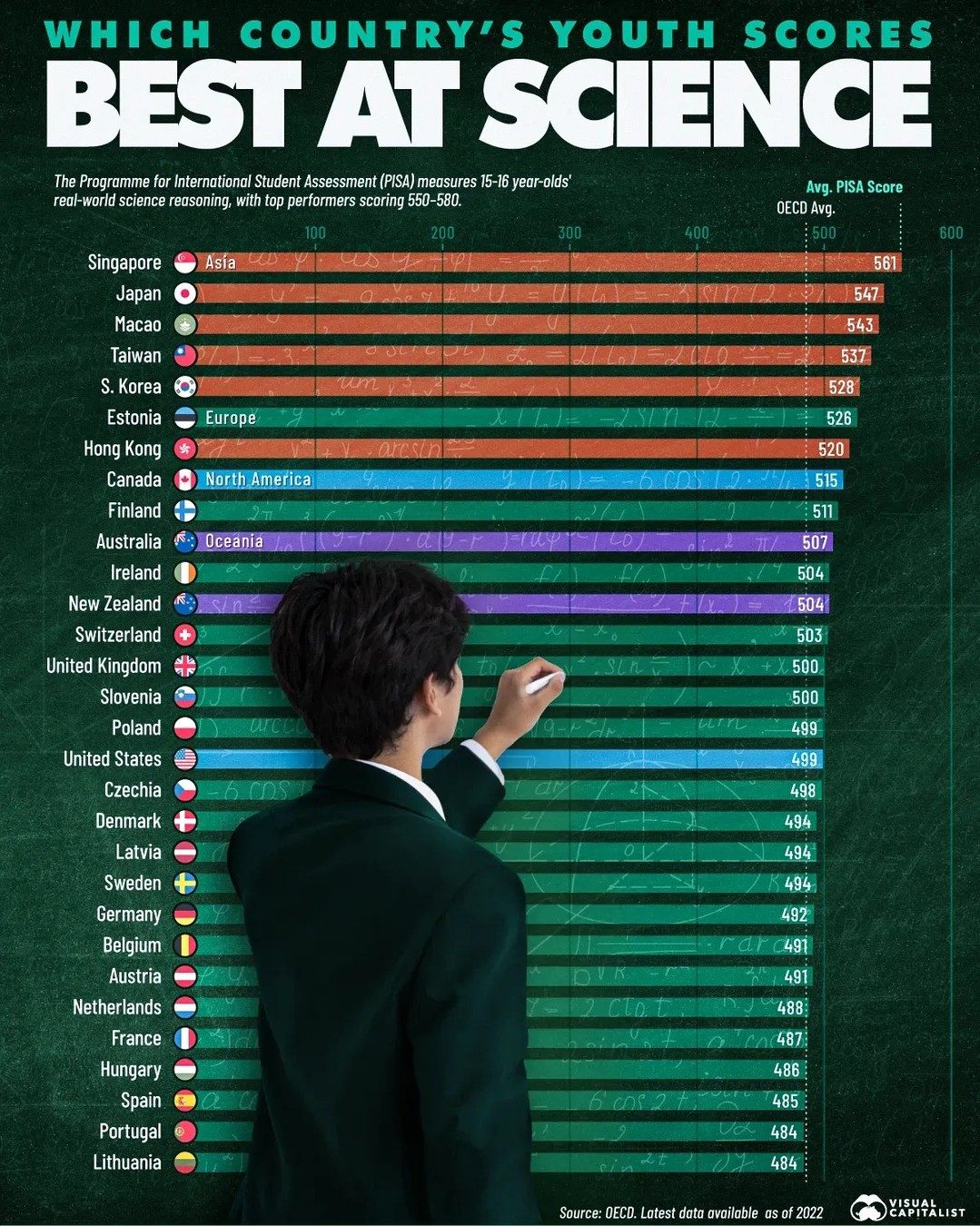
Singapore tops the global ranking for science literacy among 15-16 year olds, outperforming countries worldwide in the OECD's PISA assessment. This assessment is a critical benchmark for evaluating the real-world science reasoning skills of students, providing insights into educational strengths and areas for improvement across different nations.
Context / Why This Matters
The Programme for International Student Assessment (PISA) is an internationally recognized assessment tool that measures the performance of 15-year-old students in key subjects, including science. The assessment is designed to evaluate students' ability to apply their knowledge in real-world contexts, making it a valuable indicator of educational effectiveness and student preparedness for future challenges.
Main Discussion
The Importance of Science Literacy
Science literacy is more than just a measure of academic success; it's a vital component of a well-rounded education. It equips students with the skills to understand and engage with the world around them, fostering critical thinking, problem-solving, and analytical abilities. These skills are not only essential for careers in STEM fields but are also invaluable in everyday life, enabling individuals to make informed decisions about health, the environment, and technology.
The PISA Methodology
The PISA assessment focuses on real-world science reasoning. This means that students are tested on their ability to apply scientific concepts to practical situations, rather than simply recalling facts. The assessment is designed to measure three key areas: scientific literacy, scientific inquiry, and scientific explanations. Top performers in the PISA assessment typically score between 550 and 580, indicating a high level of scientific reasoning and application.
Top-Performing Countries
Singapore leads the pack with a score of 580, demonstrating an exceptional level of science literacy among its students. Following closely are other East Asian economies, including Macao (561), Taiwan (547), South Korea (543), and Estonia (537). These countries have long been recognized for their strong educational systems, with a particular emphasis on science, technology, engineering, and mathematics (STEM) education. Their success in the PISA assessment reflects a commitment to rigorous curriculum design, high-quality teaching, and a culture that values academic achievement.
Mid-Range Performers
Countries like Canada (528), Finland (526), and Australia (522) also perform well in the PISA assessment, showcasing their effective educational systems. These nations are known for their balanced approach to education, emphasizing both academic rigor and holistic development. Their mid-range scores indicate a solid foundation in science literacy, with room for further improvement and innovation.
Lower-Performing Countries
At the lower end of the spectrum, countries like Lithuania (480) and Portugal (484) score below the OECD average of 500. This does not necessarily indicate a lack of effort or capability, but rather highlights areas where educational systems may need to focus on enhancing science literacy. Lower scores can be attributed to various factors, including resource allocation, curriculum design, and societal attitudes towards science education.
Practical Tips
For educators and policymakers looking to improve science literacy, several practical steps can be taken:
Curriculum Enhancement
Designing a curriculum that emphasizes real-world applications of scientific concepts can significantly enhance students' understanding and retention. Incorporating hands-on experiments, projects, and interdisciplinary learning can make science more engaging and relevant to students.
Teacher Training
Investing in high-quality teacher training programs can ensure that educators are equipped with the latest teaching methods and techniques. This includes training in inquiry-based learning, scientific inquiry, and the use of technology to enhance science education.
Resource Allocation
Adequate resources, including textbooks, laboratory equipment, and digital tools, are essential for fostering a strong foundation in science. Ensuring that all schools, regardless of their location or economic status, have access to these resources can help bridge the gap in science education.
Public Engagement
Engaging the public and fostering a culture that values science education can motivate students to pursue STEM fields. This can be achieved through public awareness campaigns, science fairs, and community events that showcase the importance and relevance of science in everyday life.
Important Takeaways
The PISA science scores provide valuable insights into the global state of science education. Singapore's leadership in this area highlights the effectiveness of its educational strategies, while other countries' performances indicate areas for potential improvement. Enhancing science literacy is not just about boosting academic performance; it's about equipping students with the skills to navigate a world driven by scientific and technological advancements.
Conclusion
Science literacy is a cornerstone of a well-rounded education and a key factor in a nation's competitiveness on the global stage. The PISA assessment offers a comprehensive view of how different countries are faring in this critical area, providing a roadmap for improvement and innovation. By focusing on curriculum enhancement, teacher training, resource allocation, and public engagement, nations can foster a generation of scientifically literate individuals ready to tackle future challenges.
Watch the Reel
Questions readers ask
What is the PISA assessment and why is it important?
The Programme for International Student Assessment (PISA) is an international assessment that evaluates 15-year-old students' abilities to apply their knowledge in practical, real-world situations. It is important because it provides a global benchmark for comparing the performance of different countries' science literacy. It helps identify strengths and areas for improvement in national science curricula.
Why did Singapore rank first in the global PISA science scores?
Singapore's top ranking in the PISA science scores reflects the country's robust science curriculum and effective teaching methods. The results indicate that Singaporean students excel in applying scientific knowledge to real-world scenarios, showcasing their strong science literacy skills.
What does Singapore's high ranking in PISA science scores indicate about the country's education system?
Singapore's high ranking suggests that the country's approach to teaching science is highly effective. It demonstrates that the nation's focus on practical application and real-world science reasoning has yielded significant results, positioning Singapore as a leader in global science literacy.
Which other countries typically perform well in the PISA science assessment?
While Singapore tops the ranking, other countries that often perform well in the PISA science assessment include those in East Asia, such as Japan, South Korea, and China, as well as some European nations like Estonia and Finland. These countries are known for their strong emphasis on science and math in their curricula. Perhaps surprisingly, the United States typically ranks in the middle, highlighting areas for improvement in its science education system.
How often is the PISA assessment conducted, and when were the latest results released?
The PISA assessment is conducted every three years to allow for comprehensive data collection and analysis. The latest results, including the 2023 scores, are typically released in December following the assessment year, providing up-to-date information on global trends in science literacy among 15-year-olds.
What specific skills does the PISA science assessment evaluate in students?
The PISA science assessment evaluates students' ability to apply scientific knowledge in practical, real-world contexts. This includes skills such as identifying scientific issues, explaining phenomena scientifically, and using scientific evidence to draw conclusions. The assessment focuses on understanding and applying scientific concepts rather than rote memorization, emphasizing the practical application of science.
How can parents and teachers use PISA science results to support student learning?
Parents and teachers can use PISA science results to understand the strengths and weaknesses of their students' science skills. They can identify areas where students excel and those that require more focus. By aligning teaching methods and resources with the skills assessed in PISA, parents and teachers can better support students in developing real-world science reasoning and application abilities. Many resources are available on the OECD PISA website, including test examples, that can be used to support students' practical science skills.
Related deep dives
Similar reads based on topic and creator.



Recent articles
Fresh deep dives from the latest Reels we unpacked.




Comments
Be the first to comment.