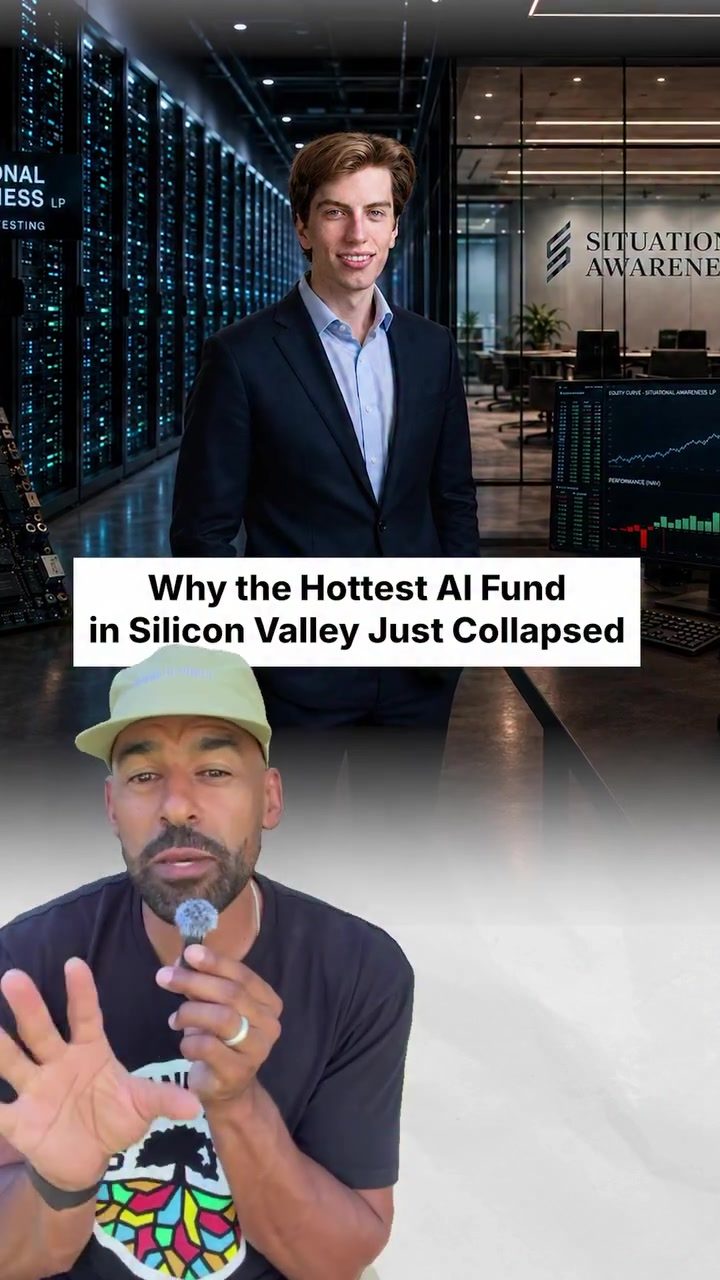
The Rise and Fall of Leopold Aschenbrenner's AI Hedge Fund
The recent collapse of Leopold Aschenbrenner's AI hedge fund, a $45 billion venture, has sent shockwaves through Silicon Valley. At just 25 years old, Aschenbrenner, a former researcher at OpenAI, built a fund that saw a staggering 439% increase in value one month ago. However, a sudden 67% loss in a single week led to the forced sale of his entire public portfolio to Ken Griffin's Citadel in a block trade. This dramatic turn of events has sparked questions about the nature of AI investing and the resilience of high-leverage strategies.
Why This Matters
The collapse of Aschenbrenner's fund is not just a story of personal failure but a case study in the volatility and complexity of AI investing. It highlights the risks associated with high-leverage strategies and the importance of understanding the underlying trends that drive investment decisions. The fund's thesis, centered around the concept of Situational Awareness, was built on the idea that whoever controls the chips, compute, energy, and data centers will control the future. This thesis, while forward-thinking, was ultimately undone by the speed at which market forces can move.
The Concept of Situational Awareness
Aschenbrenner's thesis, detailed in a paper titled "Situational Awareness", posited that the future of AI lies in the hands of those who control the essential infrastructure. This included semiconductor manufacturers, compute power providers, and energy suppliers. The idea was that as AI continues to grow, the demand for these resources will only increase, making them critical assets. Aschenbrenner built his entire fund around this thesis, achieving over 1,500% returns through June 2026. However, the sudden collapse of AI infrastructure stocks, including SK Hennix, CoreWeave, and Broadcom, which lost 67% of their value in a week, challenged this thesis.
The collapse of these stocks was not a failure of the underlying trends but a consequence of the speed at which these trends can be disrupted. Governments around the world are investing heavily in AI infrastructure, recognizing its critical importance. The demand for compute power is growing, and data centers are being built at an unprecedented rate. These trends are not disappearing; they are simply moving faster than the market can handle.
The Role of Leverage
One of the key factors in the fund's collapse was the use of leverage, which compresses time. Instead of a five-year horizon, Aschenbrenner's thesis was tested over five weeks. This rapid time compression led to a situation where the fund could not withstand the market's volatility. The lesson here is that while leverage can amplify returns, it also amplifies risks. In venture capital, where investments are typically underwritten for seven to ten-year horizons, patience and long-term thinking are crucial.
Surviving Uncertainty
The greatest investing edge, as highlighted by an experienced Venture Capitalist, is not in predicting the future but in having the patience and capital to survive uncertainty. The winners in this game are not those who identify the trend first but those who hold on while everyone else gets shaken out. The cycle of hype, correction, recovery, and dominance repeats, and strong balance sheets are often the ones that buy during corrections.
Practical Tips
For investors and entrepreneurs, the collapse of Aschenbrenner's fund offers several practical lessons:
Understand the Long-Term
AI infrastructure is a long-term play. The underlying trends may move faster than expected, but they are not disappearing. Investors need to be prepared for volatility and understand that the market may not always reflect the underlying business reality.
Diversify Your Portfolio
Diversification is key to surviving uncertainty. A well-diversified portfolio can help mitigate the risks associated with high-leverage strategies. Consider investing in a variety of assets, including but not limited to, AI infrastructure stocks.
Focus on Patience and Resilience
Patience and resilience are crucial in a volatile market. Instead of trying to time the market, focus on building a portfolio that can withstand the ups and downs. This means having enough capital to weather the storms and enough patience to hold on during corrections.
Build for the Long Term
In venture capital, the winners are those who build for the long term. This means underwriting investments for seven to ten-year horizons and being prepared to hold on to investments even during periods of volatility.
Important Takeaways
The collapse of Aschenbrenner's AI hedge fund is a reminder of the risks and rewards of high-leverage strategies. While the fund's thesis was sound, the speed at which market forces can move ultimately led to its downfall.
AI investing, particularly in infrastructure, is a long-term play. The underlying trends, such as growing compute demand, the construction of data centers, and government recognition of AI as critical infrastructure, are not disappearing. However, the market's volatility means that investors need to be prepared for significant fluctuations.
The greatest investing edge is not in predicting the future but in having the patience and capital to survive uncertainty. This means building a diversified portfolio, focusing on long-term trends, and being prepared to hold on during periods of volatility.
Conclusion
In the end, the collapse of Aschenbrenner's AI hedge fund is a case study in the risks and rewards of high-leverage strategies in AI investing. While the fund's thesis was sound, the speed at which market forces can move ultimately led to its downfall. The key takeaway is that AI investing is a long-term play, and investors need to be prepared for volatility. With a diversified portfolio, a focus on long-term trends, and the patience to survive uncertainty, investors can navigate the complexities of AI infrastructure investing and emerge stronger in the long run.
Watch the Reel
Questions readers ask
What caused the rapid collapse of Leopold Aschenbrenner's AI hedge fund?
The collapse was primarily due to a sudden 67% loss in value within a single week, leading to the forced sale of the fund's entire public portfolio. This drastic change highlights the extreme volatility and risks associated with AI investing, especially when employing high-leverage strategies.
How did Leopold Aschenbrenner's background influence his AI hedge fund?
Aschenbrenner's background as a former researcher at OpenAI likely played a significant role in his approach to AI investing. His expertise in AI technology may have influenced his investment strategies, particularly his focus on critical infrastructure, although this did not prevent the fund's eventual collapse.
What is the significance of the forced sale to Ken Griffin's Citadel?
The sale to Citadel marked a sudden and dramatic end to Aschenbrenner's AI hedge fund. It underscores the potential for rapid market shifts in AI investing and the challenges faced by high-leverage strategies when market conditions change unexpectedly.
What are the key lessons from the collapse of Aschenbrenner's AI fund for future investors?
The collapse serves as a reminder of the inherent risks and volatility in AI investing. It highlights the importance of understanding market forces, the challenges of relying on a specific investment thesis, and the dangers of high-leverage strategies.
What does the collapse say about the future of AI investing?
The future of AI investing remains uncertain, but the collapse of Aschenbrenner's fund suggests that investors need to be more aware of the potential for rapid and significant market changes. It emphasizes the need for careful risk management and a deeper understanding of AI market dynamics.
Recent articles
Fresh deep dives from the latest Reels we unpacked.




Comments
Be the first to comment.