SEO vs. AEO: Understanding the Key Differences
The digital marketing landscape is constantly evolving, and with the rise of AI-driven platforms like ChatGPT, new strategies are emerging to help content stand out. Two such strategies are Search Engine Optimization (SEO) and Answer Engine Optimization (AEO). While both aim to increase visibility, they differ significantly in their approaches and goals.
Context / Why this matters
Understanding the distinction between SEO and AEO is crucial for anyone looking to optimize their online presence. Traditional SEO has long been the go-to strategy for improving search engine rankings. However, with the advent of AI-driven platforms, AEO is gaining traction as a more targeted approach to enhance visibility. Knowing how and when to use each strategy can significantly impact your online success.
Main discussion
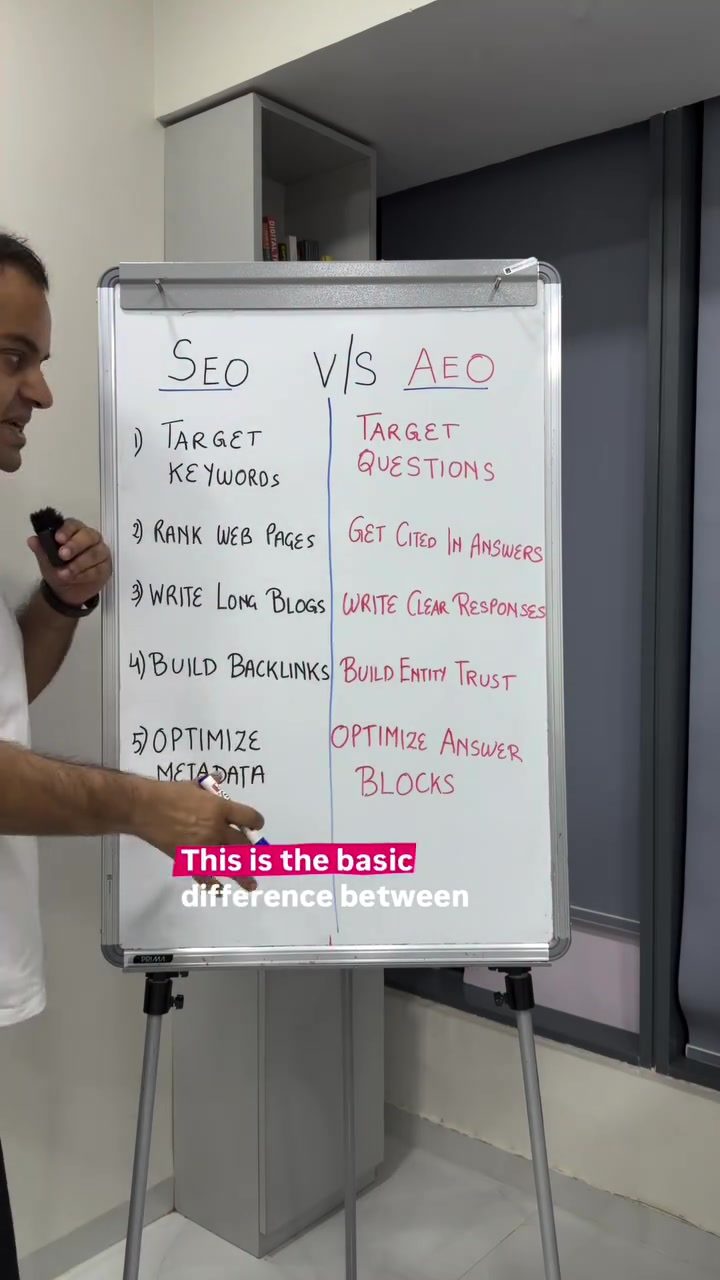
Targeting Keywords vs. Questions
In SEO, the focus is on targeting specific keywords. This involves researching and incorporating relevant keywords into your content to improve search engine rankings. In contrast, AEO centers around answering specific questions. By targeting questions, you increase the likelihood of appearing in prompts on platforms like ChatGPT, making your content more accessible to users seeking immediate answers.
Ranking Web Pages vs. Getting Cited in Answers
SEO aims to rank entire web pages higher in search engine results. This involves optimizing various elements, including content, metadata, and backlinks, to improve a page's ranking. On the other hand, AEO focuses on getting cited in answers. The goal is to have your content appear as a direct answer to a user's query, providing immediate value and increasing the chances of engagement.
Writing Long Blogs vs. Clear Responses
SEO often involves writing long-form content, such as detailed blog posts, to provide comprehensive information and incorporate multiple keywords. In contrast, AEO prioritizes clear, concise responses. The focus is on delivering straightforward, actionable answers that can be quickly understood and utilized by the user. Lengthy content is not always necessary for AEO; clarity and relevance are key.
Building Backlinks vs. Entity Trust
Building backlinks is a critical component of SEO. High-quality backlinks from reputable sources help improve a website's authority and search engine rankings. In AEO, while backlinks can still be beneficial, building entity trust is equally, if not more, important. Entity trust refers to the trustworthiness and credibility of the source or person providing the information. This is particularly relevant in AI-driven platforms, where the reliability of the source can significantly impact the visibility and accuracy of the information.
Optimizing Metadata vs. Answer Blocks
SEO involves optimizing various metadata elements, such as title tags, meta descriptions, and header tags, to improve search engine visibility. In AEO, the focus is on optimizing specific answer blocks. These are the sections of your content that directly answer questions and provide valuable information. By optimizing these blocks, you increase the likelihood of your content being featured as a direct answer on AI platforms.
ChatGPT and Other Platforms
One of the key reasons for the rise of AEO is the increasing use of AI-driven platforms like ChatGPT. These platforms prioritize providing direct answers to user queries, making it essential to optimize your content for this format. By focusing on AEO, you can ensure that your content is more likely to be cited as a reliable answer, increasing its visibility and engagement.
Practical tips
- Identify Key Questions: Start by identifying the key questions your audience is asking. Use tools like Google's People Also Ask or AI-driven platforms to gather a list of relevant questions.
- Optimize for Questions: Incorporate these questions into your content naturally. Ensure that your answers are clear, concise, and provide value.
- Build Entity Trust: Focus on building trust and credibility as a source. This can be achieved through quality content, accurate information, and a strong online presence.
- Optimize Answer Blocks: Ensure that the sections of your content that directly answer questions are optimized for visibility. Use clear formatting, headers, and keywords to make these sections stand out.
- Monitor Performance: Regularly monitor how your content is performing on AI-driven platforms. Adjust your strategy based on the data to improve visibility and engagement.
Important takeaways
- SEO and AEO are distinct strategies with different goals and approaches.
- SEO focuses on targeting keywords, ranking web pages, and building backlinks, while AEO targets questions, aims to get cited in answers, and builds entity trust.
- Understanding the differences between SEO and AEO can help you optimize your content more effectively for both search engines and AI-driven platforms.
- By incorporating both strategies, you can maximize your online presence and reach a broader audience.
Conclusion
As the digital landscape continues to evolve, it's essential to stay updated with the latest strategies and techniques. Whether you're focusing on traditional SEO or the emerging AEO, understanding the key differences and applying them effectively can significantly impact your online success. By optimizing your content for both search engines and AI-driven platforms, you can ensure that your information is accessible, valuable, and trustworthy.
Watch the Reel
Questions readers ask
What is the primary goal of SEO?
The primary goal of SEO is to improve a website's rankings on search engines like Google. This is achieved through keyword optimization, building high-quality backlinks, and creating valuable content that search engines recognize as authoritative and relevant.
How does AEO differ from SEO in terms of approach?
AEO focuses on optimizing content to provide direct answers to specific user questions on AI platforms. Unlike SEO, which relies on keyword integration, AEO targets the way users phrase their queries and aims to deliver concise, accurate information.
Why is it important to consider both SEO and AEO strategies?
Incorporating both SEO and AEO strategies ensures that your content is optimized for a variety of search scenarios. While SEO helps with traditional search engine rankings, AEO enhances visibility on AI platforms, which are becoming increasingly popular for quick, direct answers.
How can AI content optimization benefit my website’s visibility?
AI content optimization can significantly boost your website’s visibility by making your content more accessible and relevant to users who rely on AI-driven platforms for answers. This targeted approach ensures that your content is featured prominently in direct answer sections, increasing the likelihood of user engagement.
What are the key differences between SEO and AEO strategies?
The key differences lie in their focus and execution. SEO involves incorporating relevant keywords, building backlinks, and optimizing content for search engine algorithms. AEO, on the other hand, involves structuring content to answer specific user queries directly, often in a concise format suitable for AI platforms.
How can I determine if my content is optimized for both SEO and AEO?
To determine if your content is optimized for both, evaluate whether it ranks well in traditional search engine results (SEO) and appears in direct answer sections of AI platforms (AEO). Use tools like Google Search Console for SEO and test user queries on AI platforms for AEO to ensure comprehensive optimization.
Recent articles
Fresh deep dives from the latest Reels we unpacked.




Comments
Be the first to comment.