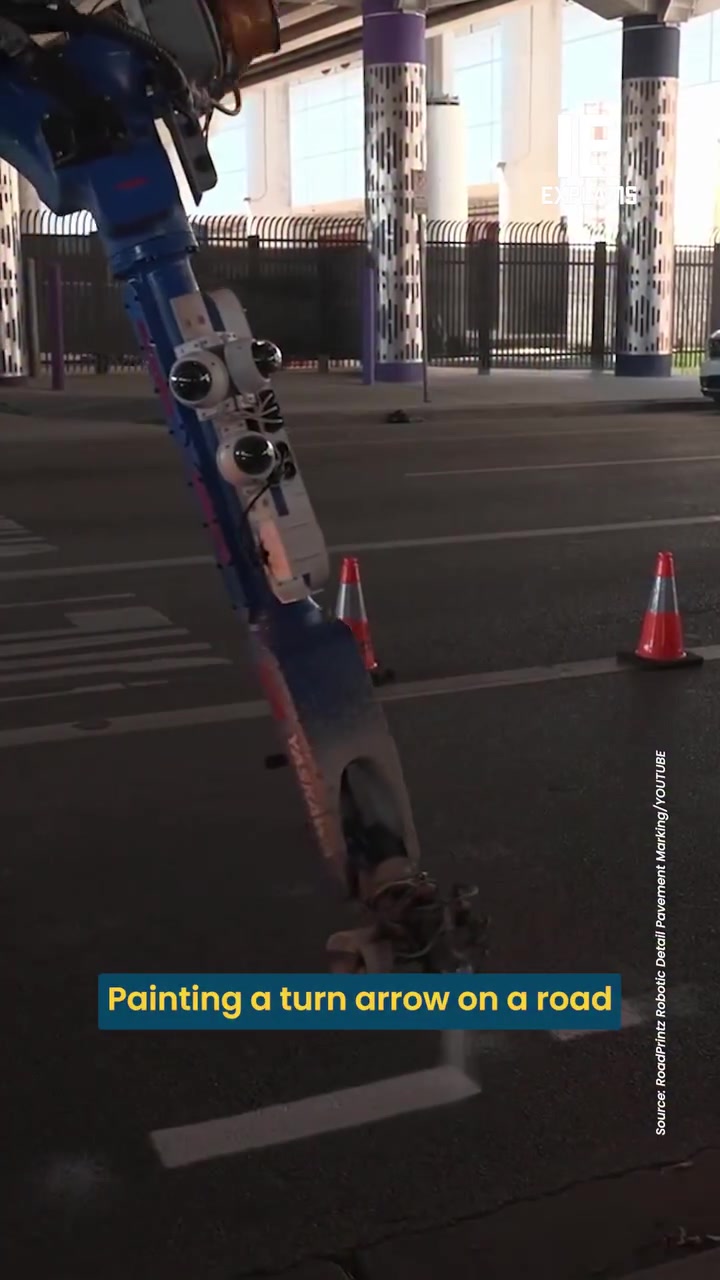
For road contractors, painting lane markers is essentially a set of dangerous dance moves — mostly done By hand with stencils, in traffic. The Electra from Roadprints aims to change that. This automated robotic vehicle can handle road-marking tasks with one operator who never exposes themselves to traffic.
The Electra vehicle's system is a full robotics package.
The Ford F550 truck is outfitted with a Yaskawa robotic arm inside. Painting no longer needs a stencil. Instead, layers of paint get placed line by line on the pavement. That detail is important — the vehicle is not just a truck with a spray gun. The operator sits inside the vehicle with a 15-inch touchscreen. The software includes the full federal MUTCD library of symbols, so an operator can paint arrows, bike sharrows, handicap symbols, crosswalks, and even custom words.
Road marking labor is a large workforce.
The Electra offers a future where fewer people need to risk their lives on hot pavement with their backs to traffic. Last year, 169 pedestrians died in work zones — some were road workers. That statistic can shake anyone, especially those who work in the profession. The Electra project began in 2016, funded by a million-dollar grant from the National Science Foundation. The company focuses on reducing the number of workers exposed to traffic and the risk involved.
The Electra is precise, which means it is cost-effective over the long term.
The Missouri transportation department has tested the Electra. They found it can cut up to 40% of the project time. Line width is extremely accurate at 2mm wide, which is three times tighter than handwork. One supervisor in Houston reported that the vehicle can scan an existing marking for 10 seconds and lay it back down in under three minutes.
The road-marking procedure is easier and safer for the operator.
Staff does not need to handle heavy metal stencils, move them around, or apply paint by hand. Now, they simply control the machine with the touchscreen, select a symbol, place it on the screen, and press paint. The Electra automatically logs the position and paint usage.
The Electra is precise. The operator gets to see exactly where the marking will land before actually applying any paint.
The system software runs off a library of road symbol standards from the Federal MUTCD.
The Electra can lay down both standard and custom markings.
The machine can apply anything from the federal standard of arrows and bike sharrows to custom words that include spell check.
Every arrow painted inside a cab is a step forward for safety. The fewer people on the pavement are injured or killed in traffic-related incidents.
Painted arrows are the start of a project, not the end.
A good quality road-marking project needs to last at least a few years, and the vehicle will need regular maintenance. An Electra truck is as much of a rolling factory as it is a vehicle, requiring competent service professionals in-house. The company itself begins training staff in maintenance. In industrial settings, training staff in maintenance is routine, but it is a small step toward the larger task of operating the machine.
The Electra turns road-marking projects into a collaborative effort.
Interns work as operators while the supervisor logs data and monitors the work so that operators can learn and improve. The vehicle can lay down lines with three times the precision of manual labor.
The Electra is a road-marking machine, but it has the potential to change construction labor.
The federal government can push the technology further with more grants, new features, or vehicle size options. The Electra is currently available in the form of a truck. The product could redefine construction labor by putting fewer people out in the road and traffic. Similar technology can possibly be used for other industrial construction tasks. The road is one step, but it is a step forward.
Watch the Reel
Questions readers ask
How does the Electra Truck from Roadprints work in painting lane markers?
The Electra Truck uses a robotic arm to paint lane markers line by line, guided by an operator inside the vehicle. The operator uses a touchscreen to select symbols from the federal MUTCD library and control the painting process, ensuring precision and safety.
What kind of safety improvements does the Electra Truck offer over traditional road marking methods?
The Electra Truck significantly reduces the risk of injury by keeping the operator inside the vehicle and away from traffic. This is a major improvement over traditional methods, where workers often have to manually paint markers in traffic, putting them at risk.
How precise is the Electra Truck in painting lane markers?
The Electra Truck is extremely precise, with a line width accuracy of 2mm, which is three times tighter than hand-painted markings. This precision not only improves the quality of the markings but also makes the process more cost-effective over the long term.
Can the Electra Truck handle custom markings?
Yes, the Electra Truck can lay down both standard and custom markings. It includes a spell check feature for custom words, making it versatile for various road-marking needs.
What kind of maintenance does the Electra Truck require?
The Electra Truck requires regular maintenance like any other specialized vehicle. Roadprints provides training for staff to handle maintenance, ensuring the truck remains operational and efficient. Given its complexity, competent service professionals are necessary for upkeep.
How does the Electra Truck compare to traditional road-marking methods in terms of efficiency?
The Electra Truck can cut up to 40% of the project time compared to traditional methods. It scans existing markings quickly and lays down new ones efficiently, making the entire process faster and more accurate.
Related deep dives
Similar reads based on topic and creator.

Recent articles
Fresh deep dives from the latest Reels we unpacked.
Comments
Be the first to comment.