The Evolution of the Mobile Phone Market Over 30 Years
Mobile phones have undergone a remarkable transformation over the past three decades, evolving from simple communication devices to powerful, multifunctional gadgets. Understanding this evolution provides insights into technological advancements, market dynamics, and consumer preferences.
Why This Matters
The mobile phone market's evolution is a story of innovation, competition, and market dominance. Over the years, several key players have risen and fallen, shaping the industry. From the days of Nokia's dominance to the current era of Samsung and Apple, the market has seen significant shifts. These changes reflect broader trends in technology, consumer behavior, and global economics.
The Early Days: Nokia and Motorola
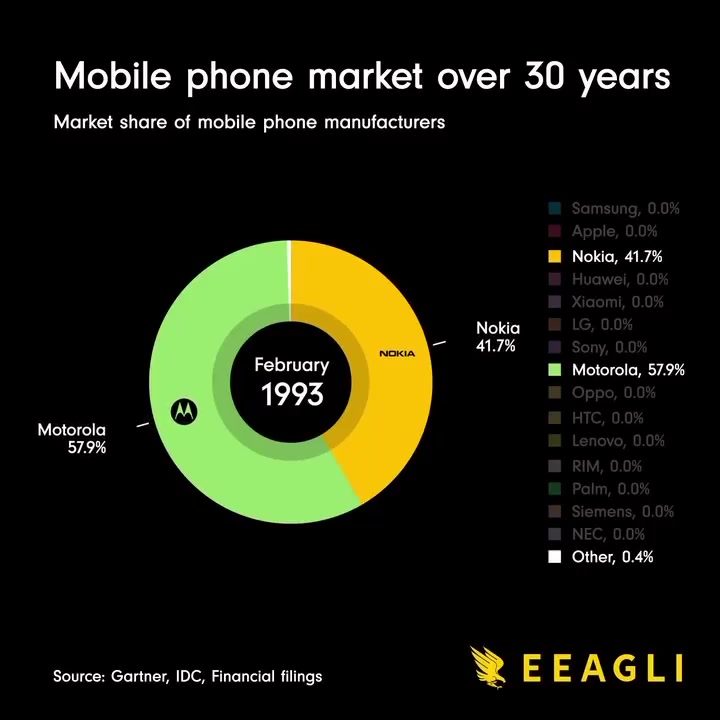
In the early 1990s, the mobile phone market was dominated by two giants: Nokia and Motorola. In January 1993, Nokia held 41.9% of the market share, while Motorola held 57.9%. These companies were pioneers in the mobile phone industry, introducing features like the iconic Nokia ringtone and Motorola's flip phones. Their success was built on reliable hardware and robust marketing strategies.
Dominance and Innovation
Nokia's dominance in the 1990s can be attributed to its focus on durability, affordability, and simplicity. The Nokia 3310, for example, became a cultural phenomenon due to its long battery life and sturdy design. Motorola, on the other hand, was known for its innovative designs, such as the StarTAC, one of the first clamshell phones.
The Rise of Sony and the Decline of Motorola
By September 1997, the market landscape had started to change. Nokia's market share had slightly decreased to 20.2%, while Motorola's share remained significant at 25.6%. Notably, Sony had entered the market with 13.1% share, indicating a growing interest in mobile phones that combined music and communication capabilities.
Nokia's Resurgence
In February 2002, Nokia regained its strong position with 33.7% market share, while Motorola's share dropped to 14.8%. This period saw Nokia introducing features like color screens, polyphonic ringtones, and even basic gaming. The Nokia 3210, for example, became a popular choice due to its customizable covers and simple games like Snake.
The Emergence of New Players
The early 2000s marked the beginning of a new era in the mobile phone market, with the emergence of players like Samsung, Apple, and Huawei. These companies brought innovative features and design elements, challenging the dominance of Nokia and Motorola.
Samsung's Rise
Samsung's entry into the mobile phone market was marked by its relentless focus on innovation and affordability. By introducing features like touchscreens and high-resolution cameras, Samsung quickly gained market share. The Samsung Galaxy series, launched in the late 2000s, became a major competitor to Apple's iPhone.
Apple's Revolution
Apple's iPhone, launched in 2007, revolutionized the mobile phone industry. With its intuitive user interface and touchscreen design, the iPhone set new standards for mobile phones. Apple's focus on user experience and ecosystem integration, including apps and services like iTunes and the App Store, solidified its position as a market leader.
Huawei and Xiaomi
Huawei and Xiaomi, Chinese manufacturers, entered the market with a focus on affordability and performance. These companies gained popularity in emerging markets and have since expanded their reach globally. Huawei, in particular, has made significant strides in technology, including 5G networks and advanced camera features.
Key Drivers of Market Evolution
Several factors have driven the evolution of the mobile phone market. These include technological advancements, consumer preferences, and market competition.
Technological Advancements
Technological advancements have played a crucial role in the evolution of mobile phones. From basic communication devices to smartphones, mobile phones have evolved to include features like touchscreens, high-resolution cameras, and advanced processors. These advancements have been driven by innovation in hardware and software.
Consumer Preferences
Consumer preferences have also shaped the mobile phone market. Features like longer battery life, better cameras, and more storage have become essential for consumers. Additionally, the demand for affordable, high-quality devices has driven the growth of companies like Xiaomi and Huawei.
Market Competition
Competition in the mobile phone market has been intense, with companies constantly innovating to stay ahead. This competition has led to rapid advancements in technology and design, benefiting consumers with a wider range of options.
Practical Tips for Understanding Market Trends
To stay informed about the mobile phone market, consider the following tips:
-
Follow Industry Reports: Reports from organizations like Gartner, IDC, and Financial Filings provide valuable insights into market trends and player performance.
-
Track Technological Advancements: Keeping an eye on new technologies and features can help you understand how the market is evolving.
-
Analyze Consumer Behavior: Understanding consumer preferences and buying patterns can provide insights into market demands and future trends.
-
Monitor Competitive Moves: Following the strategies and innovations of key players can help you anticipate market shifts and new opportunities.
Important Takeaways
The mobile phone market has evolved significantly over the past three decades, driven by technological advancements, consumer preferences, and market competition. From Nokia and Motorola's dominance to the rise of Samsung, Apple, and Huawei, the market has seen notable shifts. Understanding these trends can provide valuable insights into the future of the mobile phone industry and technology.
Conclusion
The evolution of the mobile phone market is a story of innovation, competition, and consumer preferences. From the early days of Nokia and Motorola to the current era of Samsung and Apple, the market has seen significant changes. By understanding these trends, one can gain insights into the future of mobile technology and prepare for upcoming advancements.
Watch the Reel
Questions readers ask
What were the key factors that contributed to Nokia's dominance in the early mobile phone market?
Nokia's early dominance can be attributed to its durable and user-friendly devices, strategic partnerships, and aggressive marketing. The company was also quick to adopt new technologies, such as color screens and cameras, which helped it maintain its market leadership.
How did Motorola's StarTAC change the mobile phone industry?
The Motorola StarTAC, released in 1996, was a game-changer due to its compact, clamshell design and innovative features. It popularized the idea of mobile phones as personal devices, setting new standards for design and functionality and paving the way for future innovations.
What strategies did Samsung use to rise in the mobile industry?
Samsung's rise was fueled by aggressive marketing, a strong focus on design and innovation, and a wide range of devices that catered to different market segments. The company's ability to adapt to consumer preferences and offer high-quality products at competitive prices helped it gain a significant market share.
How did Apple revolutionize the mobile phone market with the iPhone?
Apple revolutionized the mobile phone market with the introduction of the iPhone in 2007, which combined a mobile phone, an internet communicator, and an iPod into a single device. Its user-friendly interface and robust app ecosystem significantly influenced consumer preferences and set new benchmarks for the industry.
What role have consumer preferences played in the evolution of the mobile phone market?
Consumer preferences have been a driving force in the evolution of the mobile phone market, pushing companies to innovate and adapt. The demand for features like touchscreens, high-quality cameras, and apps has led to significant advancements and shaped the design and functionality of modern smartphones.
What technological advancements over the past 30 years have had the biggest impact on the mobile phone industry?
Technological advancements like the transition from analog to digital networks, the introduction of touchscreens, the development of high-speed mobile internet, and the creation of mobile operating systems (iOS and Android) have had the most significant impact on the mobile phone industry.
How have market dynamics influenced the rise and fall of mobile phone giants over the past 30 years?
Market dynamics, including competition, technological changes, and consumer trends, have greatly influenced the rise and fall of mobile phone giants. Companies that quickly adapted to these dynamics, like Apple and Samsung, thrived, while those that failed to innovate, such as Nokia and Motorola, experienced a decline in market share.
Related deep dives
Similar reads based on topic and creator.


Recent articles
Fresh deep dives from the latest Reels we unpacked.




Comments
Be the first to comment.