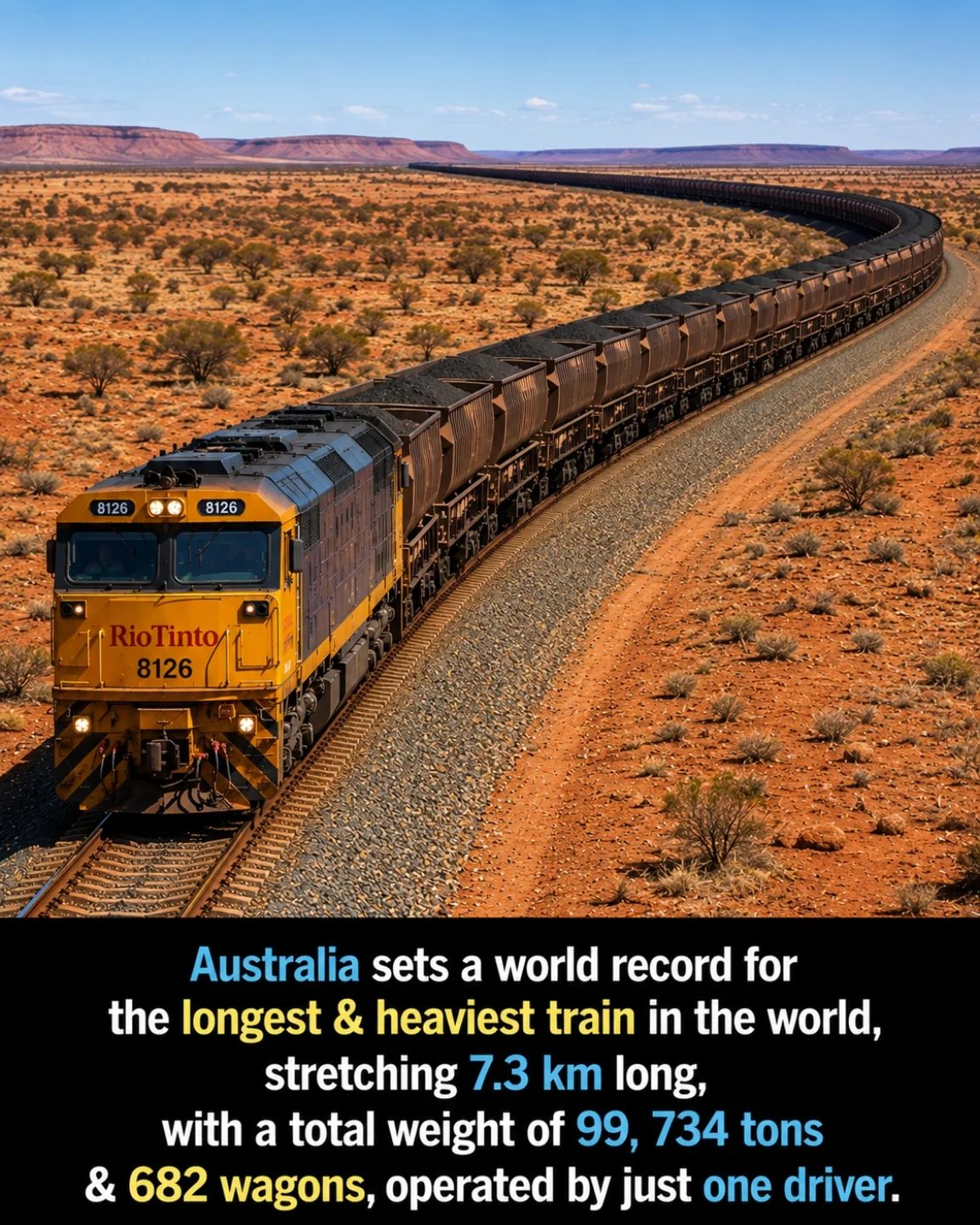
World Record Train
The Rio Tinto World Record Train is a marvel of engineering and logistics. This record-breaking train journeyed through the Australian desert, setting new benchmarks for the longest and heaviest train in the world. Weighing a staggering 99,734 tons and stretching over 7.3 kilometers, it also showcased an impressive feat of efficiency, being operated by a single driver.
Context / Why This Matters
Trains play a crucial role in the global transportation of goods, particularly in remote and rugged terrains. The success of the Rio Tinto World Record Train demonstrates the potential of rail transport in handling large volumes of freight over long distances. This achievements have significant implications for industries that rely on efficient and sustainable transportation solutions.
Main Discussion
The Scale of the Operation
The sheer size of the Rio Tinto World Record Train is awe-inspiring. Weighing 99,734 tons and comprising 682 wagons, this train set a new standard for what is possible in railway logistics. The length of 7.3 kilometers means that it would take nearly 10 minutes to pass a stationary point at a steady speed of 60 kilometers per hour. This monumental scale is a testament to the engineering prowess and logistical planning involved in such an operation.
The Engineering Marvel
The engineering behind such a massive train is intricate. Each wagon must be precisely designed to handle the weight and length of the entire train. The coupling system, brakes, and control mechanisms are all critical components that must function seamlessly to ensure the safe operation of the train. Special attention is given to the wheels and tracks to withstand the immense weight and stress.
Operational Efficiency
Operating a train of this magnitude with just one driver is a remarkable achievement. This speaks volumes about the sophistication of modern train control systems and the advanced technologies used in railway operations. The driver relies on sophisticated communication systems, real-time data monitoring, and automated controls to manage the train's movement and safety.
The Environmental Considerations
The environmental impact of such a massive transportation system is an important consideration. Rail transport is generally more environmentally friendly compared to road or air transport, especially for bulk goods. Trains emit fewer greenhouse gases per unit of cargo and are more fuel-efficient.
Sustainable Practices
Rio Tinto has been making significant strides in adopting sustainable practices and reducing its carbon footprint in recent years. The use of such a massive train for transporting goods is in line with their broader commitment to sustainable logistics and environmental responsibility.
The Role of Technology
Technology plays a pivotal role in the operation of the World Record Train. Advanced communication systems, automated controls, and real-time data monitoring are essential for managing a train of this scale. These technologies not only improve operational efficiency but also enhance safety and reliability.
Real-Time Monitoring
Real-time monitoring systems allow for continuous tracking of the train's performance, ensuring that any issues are promptly addressed. This includes monitoring the speed, weight distribution, and mechanical performance of the train.
Safety Measures
Safety is a paramount concern in such massive and complex operations. The Rio Tinto World Record Train employs various safety measures, including redundant braking systems, emergency communication systems, and advanced collision avoidance technologies. The driver's role is to oversee these systems and intervene if necessary.
Practical Tips
Operating a train of the scale of the Rio Tinto World Record Train requires meticulous planning and execution. For those involved in the logistics and transportation industry, here are some practical tips:
Logistical Planning
Careful logistical planning is critical for the successful operation of such a massive train. This includes route planning, scheduling, and coordination with other transportation systems. Efficient logistical planning helps to minimize delays and maximize operational efficiency.
Technological Integration
Investing in advanced technology can significantly enhance the operation of large-scale transportation systems. This includes using real-time monitoring systems, automated controls, and communication technologies to improve safety and reliability.
Safety Protocols
Maintaining strict safety protocols is essential for the safe operation of such large-scale transportation systems. This includes using redundant braking systems, emergency communication systems, and advanced collision avoidance technologies.
Training and Expertise
Having a well-trained and experienced team is crucial for the successful operation of such massive trains. This includes training drivers in the operation of advanced control systems and emergency protocols.
Environmental Considerations
Considering the environmental impact of such large-scale transportation systems is essential. Adopting sustainable practices and using environmentally friendly technologies can help to minimize the environmental impact and contribute to sustainability goals.
Important Takeaways
The Rio Tinto World Record Train is a testament to the advancements in railway logistics, engineering, and technology. It showcases the potential of rail transport in handling large volumes of freight over long distances efficiently and sustainably. The successful operation of this massive train highlights the importance of careful planning, technological integration, and safety measures in such complex operations.
Conclusion
The Rio Tinto World Record Train represents a significant milestone in the world of railway logistics. Its record-breaking dimensions and operational efficiency make it a remarkable achievement in the transportation industry. The success of this operation underscores the importance of advanced technology, rigorous safety protocols, and sustainable practices in the logistics and transportation sector. As we continue to push the boundaries of what is possible, the lessons learned from the Rio Tinto World Record Train will undoubtedly shape the future of railway logistics and transportation.
Watch the Reel
Questions readers ask
How long was the Rio Tinto World Record Train?
The Rio Tinto World Record Train stretched over 7.3 kilometers, making it the longest train in the world. This immense length is equivalent to approximately 4.5 miles, showcasing the vast scale of the operation.
How much did the Rio Tinto World Record Train weigh?
The train weighed nearly 100,000 tons, with a precise measurement of 99,734 tons. This substantial weight made it the heaviest train in the world, highlighting the capacity of rail transport for moving large volumes of freight.
How many wagons were in the Rio Tinto World Record Train?
The train consisted of 682 wagons. This enormous number of wagons contributes to the train's record-breaking length and weight, demonstrating the efficiency of rail transport in handling extensive cargo.
Who operated the Rio Tinto World Record Train?
Remarkably, the train was operated by a single driver. This underscores the advanced engineering and logistics involved in managing such a colossal train, even in the challenging conditions of the Australian desert.
What is the significance of the Rio Tinto World Record Train?
The success of the Rio Tinto World Record Train underscores the potential of rail transport in moving large volumes of freight efficiently and sustainably, especially in remote and rugged terrains. This achievement sets new benchmarks for the industry and highlights the benefits of rail transport for various sectors.
What route did the Rio Tinto World Record Train travel?
The train journeyed through the Australian desert, a remote and challenging terrain. This route showcases the capacity of rail transport to operate effectively in harsh environments, further emphasizing its potential for industries that rely on efficient transportation.
What is the world record for the heaviest train?
The world record for the heaviest train is held by the Rio Tinto World Record Train, which weighed 99,734 tons. This record highlights the immense capacity of rail transport in moving large volumes of freight, contributing to the industry's capabilities and sustainability.
Related deep dives
Similar reads based on topic and creator.



Recent articles
Fresh deep dives from the latest Reels we unpacked.




Comments
Be the first to comment.