A Geological Marvel in the Sahara
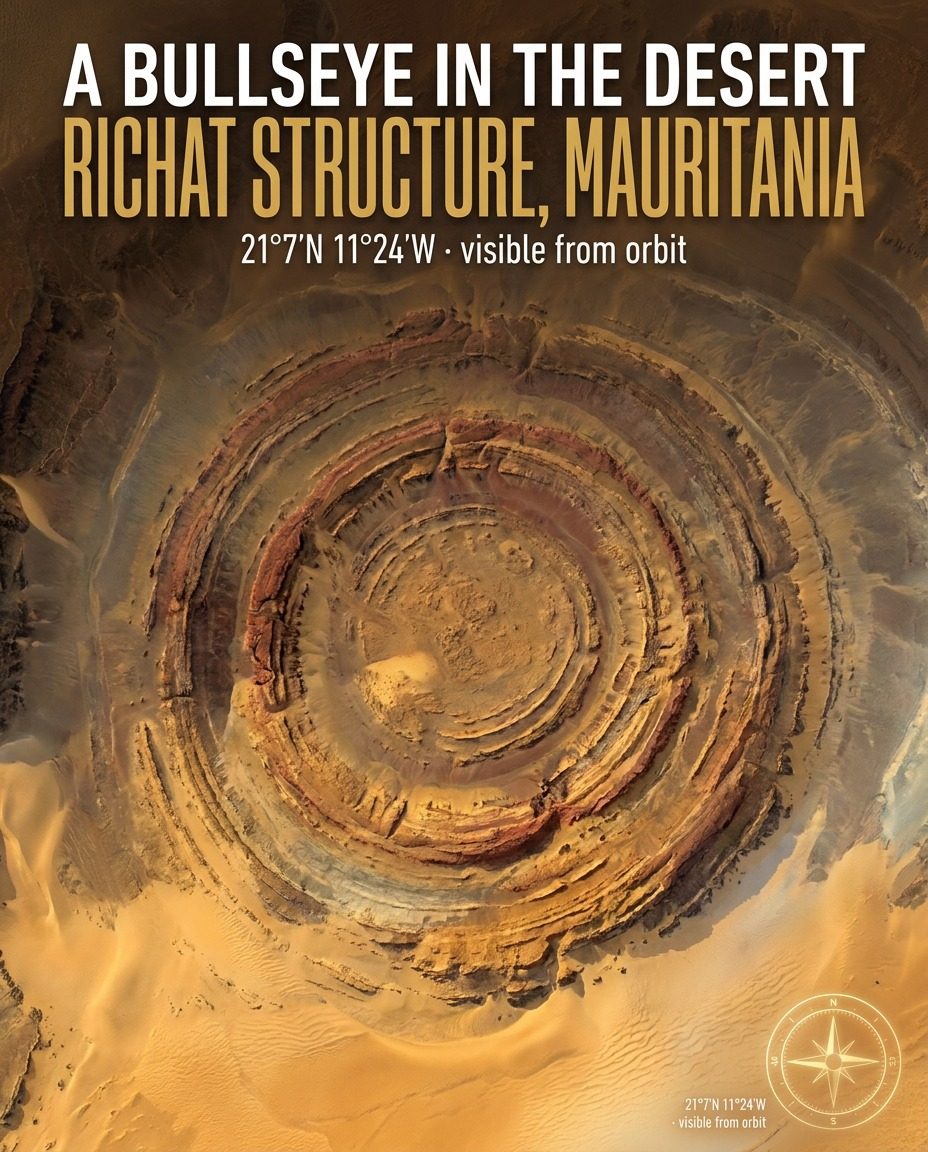
The Richat Structure in Mauritania is a geological puzzle right on top of a scale of a continent. The circular feature is approximately 50 kilometers in diameter, and can be seen plain even from outer space. Some points of its origin still puzzle researchers—they suspect impacts from outer space, volcanic activity, or erosion. Despite its ambiguous origins, the Richat Structure remains one of the most prominent and recognizable features of the Sahara, often drawing the gaze of astronauts and satellite imagery enthusiasts alike. The Richat Structure stands as a testament to the power of geological forces. One might imagine a target’s bullseye; but the Richat's circularity is unique in nature. From orbit, this feature offers a remarkable view that offers a good deal of insight into the complex geology of the region. The unique terracing of the structure is especially visible from aerial perspectives, providing clues to its formation. However, the structure's prominence and visibility have made it a useful landmark for early astronauts.
The Geographic Significance
Coordinates 21°7'N 11°24'W pinpoint the Richat Structure to the center of a wide, empty expanse of the Sahara Desert. This region is often far from any landmarks, but the Richat Structure stands out sharply, which is why it's common for the astronauts to use it for location verification in the wide, uniformity of the desert. The prominence of this structure marks an intersection of geology and human curiosity, especially for astronauts who find a recognizable shape all alone in the vast ocean of sand. The visibility of the Richat Structure from space has made it a valuable reference point for navigational purposes, particularly during the early days of space exploration. Astronauts training mission preparation heavily relied on visual landmarks, making this structure an invaluable asset. The structure's distinctive shape and size made it an easy point to identify from orbit, helping early astronauts to orient themselves and verify their location.
A Multivalent Landscape
The structure, known as the Eye of the Sahara, has not only geographical and navigational significance. It also has cultural and scientific significance. Scientifically, the Richat Structure offers a unique opportunity to study geological processes and features. The formation of this feature is believed to be the result of a combination of factors. Researchers suspect the involvement of volcanic activity, erosion, and possibly even extraterrestrial impact. Each of these theories contributes to the overall understanding of geological processes in the region. The Richat Structure’s prominence and visibility have also made it a popular subject for study. Culturally, the Richat Structure has captivated the imagination of countless explorers, scientists, and astronauts alike. At the 40th anniversary of the Apollo 15 mission, the three astronauts running the space voyage experimented the Eye of the Sahara as the central mission experiment. The structure has been the subject of countless photographs, artworks, and even a flyover mission dedicated to studying its unique features. Because this circular formation holds a fascinating mystery, it remains an enduring icon of the Sahara. The Richat Structure, a circular geological phenomenon, captures the depth of the Sahara's geology, its navigational importance, and the cultural intrigue it has inspired. Its enduring legacy as the Eye of the Sahara continues to inspire exploration and scientific inquiry, making it a true marvel of the natural world.
Watch the Reel
Related deep dives
Similar reads based on topic and creator.




Recent articles
Fresh deep dives from the latest Reels we unpacked.



Comments
Be the first to comment.