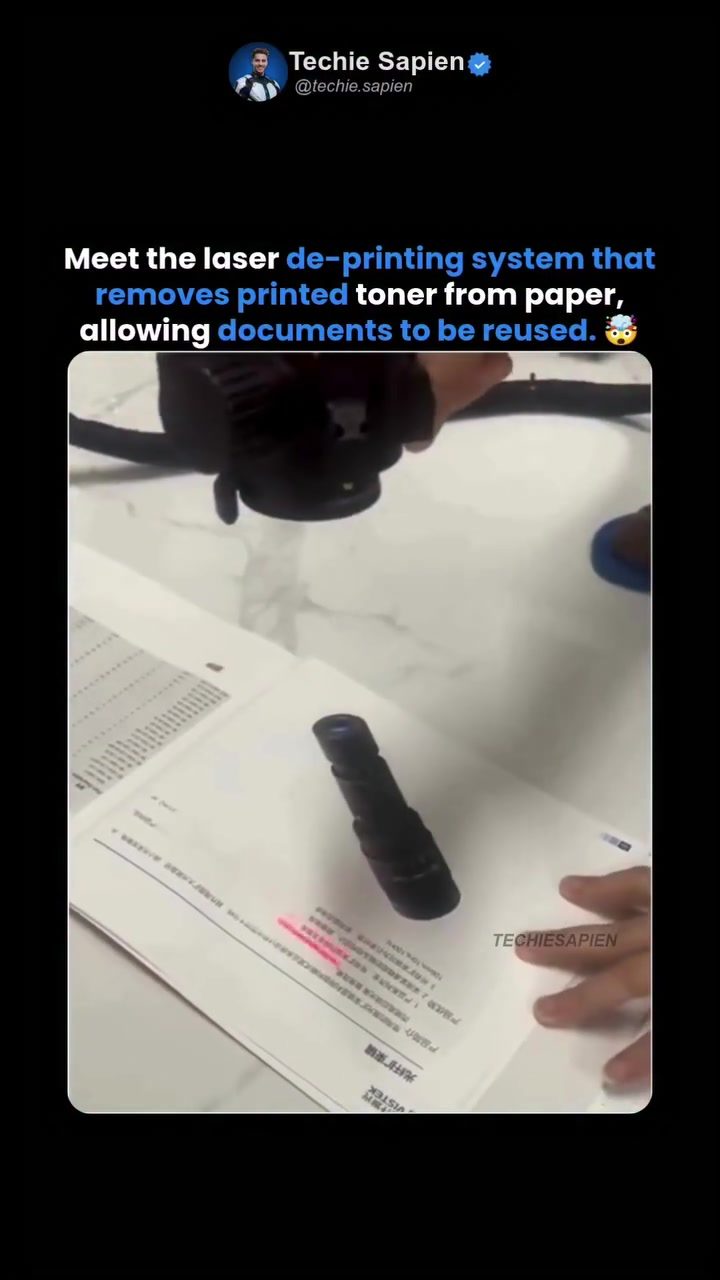
Laser De-Printing: Revolutionizing Paper Reuse
Laser de-printing technology is paving the way for a more sustainable future by offering a unique solution to paper waste. This innovative system removes printed toner from paper, allowing documents to be reused rather than discarded. Unlike traditional recycling methods, laser de-printing precisely targets the toner, leaving the paper fibers largely intact. This process not only reduces waste but also saves resources and lowers environmental impact.
Why This Matters
The environmental impact of paper production and disposal is significant. Traditional paper recycling processes can be resource-intensive and often result in lower-quality paper. Laser de-printing addresses these issues by facilitating the reuse of documents, thereby extending the life of paper and reducing the need for new paper production. This technology is particularly relevant for offices, schools, factories, and businesses, where paper usage is high. By adopting laser de-printing, these entities can achieve substantial cost savings and contribute to a more sustainable workspace.
Understanding Laser De-Printing
How It Works
The laser de-printing system employs controlled laser energy to vaporize or loosen toner from laser-printed documents. This process does not damage the sheet, making it possible to reuse the paper multiple times. The technology is particularly effective with laser-printed documents, where the toner adheres to the paper in a way that allows for precise removal without damaging the fibers.
Benefits Over Traditional Recycling
Traditional paper recycling involves breaking down the paper into pulp and reforming it into new sheets. This process can degrade the paper quality over time and requires significant energy and water resources. In contrast, laser de-printing allows for the reuse of the same paper multiple times, preserving its quality and reducing the need for new paper production. This makes laser de-printing a more sustainable and environmentally friendly option.
Practical Tips for Implementing Laser De-Printing
Office Adoption
For offices looking to adopt laser de-printing, the first step is to assess the volume of paper waste generated daily. This will help in determining the size and number of de-printing devices needed. It is also essential to train staff on properly using the de-printing devices to ensure optimal performance and longevity. Regular maintenance and monitoring of the devices will help in maintaining their efficiency over time.
Schools and Educational Institutions
In educational settings, laser de-printing can significantly reduce the cost of printing and copying. Teachers and administrators can use the de-printed paper for drafts, notes, and other non-essential printing tasks. This not only saves money but also teaches students about the importance of sustainability and resource conservation.
Industrial Applications
Factories and manufacturing plants can benefit from laser de-printing by reducing the amount of paper waste generated from internal documents, manuals, and labels. Integrating laser de-printing into the production process can help achieve a more circular economy, where resources are reused and waste is minimized.
Important Takeaways
- Laser de-printing technology offers a sustainable solution to paper waste by allowing documents to be reused.
- The process precisely targets the toner, leaving the paper fibers largely intact and preserving the paper's quality.
- Adopting laser de-printing can lead to significant cost savings and environmental benefits for offices, schools, and businesses.
- Proper implementation and maintenance are key to maximizing the benefits of laser de-printing.
Conclusion
Laser de-printing technology represents a significant leap forward in sustainable paper management. By enabling the reuse of documents, this innovation reduces waste, saves resources, and lowers environmental impact. As sustainable technologies continue to evolve, laser de-printing could become a crucial step toward a more eco-friendly and circular economy. For businesses, schools, and factories, adopting laser de-printing is not just a cost-effective solution but also a commitment to a greener future.
Watch the Reel
Questions readers ask
How does laser de-printing technology work to reduce paper waste?
Laser de-printing technology uses a precise process to remove toner from printed documents, allowing the paper to be reused. This method targets only the toner, leaving the paper fibers intact so the paper can be written on again. This significantly reduces the amount of paper waste generated in offices and households.
What are the benefits of using a laser de-printing device in an office setting?
Incorporating a laser de-printing device in an office can lead to substantial cost savings by reducing the need to purchase new paper. Additionally, it promotes a greener work environment by minimizing paper waste and lowering the carbon footprint associated with paper production and disposal.
Can laser de-printing damage the original document or alter its content?
No, laser de-printing is designed to remove only the toner from the printed surface, preserving the paper's integrity. This means the original document remains intact and can be reused for new printing tasks without any alteration to its existing content.
Is laser de-printing a more sustainable option compared to traditional recycling?
Yes, laser de-printing is generally more sustainable than traditional recycling methods. Traditional recycling can degrade the quality of paper, often leading to shorter paper lifespan. Laser de-printing, on the other hand, preserves the paper fibers, allowing for multiple reuses and reducing the need for new paper production.
How does laser de-printing contribute to a sustainable office environment?
By enabling the reuse of printed documents, laser de-printing reduces the environmental impact of printing. It minimizes the amount of paper that ends up in landfills and decreases the demand for new paper production, conserving resources and lowering greenhouse gas emissions.
Can all types of printed documents be de-printed using laser de-printing technology?
Laser de-printing technology is effective on a wide range of printed documents, including those printed with laser toner. However, it may not be suitable for documents printed with inkjet printers or those with special coatings. It is always best to check the compatibility of your documents with the specific laser de-printing device you are using.
Related deep dives
Similar reads based on topic and creator.


Recent articles
Fresh deep dives from the latest Reels we unpacked.




Comments
Be the first to comment.